
Cyber Security course · lesson 24 of 24
- 1What Is Cyber Security?
- 2Fundamental IT Skills for Cyber Security
- 3Operating Systems for Security: Windows, Linux and macOS
- 4Virtualization and Your Safe Cyber Security Lab
- 5Networking Fundamentals for Cyber Security
- 6Network Services and Infrastructure for Cyber Security
- 7Network Troubleshooting and Traffic Analysis Tools
- 8Core Security Concepts Every Defender Uses
- 9Authentication and Access Control Explained
- 10Cryptography Basics for Cyber Security
- 11Secure Protocols and Wireless Security
- 12The Threat Landscape and Security Frameworks
- 13Social Engineering and Human Attacks
- 14Network and Wireless Attacks and How to Detect Them
- 15Web Attacks and the OWASP Top 10
- 16Malware, Exploits and System Attacks
- 17Hardening and Endpoint Security
- 18Network Defense, Logging and SIEM
- 19Vulnerability Management and Threat Hunting
- 20Incident Response and Digital Forensics
- 21Cloud Security Basics
- 22Scripting for Security
- 23Ethical Hacking, CTFs and Penetration Testing
- 24Cyber Security Standards, Certifications and Capstone
After this lesson, you should be able to explain what a security framework does, choose a sensible next learning step for a few different career interests, and bring the Harbor Books course case together in a written capstone. You will use the fictional shop's existing assets and lessons to plan defenses, an authorized lab test, monitoring and an incident report. Most of it is a paper exercise, with an optional run inside your own lab: do not scan, attack or change any real service.
Across this course, Harbor Books has grown from a small shop with a front-office computer into a fictional business with a point-of-sale system, staff Wi-Fi, a web shop, cloud files and an incident response plan. The owner asks a practical question: "How can we show that we are protecting the things that matter, and how do we know what to improve next?" A framework can organize the answer. A certification can help a person demonstrate a certain kind of knowledge. Neither one replaces the work of understanding the business, applying controls and learning from evidence.
Standards, frameworks and controls solve different problems
Security teams use words like standard, framework, control and compliance as if they mean the same thing. They are related, but each plays a different role.
A standard is a published set of requirements, specifications or guidance. Some standards are voluntary; laws, contracts or regulators may make specific requirements applicable to an organization. ISO/IEC 27001:2022 specifies requirements for an information security management system (ISMS), a repeatable way to manage information security risks, assign responsibilities, review performance and improve. An organization can use the standard to build its management system; certification is a separate decision involving an external conformity assessment body. Buying the standard or displaying a certificate does not itself secure a system.
A framework organizes outcomes, activities or decisions. It gives an organization a common vocabulary and a way to assess where it is, decide where it wants to be and communicate progress. A framework usually does not dictate one product or identical implementation for every organization. Controls are the specific safeguards put in place to reduce risk: for example, requiring multi-factor authentication for administrative access, keeping backups offline, or reviewing alerts each business day.
Compliance means meeting obligations that apply to a particular organization, service, location or contract. A checklist can provide evidence for an audit, but passing an audit does not prove that every threat has been addressed. Good practice connects obligations to the actual systems and risks, records evidence, and revisits the controls when the business changes.
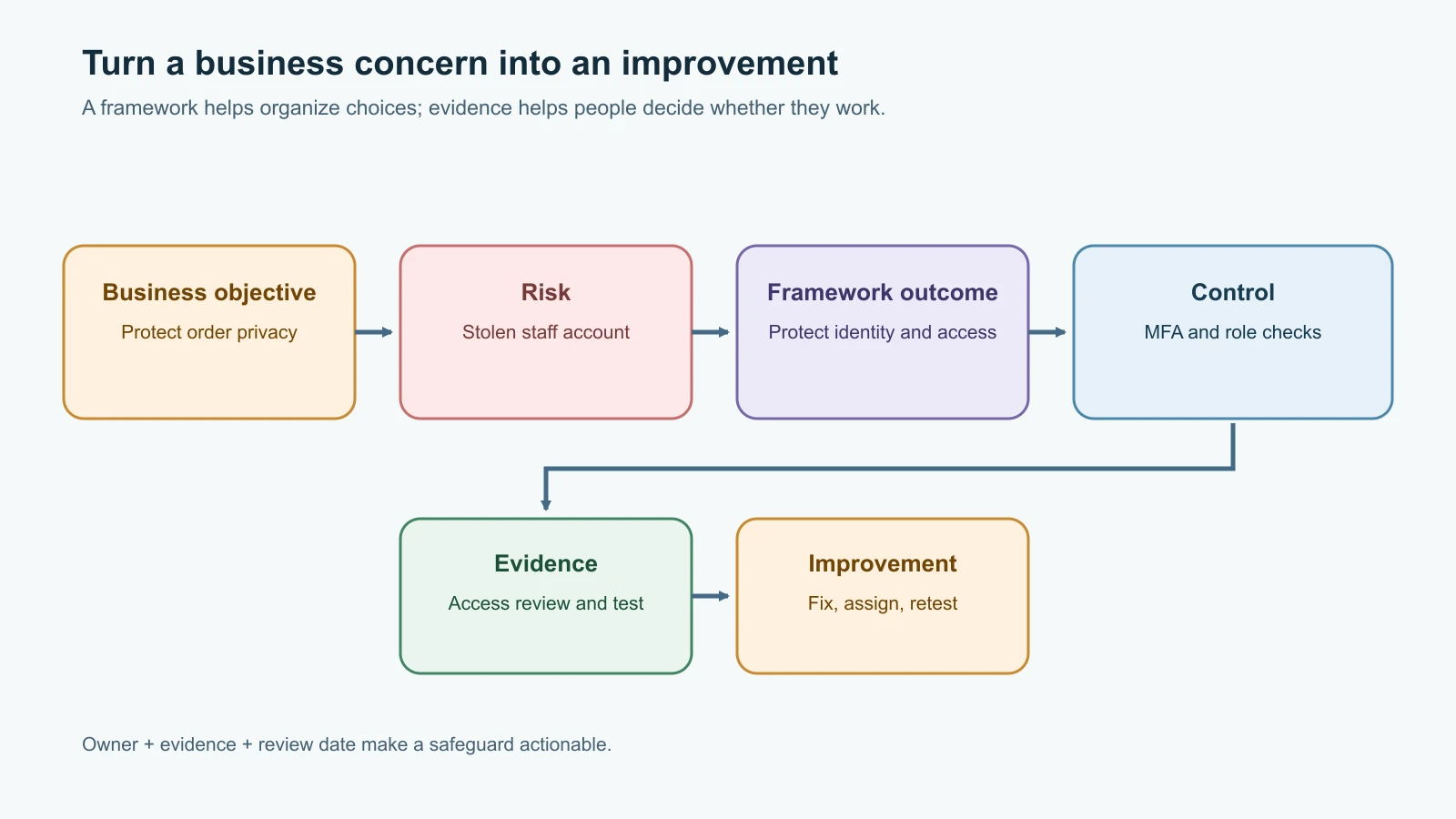
The relationship is easier to see as a chain:
| Step | Harbor Books example |
|---|---|
| Business objective | Keep customer orders available and private. |
| Risk | A stolen staff password could expose order information. |
| Framework outcome | Manage identity and access risks, and detect suspicious activity. |
| Control | Require MFA for staff and restrict order records by job role. |
| Evidence | Configuration record, access review and synthetic test result. |
| Improvement | Fix a missing role check, assign an owner and retest. |
The chain is useful because it makes the reason for a control visible. "Install a security product" is not an objective. The objective is to reduce a risk to an acceptable level, and evidence helps the owner decide whether the chosen action is working.
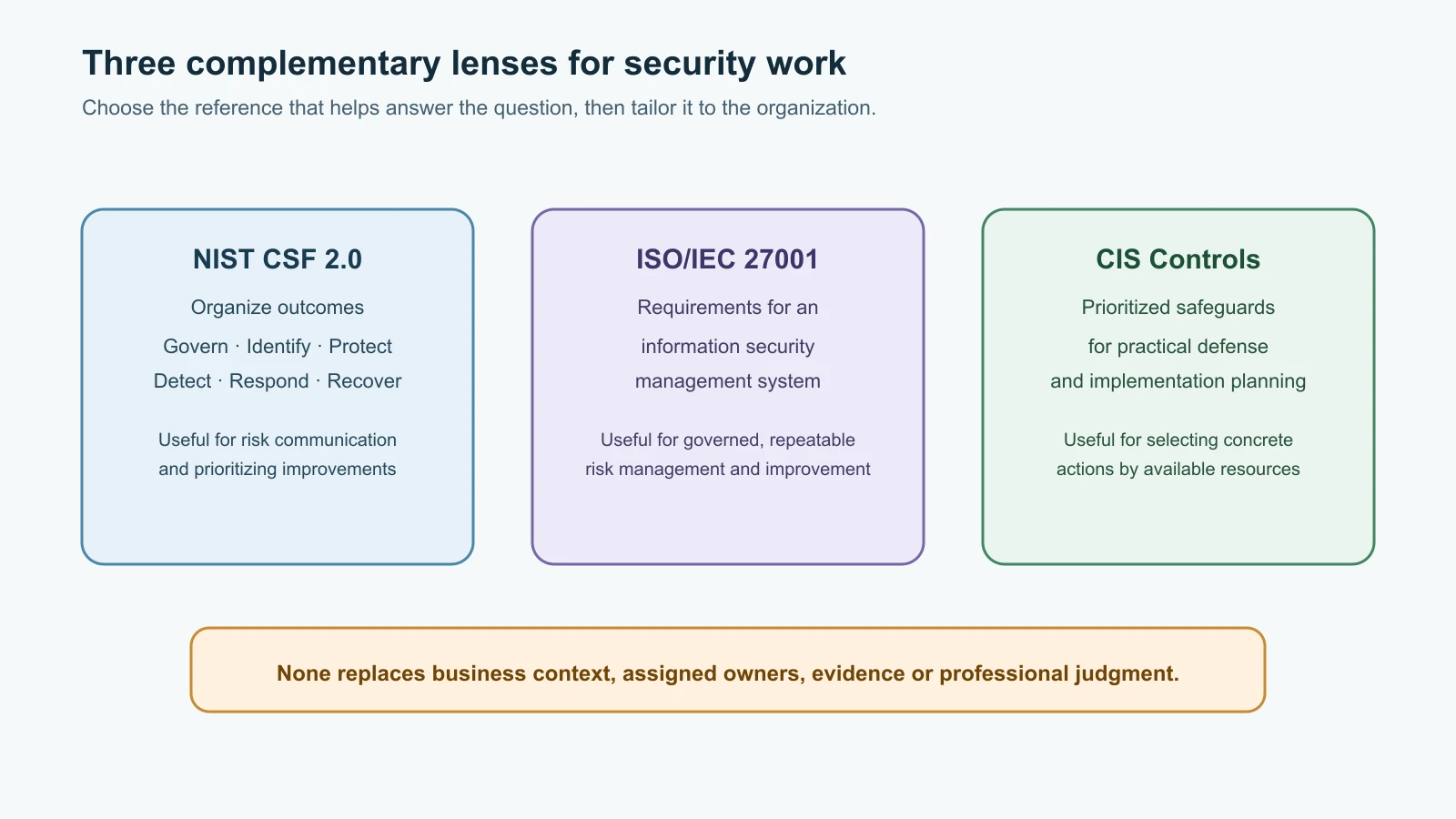
Three references you will see often
NIST Cybersecurity Framework
The NIST Cybersecurity Framework (CSF) 2.0 is a risk-management framework that organizations of different sizes and sectors can use to understand, assess, prioritize and communicate cybersecurity outcomes. Its six functions are Govern, Identify, Protect, Detect, Respond and Recover. Govern emphasizes that cybersecurity risk is part of organizational decision-making, with roles, policy, oversight and supply-chain considerations. The other functions help teams understand assets and risks, apply safeguards, find possible incidents, act on them and restore services.
The CSF is outcome-oriented. It does not require every organization to use a particular firewall or SIEM. Harbor Books might use the Identify function to inventory its point-of-sale terminal and cloud accounts, then decide which Protect outcomes matter most given its size and the sensitivity of its data. A larger organization may use the same functions with more formal risk tiers, reporting and assurance.
NIST's Risk Management Framework (RMF) is a related but distinct process with steps to Prepare, Categorize, Select, Implement, Assess, Authorize and Monitor security and privacy controls. It is often used in federal and other formal risk-management contexts. Think of CSF as a high-level way to frame cybersecurity outcomes and RMF as a lifecycle for managing system-level risk and controls. Both require tailoring; neither is a universal recipe.
ISO/IEC 27001
ISO/IEC 27001:2022 sets requirements for establishing, maintaining and continually improving an ISMS. It focuses on how an organization manages information-security risks across people, processes and technology. The organization defines its scope, evaluates risks, chooses how to address them, assigns owners and checks whether the system is effective. The standard's requirements are not a list of commands to paste into every environment.
An organization may decide to seek certification because customers, partners or its own governance process value an independent assessment. Certification applies to a defined scope and should be understood in that context. It does not mean every supplier, product, office or future change is automatically covered. Small businesses can adopt useful management practices without pursuing formal certification.
CIS Critical Security Controls
The CIS Critical Security Controls are a prioritized set of safeguards. CIS Controls v8.1 groups safeguards in areas such as asset inventory, secure configuration, account management, data protection, audit logging, incident response and penetration testing. Its Implementation Groups (IG1, IG2 and IG3) help organizations prioritize based on risk and resources. CIS describes IG1 as essential cyber hygiene and a sensible starting point for many organizations.
For Harbor Books, an inventory of devices and cloud services is a practical first step. It is hard to protect an unknown asset or decide whether an alert is unusual if nobody knows who owns the system. Controls are useful when selected for the organization's context, assigned to a person and checked with evidence. A mapping between two frameworks can help translate work, but it does not mean that satisfying one safeguard automatically proves compliance with every requirement in another standard.
A simple way to use a framework
Frameworks can look intimidating because they contain many outcomes, controls and references. Begin with a small, bounded question rather than trying to "implement the whole framework" in a weekend.
- Name the service and its owner. For example, the web shop and order database belong to the shop's operations lead.
- Describe the business impact. What happens if the service is unavailable, data is exposed or records are altered?
- List important assets and dependencies. Include staff accounts, the payment provider, hosting, backups and the identity service. Mark third parties and clarify who owns each action.
- Select relevant outcomes or safeguards. Choose a manageable set that addresses the risk and any legal, contractual or customer obligations.
- Assign a person and a date. A control without an owner can stay unfinished indefinitely.
- Choose evidence. Evidence might be an access review, a restored backup test, a configuration record or a carefully scoped exercise in a test environment.
- Review and improve. Record exceptions and residual risk, then revisit the decision when systems, threats or obligations change.
This is a management loop, not a one-time paperwork task. The purpose of a framework is to make decisions more coherent and repeatable. If a requirement is unclear or has legal consequences, the organization should consult its qualified compliance or legal advisers.
Certifications are learning and career signals
A certification is a credential issued by an organization after a candidate meets its rules. Depending on the program, those rules may include an exam, practical assessment, experience, ethics commitments and continuing education. A certificate can help demonstrate study or experience in a defined subject. It cannot guarantee a job, replace supervised work, or prove that its holder is skilled in every area of security.
Choose a credential by asking what work you want to do, what knowledge you already have, whether the program has prerequisites, how employers in your target region view it, and what the full cost and renewal commitments are. Verify current exam versions, experience requirements, fees, formats and renewal rules on the issuer's official site before paying. These details change; this lesson does not make a price comparison.
| Interest or stage | Examples named in this course | What to investigate |
|---|---|---|
| IT and technical foundations | CompTIA A+, Linux+, Network+; Cisco CCNA | Whether you need broad support knowledge, Linux practice or deeper networking. These are not all security certifications, but can build useful foundations. |
| Early security learning | CompTIA Security+; entry-level options from Cisco and other issuers | The current exam objectives, hands-on practice expected, local employer recognition and whether you already know the networking and operating-system basics. |
| Audit and governance | ISACA CISA, CISM; ISO/IEC 27001 training or auditor paths | Whether your goal is systems audit, security management, risk governance or ISMS implementation. CISA and CISM have professional experience requirements for certification. |
| Security operations and broad practice | GIAC GSEC and other role-specific GIAC credentials | The exact subject, exam format, training bundle and cost. GIAC offers credentials across defense, forensics, offensive operations, cloud and other areas. |
| Penetration testing | EC-Council CEH; GIAC GPEN, GWAPT; OffSec OSCP/OSCP+; CREST pathways | Required foundations, the practical assessment style, report-writing expectations, scope rules and recognition where you plan to work. |
| Advanced security leadership | CISSP; CISM; CISA for audit leadership | Eligibility and experience requirements, continuing education, professional ethics and whether the role actually needs this credential. |
Names and pathways evolve. For example, providers may rename an exam, add a renewal tier or change what an acronym expands to. Treat this table as a map of areas to research, not a current exam syllabus. The ISC2 CISSP, ISACA CISA and CISM, Cisco CCNA, GIAC and OffSec pages linked below explain their current requirements. CREST maintains its own assessment and membership information. Requirements can also differ by country, employer and public-sector hiring rules.
There is no universal "best first certification." If you are new to computers and networking, strengthen those skills before choosing a specialist security exam. If you already work in IT, look at the next responsibility you want and choose learning that fills a real gap. A learner interested in incident response may benefit more from log analysis and evidence-handling practice than from immediately pursuing a penetration-testing credential. A person aiming for governance may need writing, risk assessment and stakeholder communication alongside technical knowledge.
Certifications are one way to structure learning, but projects and clear explanations matter too. Keep a portfolio of safe, authorized work: a home lab diagram, a redacted incident exercise, a synthetic log-analysis report, a risk register or a secure configuration checklist. Never publish real employer data, credentials, client findings or platform solutions without permission. Describe what you did, what boundaries applied, what evidence you observed and what you would improve.
Harbor Books capstone: connect the course
The capstone is a short written exercise that brings together the course's fictional business. You are acting as a junior security analyst who has been asked to help prepare a scoped assessment and tabletop review. Use the Harbor Books scenario and concepts from earlier lessons. Keep all testing hypothetical or inside the local lab built in Virtualization and Your Safe Cyber Security Lab. Do not interact with a real shop, payment service, cloud account or network.
Scenario and boundaries
Harbor Books has a front-office workstation, a point-of-sale terminal, staff Wi-Fi, a staging web shop, a production web shop, a cloud drive and a third-party payment provider. The operations lead has approved a paper plan for the staging shop only. The lab version uses a disposable VM, synthetic orders and test accounts. Production, real customer records, employee phishing, payment-provider systems, denial-of-service tests, persistence and destructive actions are explicitly excluded. This mirrors the scope discipline in Ethical Hacking, CTFs and Penetration Testing.
If you use the actual course lab, follow its written boundaries and isolate the target as described in Virtualization and Your Safe Cyber Security Lab. Parts 1 to 3 do not require running tools; Part 4 is an optional lab run using scripts you already built and tested. The point is to make a defensible plan and communicate a decision, not to demonstrate access to a system.
Part 1: identify what matters and choose controls
Create a one-page asset and risk summary. Include at least four assets, who owns each, what data or service it supports, and one plausible risk. Rank the risks with a short explanation of likelihood and impact rather than pretending a score is exact. For example, an unavailable point-of-sale terminal may stop sales; a compromised staff account may expose order information or permit changes.
Choose three safeguards and connect each to a risk, an owner and evidence that would show whether it is working. You might consider MFA and role-based access for staff, backups with a documented restore test, patch ownership for the web shop, secure Wi-Fi configuration, logging for administrative changes or a process for reporting suspicious messages. These topics connect to Authentication and Access Control, Hardening and Endpoint Security, and Network Defense, Logging and SIEM.
Name the framework lens you used and explain why it fits your question. You could use the CSF functions to organize outcomes, CIS safeguards to prioritize concrete actions, or ISO/IEC 27001 concepts to describe ownership and continuous improvement. You do not need to claim that Harbor Books is compliant or certified.
Part 2: plan an authorized lab assessment
Write a brief rules-of-engagement note for the staging application. State the approving owner, exact lab asset, purpose, time window, allowed methods, test account, synthetic data, prohibited actions, stop contact and evidence-handling method. A good boundary says what is included and what is excluded. "Test the website" is not specific enough.
Describe two checks you would perform in the isolated lab and what result would count as evidence. For example, review whether a low-privilege test account can access only its permitted synthetic order, and confirm whether the staging server records an administrative login event. Describe the expected secure behavior and the safe response if you encounter unexpected data or instability. Do not provide a target outside the lab or instructions for attacking a live service.
For each observation, separate fact from interpretation. "The test account received an order summary for a different synthetic account" is an observation. "The production database is exposed" is an unsupported conclusion unless production was separately and legitimately assessed. The report should clearly state scope and limitations.
Part 3: monitor, respond and report
Create a tiny monitoring plan for the exercise. Identify which logs or events would be relevant, who reviews them, and what would trigger a pause and escalation. For example, unexpected access to a real record, repeated service errors, an alert from the lab host or activity outside the test window should stop the exercise and reach the named contact. Logs should be protected and retained only as agreed.
Then write a short tabletop incident report using one hypothetical event: an administrator notices an unfamiliar role change in the staging application. Record the time, source of the information, affected lab asset, evidence collected, immediate containment decision, people notified, recovery or follow-up, and open questions. State what is known and what is not known. Follow the response stages in Incident Response and Digital Forensics. In a real incident, follow the organization's approved plan and involve the right technical, management, legal and privacy roles.
Finish with a one-paragraph debrief: what control would reduce the chance of recurrence, what evidence would show the fix worked, and who owns the next action? This closes the loop from risk to control, assessment, monitoring and improvement.
Part 4 (optional): secure, change, detect and report in your lab
If your lab from Virtualization and Your Safe Cyber Security Lab is built, you can run a small version of the whole course on harbor-server, with the network still set to host-only. Nothing here touches anything outside your own virtual machines.
- Secure. Make a folder such as
~/shop-sitewith two or three plain files standing in for the web shop. Take a baseline with the file-integrity checker from Hardening and Endpoint Security:python3 fim.py ~/shop-site shop-baseline.json init. - Change, playing the attacker. In your own lab, add a file named
upload.php, edit one existing file and delete another. This stands in for an intruder tampering with the site; no exploit is used. - Detect. Run
python3 fim.py ~/shop-site shop-baseline.json check. It should list the added, removed and changed files and exit with code 1. Then run the brute-force analyzer from Network Defense, Logging and SIEM on its syntheticsample-auth.csvto stand in for the login evidence. - Report. Write the Part 3 incident report using what the two tools printed as your evidence. Record the time, the hash baseline file, what each tool can and cannot show, and the next action.
Your exact output will depend on the files you create. If a tool prints something you did not expect, that is useful: write down why, the way you would in a real report.
Mistakes beginners make
- Treating a framework as a product to install or a checklist that guarantees security.
- Assuming that a standard, audit or certificate proves every system is safe.
- Confusing a framework's high-level outcome with a specific technical control.
- Mapping controls mechanically without checking whether they address the organization's real risks.
- Choosing a certification because it sounds prestigious without reading its current objectives, prerequisites and renewal rules.
- Assuming an exam pass automatically grants a credential when the issuer also requires experience, an application or continuing education.
- Believing that a credential alone proves practical ability or guarantees employment.
- Publishing private work samples, client evidence or challenge answers in a portfolio.
- Calling a paper scenario a penetration test or claiming a vulnerability without evidence from the stated scope.
- Writing a capstone report that skips the asset owner, exclusions, evidence protection or next action.
- Forgetting to revisit controls when the business, its services or its obligations change.
Recap and try it yourself
Standards, frameworks, controls and compliance have related but different jobs. NIST CSF 2.0 helps organize cybersecurity outcomes; NIST RMF provides a risk-management lifecycle; ISO/IEC 27001 specifies requirements for an information security management system; CIS Controls prioritize safeguards. A framework helps teams make and explain decisions, while evidence shows whether a selected control is in place and useful.
Certifications can structure learning and signal knowledge in a defined area. Their requirements, value and cost vary, so check the issuing body's current information and choose based on your goals and experience. The Harbor Books capstone ties the course together: understand assets and risk, select defenses, plan only authorized lab checks, monitor relevant evidence, document a hypothetical incident and assign an improvement.
Try it yourself by completing capstone Parts 1 to 3 on paper, and Part 4 if your lab is ready. Keep the scenario fictional, name the framework you used, and make your report distinguish observations from assumptions. Ask another learner to review whether your scope is clear, whether each safeguard has an owner and evidence, and whether the incident report says what should happen next.
Sources checked on 12 November 2026: NIST Cybersecurity Framework 2.0, Risk Management Framework overview, ISO ISO/IEC 27001:2022 overview, Center for Internet Security CIS Controls, CIS Controls list and Implementation Groups; CompTIA certifications; Cisco CCNA exam overview; ISC2 CISSP experience requirements; ISACA CISA requirements and CISM requirements; GIAC certification directory and GPEN overview; OffSec PEN-200 and OSCP+; EC-Council CEH; and CREST certifications. Certification requirements and program names may change. All Harbor Books details are fictional. No external system was tested.