
Prompt Engineering course · lesson 14 of 26
- 1What Is Prompt Engineering? A Practical Beginner's Guide
- 2How a Model Reads Your Prompt: Tokens and Context
- 3Choosing a Model and Reading Its Documentation
- 4Controlling Model Output: Sampling and Limits
- 5Your First Prompt Workflow: Test One Change at a Time
- 6Be Clear and Direct: Give the Model a Usable Task
- 7System, Role, and Context Prompts: Give Instructions Their Place
- 8Zero-Shot, One-Shot, and Few-Shot Prompting
- 9Structure Prompts with Delimiters, Tags, and Templates
- 10Structured Output: Get Answers You Can Parse and Check
- 11Prompting with Long Documents and Large Context
- 12Prompt Recipes for Ten Common Jobs
- 13Chain-of-Thought Prompts and Thinking Models
- 14Step-Back Prompting and Prompt Chaining
- 15Self-Consistency, Tree of Thoughts, and ReAct
- 16Self-Evaluation and Reliability Checks
- 17Define Success and Build Test Cases
- 18Compare Prompts with Graders
- 19Debug a Failing Prompt
- 20Automatic Prompt Engineering
- 21Version and Document Your Prompts
- 22Hallucinations and Grounding
- 23Bias and Debiasing Prompts
- 24Prompt Injection and Safe Prompting
- 25Prompts in Production
- 26Capstone: Build and Test a Prompt Library
Some questions are difficult because they ask for a specific answer before the important factors are clear. Other tasks are too large to do reliably in one pass. Two techniques can help: step-back prompting, which asks a broader question first, and prompt chaining, which breaks work into separate steps and passes the results forward.
Neither technique is required for every prompt. Each adds work and can introduce new errors. Use them when a broader frame or a checkable intermediate result improves the outcome.
Step back to find a useful frame
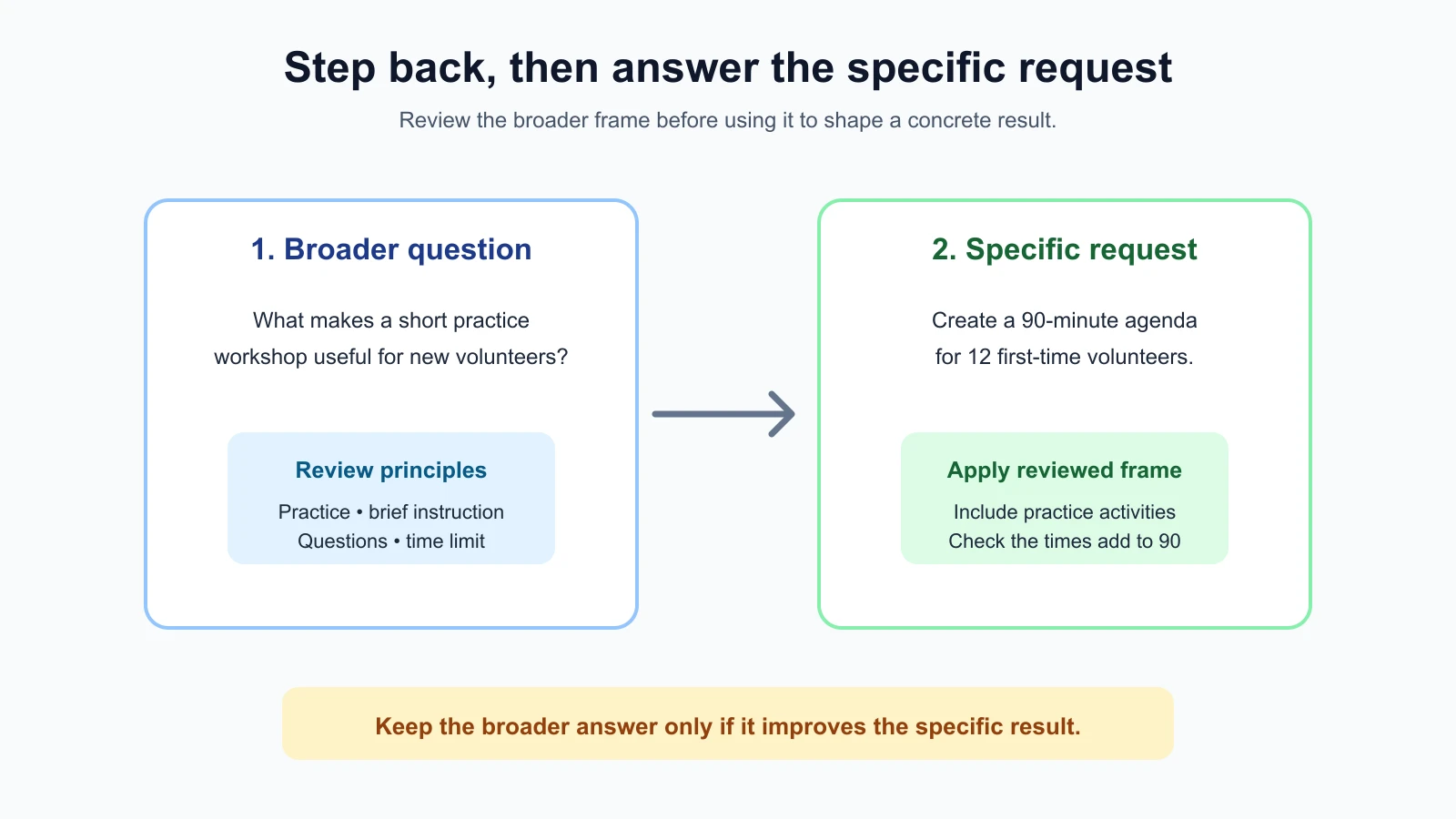
Step-back prompting asks a more general question before asking the specific one. Instead of jumping directly to a recommendation, first identify the principles, constraints, or knowledge that should guide it. Then apply that frame to the original task.
Imagine you need an agenda for a 90-minute workshop for first-time volunteers. A direct prompt might produce a generic agenda. A step-back prompt first asks what makes a short, practice-focused volunteer workshop useful. That broader answer might surface principles such as giving participants time to practice, keeping instructions brief, and reserving time for questions. A second prompt can apply those principles to the specific group and time limit.
The original paper, Take a Step Back: Evoking Reasoning via Abstraction in Large Language Models, studied this two-stage technique on reasoning-intensive tasks. Its abstract reports performance gains in experiments involving STEM, knowledge questions, and multi-hop reasoning. Those results establish that abstraction can help on some tested tasks. They do not show that every everyday request needs a preliminary general question.
Stepping back is useful when you are unsure which factors matter, when a task combines unfamiliar requirements, or when a specific question invites a narrow response. It can expose a framework before you commit to an answer. It is less useful when the task is already precise, the criteria are known, or the “general” answer would be generic filler.
A two-prompt example
Here is a simple step-back sequence for the volunteer workshop:
Prompt 1: Identify the frame
1What makes a 90-minute workshop useful for first-time volunteers who need to practice welcoming visitors?
2List up to four planning principles. Keep them practical and do not propose a full agenda yet.
Prompt 2: Apply it
1Use these planning principles: [paste the reviewed principles].
2Create a 90-minute agenda for 12 first-time volunteers.
3The goal is to practice welcoming visitors, not to teach policy.
4Include a short opening, two practice activities, a break if it fits, and a closing question.
5Show the duration of each part. The times must add up to 90 minutes.
The first prompt asks what matters in general. The second supplies the actual constraints and asks for a specific deliverable. Review the principles before reusing them. If the broad answer ignores a key condition, correct it before passing it forward.
You can also do both stages in one prompt when a separate call is unnecessary: “First identify up to four principles for a useful practice workshop. Then use them to create a 90-minute agenda for these 12 participants…” The task remains conceptually staged, but the application makes one model request. Use two calls when you need to inspect, edit, store, or approve the first result before generating the second.
Decompose a large task into steps
Task decomposition means dividing a larger goal into smaller jobs with clear outputs. Prompt chaining sends one step’s output into a later step, often through separate model calls. A chain might gather facts, turn them into a structured outline, draft a response, and check the draft against stated requirements. The AI Agents lesson on chaining, routing, and parallelization explores the same pattern in agent workflows.
A single prompt may be enough for a short task. A chain is more useful when each stage has a different purpose, when an intermediate result needs review, or when a later step depends on validated information from an earlier one. Anthropic’s current prompting best practices describe explicit chaining as useful when developers need to inspect intermediate outputs or enforce a pipeline. That is a design option, not a requirement to split every task into multiple calls.
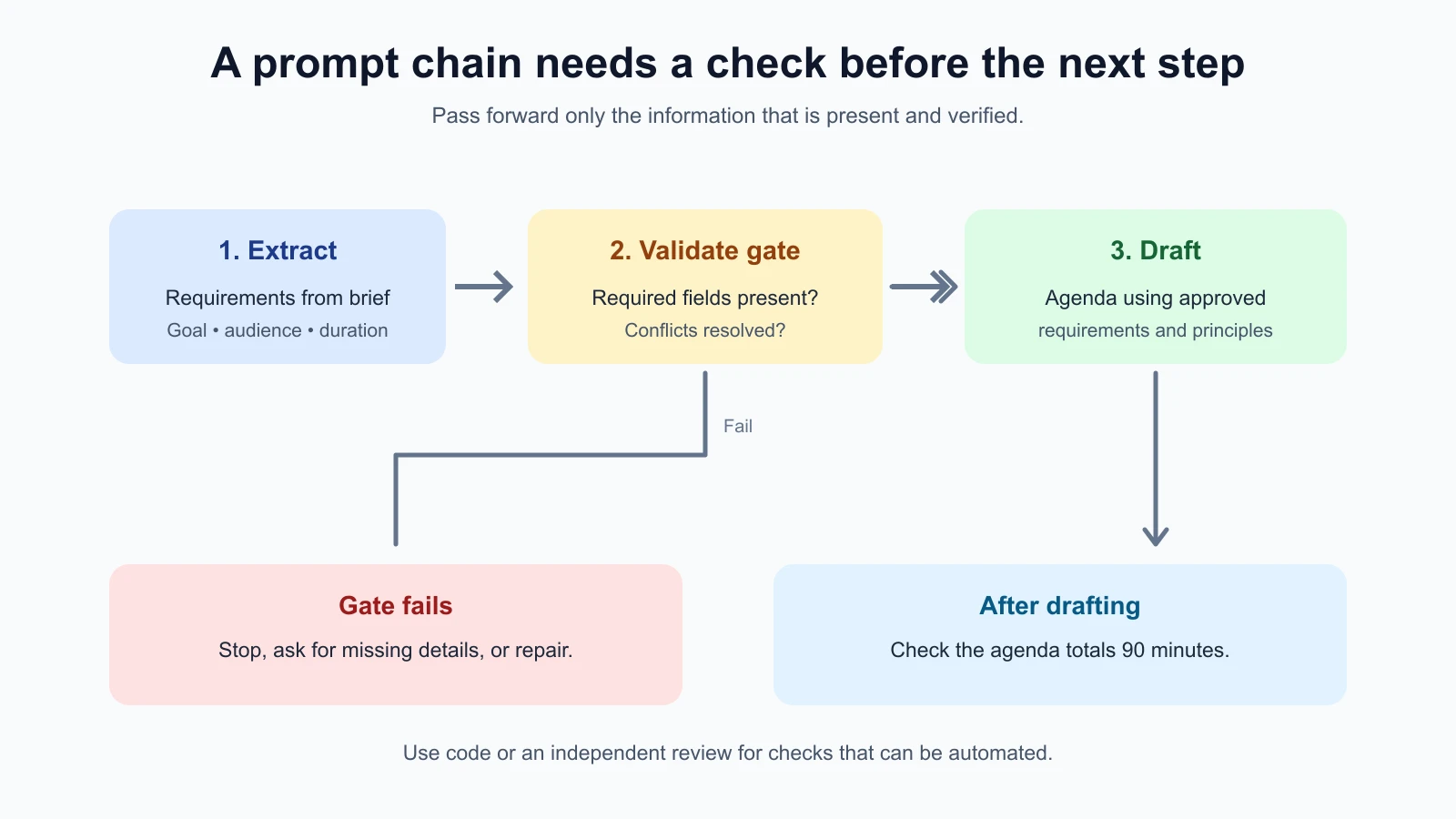
For the workshop example, a small chain could look like this:
- Extract requirements: Read the brief and return audience, goal, duration, and required activities.
- Check the requirements: Confirm that the duration is present, the audience is clear, and no instruction conflicts with the goal.
- Draft the agenda: Use only the approved requirements and planning principles. Return each activity with its length.
- Check the schedule: Add the activity lengths in application code or verify them independently. If the total is not 90 minutes, request a correction or revise the schedule.
Each step has a specific output. The second stage acts as a gate: the draft does not proceed until the required inputs are present and consistent. A gate is a check that must pass before the workflow moves forward.
Put a check between dependent steps
Passing an unchecked answer from one prompt to another can carry a mistake forward. If the first stage invents a requirement, the next stage may build a polished plan around it. A chain needs checkpoints where an error can be caught before it spreads.
Choose checks that are concrete. Is a required field missing? Does a number exceed a limit? Is a source quote present in the document? Does the draft include every required section? Code can verify exact properties such as a sum, a date format, or a field type. A person may need to review a subjective choice such as whether the agenda feels welcoming.
Keep the original source close to the stages that need it. A summary may omit an exception that a later prompt needs. Pass source IDs and relevant excerpts along with intermediate notes, or retrieve the original again when checking an exact claim. Do not let a later stage treat an unverified model summary as a trusted fact.
If an intermediate result is structured, validate it before passing it forward. The lesson on structured output explains how to parse and check it. If a prompt chain uses user-provided material, preserve its boundaries and keep application rules separate from untrusted text, as described in structure, delimiters and templates.
Make each stage small and independent enough to review
A useful stage has one purpose and an output you can inspect. “Analyze the whole project, make a strategy, draft everything, and check it” combines too many jobs to diagnose. A clearer sequence might be “extract stated goals,” “list missing decisions,” and “draft a plan from approved goals.”
Keep intermediate results as short as the next stage allows. Long explanations can add noise and increase the chance that later prompts focus on irrelevant details. For a planning task, a list of constraints and open questions may be more useful than a lengthy narrative about how the model considered them.
Give each stage the context it needs. Do not assume a separate API call remembers earlier calls unless your application explicitly passes conversation state or the prior output. Include the relevant inputs, stable rules, and data when making each request. Check the provider’s API documentation for how conversation history is represented.
A chain also creates more places to fail. The model may misunderstand the first prompt, validation may be incomplete, a later call may receive stale context, or the final answer may introduce a new error. More calls can add latency and cost. Keep the chain no longer than necessary, and stop when the result meets the acceptance criteria.
When to use one prompt, a step-back, or a chain
Use one direct prompt when the task and success criteria are already clear and the answer can be checked in one pass. Try a step-back when a general framework would help you decide what to consider before solving the specific case. Use a chain when the task has distinct stages, requires human approval between steps, or needs different checks at different points.
These techniques can be combined. A step-back answer can become the first item in a chain, but review it before treating it as a rule. A multi-step task can also be represented in a single well-structured prompt when separate calls provide no practical benefit.
A useful first question is: “What would I need to inspect before continuing?” If the answer names a clear intermediate output, a chain may help. If there is nothing meaningful to review or validate, extra stages may only add delay.
| Situation | A useful starting point |
|---|---|
| Clear, small task | One direct prompt |
| Unsure which principles or factors apply | Step back, then answer |
| Distinct stages with reviewable outputs | Prompt chain with a gate |
| Exact check such as a total or required field | Validate with code or another reliable check |
| No improvement from extra steps | Use the simpler prompt |
Test whether the extra stage helps
Compare the direct prompt with the step-back or chained version using the same representative inputs. Define success before changing the approach. For the workshop agenda, checks could include whether the total is 90 minutes, whether both activities involve practice, and whether the plan stays focused on welcoming visitors.
Record quality alongside practical costs. Does the extra stage catch a real error? Does it make the final answer more complete or easier to inspect? How much time and model usage does it add? Use the smallest chain that meets the checks. The first prompt workflow explains how to compare versions fairly.
Avoid using a second model call merely to ask the same model whether its previous answer is correct. A self-check can catch some omissions, but it can also repeat the same misunderstanding. Prefer independent checks where possible: arithmetic in code, facts against a source, or review by someone who understands the task.
Mistakes beginners make
- Stepping back when the task is already clear. A broad question can add a generic answer without helping the specific one.
- Treating a proposed framework as a fact. Review the first-stage output before using it as a rule.
- Making too many stages. Split only where there is a distinct output or useful check.
- Passing unverified results forward. A later step can amplify an earlier error.
- Dropping source details between calls. Keep relevant excerpts, IDs, and constraints with the stage that needs them.
- Using a model to check everything. Use code for exact conditions and people for subjective or consequential review.
- Ignoring added latency and cost. Compare whether the quality gain is worth another call.
- Assuming a chain remembers earlier calls. Pass the needed context or use documented conversation state.
Recap and try it yourself
Step-back prompting asks a broader question to identify a useful frame before answering a specific request. Prompt chaining divides a larger job into stages and passes outputs forward. Add a check before dependent stages, preserve source context, and use code or human review where they are stronger than another model call. Extra steps should make the result better or easier to inspect.
Try it: choose a task with several requirements. Write a direct prompt, then create either a broader first question or a two-stage chain with one clear gate. Test both approaches on the same examples and note whether the extra step catches a real issue. In the next lesson, we will compare self-consistency, tree of thoughts, and ReAct.