
Forward Deployed Engineer course · lesson 3 of 24
- 1What Is a Forward Deployed Engineer?
- 2A Day in the Life of a Forward Deployed Engineer
- 3FDE Career Paths, Tiers, and Interview Gates
- 4Build Your Forward Deployed Engineer Skill Map
- 5Requirements Gathering with a Customer
- 6Discovery, Scoping, and Sequencing Customer Work
- 7Audit Customer Data Before You Build
- 8Enterprise Workflow, Business Value, and ROI
- 9Choosing an AI Approach for a Customer
- 10Build a Working Prototype Fast
- 11Integration Engineering and the Last Mile
- 12Working Safely with Legacy Systems
- 13Data Pipelines for AI Features
- 14Evals as Acceptance Criteria
- 15Debugging Agent Logic and Observability
- 16Deploying in the Customer's Cloud
- 17Cost, Latency and Inference Choices
- 18Security, Privacy and AI Governance
- 19Stakeholders and Communication
- 20Technical Writing for Handoff
- 21UAT, Go-Live, and Day 2 Operations
- 22Executive Reporting and Proving ROI
- 23The Product Feedback Loop
- 24Capstone: Run an Engagement End to End
After this lesson, you should be able to map your current skills to forward deployed engineer (FDE) work, choose a practical gap to close, and describe what an interview might test. This is a career lesson for working developers and technical practitioners. It is not a course on data structures and algorithms (DSA) or system design. Those subjects need their own practice; here we will identify the role they play and where to continue.
What the roadmap's tiers mean
The roadmap groups the journey into foundations, technical skills, customer delivery, and the work of the role itself. These are useful learning layers. They do not map to one standard set of job titles such as junior, mid-level, and senior FDE. Companies set their own levels and may use different titles for similar work.
For this lesson, think of the tiers as a growth in responsibility:
- Engineering foundation: build and debug software, use Git, and understand the systems your code depends on.
- Production breadth: connect services and data, check behavior, and understand deployment and operations.
- Customer delivery: clarify an unfamiliar problem, agree on a first result, and communicate technical decisions to the people involved.
- Engagement ownership: carry work from discovery through delivery and handoff, then make reusable lessons visible to product teams.
This progression is a teaching interpretation of the roadmap's skill layers. It is not an industry leveling system. Some people enter through a new graduate role and learn parts of the job with a team. Other employers hire experienced engineers who already have production and customer-facing experience. The role description tells you what a particular team expects.
For example, on 5 November 2026, an OpenAI Forward Deployed Engineer posting for AI infrastructure listed five or more years of engineering or technical deployment experience that included customer-facing work. Palantir's careers page listed new graduate Forward Deployed Software Engineer roles. Those are different entry points from two employers, not a complete picture of the market and not a guarantee that either posting will remain open.
Paths from the work you already know
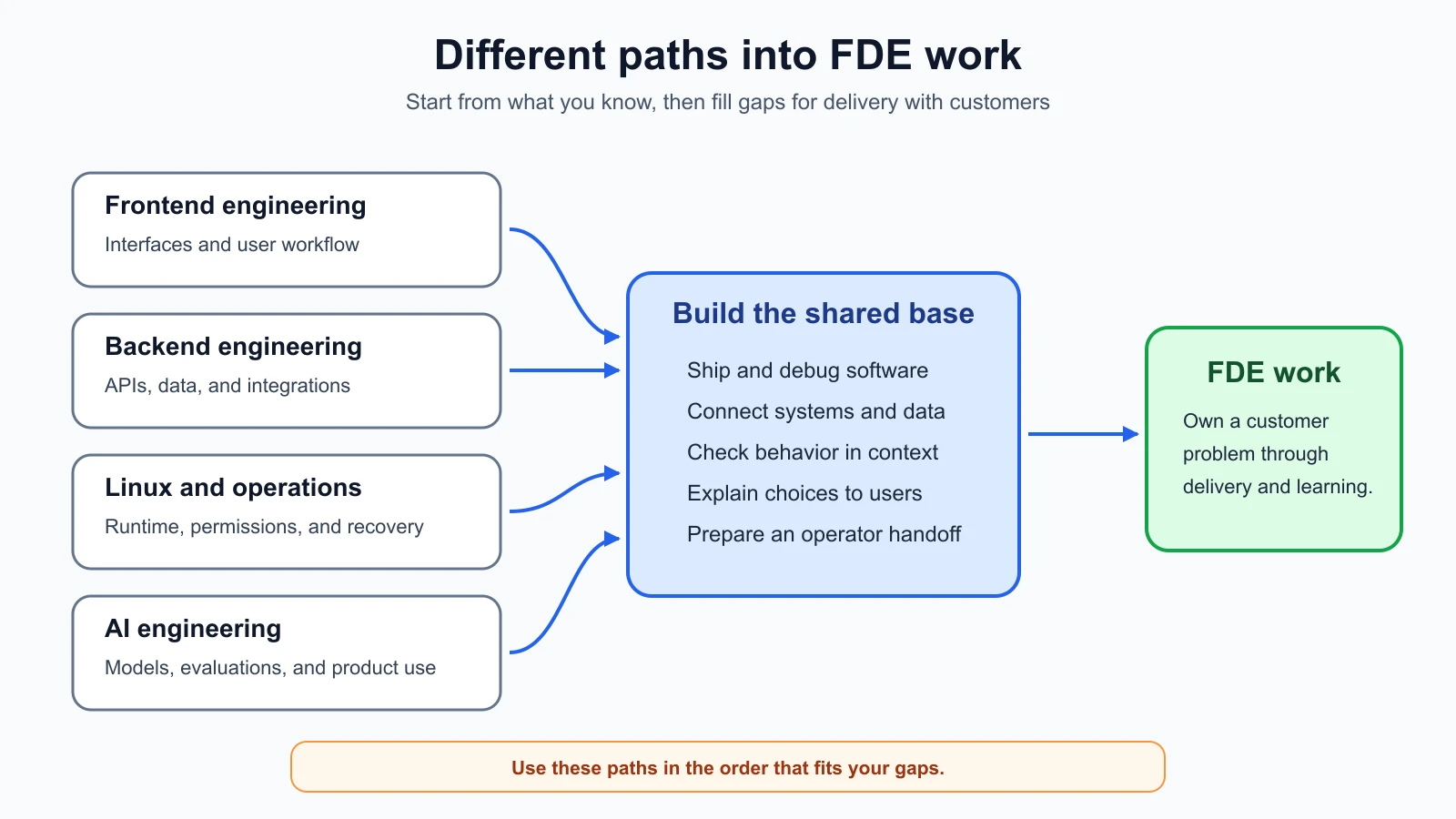
There is no single required previous title. Start from what you can already do, then identify what you need to demonstrate in a customer environment. The roadmap's "From X to FDE" paths include frontend, backend, Linux, and AI engineering. The paths below show how each background can transfer and where to build more range.
From frontend engineering
Frontend engineers know how people interact with an application. They often have practice making a workflow understandable, testing interface behavior, and incorporating feedback. Those skills matter when an FDE builds a tool for dispatchers, analysts, or customer support teams.
Broaden this background with server-side APIs, data models, authentication, integration failure handling, and operating a deployed service. A screen that looks correct can still show stale or unauthorized data. Build an example that reads data from a service, handles an error clearly, and includes a short explanation of the data boundary. The Frontend Developer roadmap lists interfaces, accessibility, APIs, testing, and debugging as areas within frontend practice.
From backend engineering
Backend engineers often bring experience with APIs, data storage, service behavior, and integrating external systems. Those skills connect directly to customer environments, where the available interface may be incomplete or behave differently from a developer's local setup.
Try adding direct workflow observation, a usable interface, plain-language trade-off explanations, and an operating plan. Pair a small API with a simple user-facing flow, then ask someone to use it while you observe where the design or terminology fails. The Backend Developer roadmap covers server logic, APIs, data handling, authentication, and integrations.
From Linux, systems, or operations work
Linux and operations practitioners may know how applications behave at runtime: processes, files, permissions, networking, logs, and service recovery. That perspective helps when a solution must run inside an environment the product team does not own.
Add application architecture, feature coding and review, data modeling, and attention to the user's experience of a failure. Build a small service and write the steps another person would need to run it, diagnose a failed request, and restore it. The Linux roadmap is a starting point for the operating-system side; it does not replace application engineering practice.
From artificial intelligence or machine learning engineering
Artificial intelligence (AI) engineers may already know how to connect a model to a product, evaluate outputs, and inspect failure cases. The AI Engineer roadmap describes applying existing models and tools in practical systems. Those capabilities help when a customer problem genuinely needs AI.
To round out this background, practice customer discovery, data permissions, legacy integration, deployment ownership, and explaining model limits in the customer's workflow. A model evaluation that looks good offline does not by itself show that an operator can use the system safely. Extend a project by adding the user's decision step, an escalation path, and checks on representative examples. The AI Agents course's model selection lesson covers model choice in more depth.
These paths are starting points, not separate tracks you must finish one by one. A frontend engineer may have strong customer communication already. A systems engineer may have built complex products. Use the role description and your own evidence to find the missing piece, rather than studying every roadmap node before applying.
Why this usually is not a beginner role
An FDE often works where requirements are incomplete and the cost of a wrong assumption can be high. The engineer may need to inspect an unfamiliar codebase, learn a customer's process, decide what can be changed safely, and explain what remains unknown. That calls for a working base in software development and judgment about when to test, ask, or pause for an owner decision.
Entry routes do not require a fixed number of years in the same title. The Palantir careers page lists new graduate roles, while the current OpenAI posting mentioned above asks for substantial engineering or deployment experience. The hiring path depends on the employer, the level, and the work the person will own. A new graduate position can still require strong technical fundamentals and structured support from senior colleagues.
If you have not yet built and maintained a small service, used Git with another person, or debugged a failure outside a tutorial, work on those foundations first. The WriterDock Vibe Coding course covers a beginner path to building projects with AI tools, and its security lesson adds practices for protecting data and accounts. If you can build software but have not delivered it for users, choose one small project and carry it through deployment, review, and handoff before you focus on interview tactics.
What the interview gates can assess
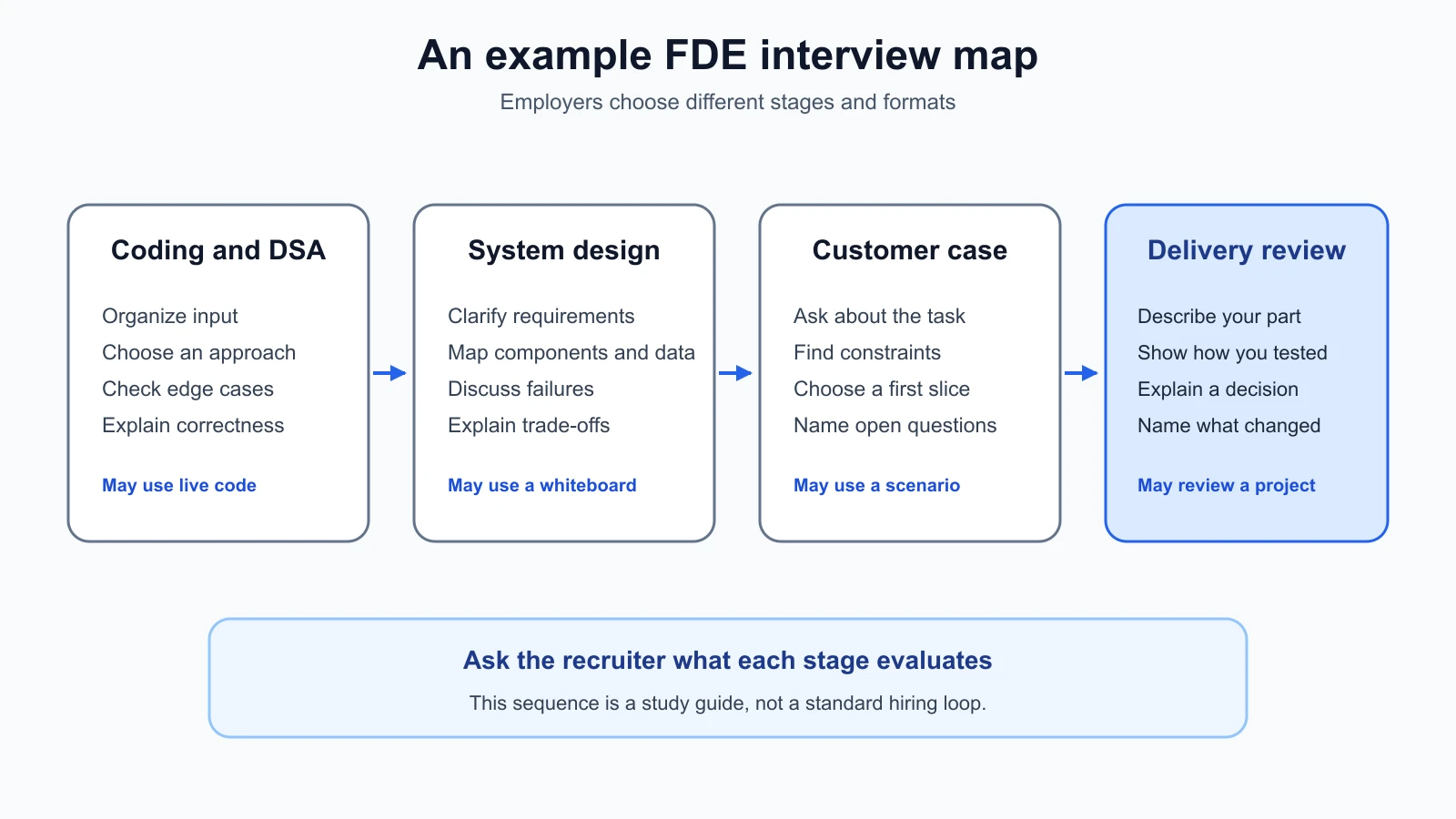
An interview gate is a selection stage that affects whether you move to the next stage. The roadmap places DSA among the early interview gates and includes system design. Employers vary: one process may begin with coding, another may use a customer case, and another may combine a technical screen with an architecture discussion. Ask the recruiter what each stage evaluates and whether the format includes live coding, take-home work, or a customer scenario.
DSA and coding
Data structures are ways to organize information in a program, such as a list, map, or tree. Algorithms are the steps a program follows to solve a problem. A coding interview may ask you to transform input, find a value, or process a sequence while explaining why the solution works. The interviewer may also ask about memory or runtime, meaning how much storage or processing time the solution uses.
For an FDE role, coding is still important. The interview may also look at how you clarify requirements, choose a straightforward solution, handle invalid input, and make your code easy to check. Do not assume every employer uses the same exercise or scoring method. The roadmap.sh DSA roadmap is one place to study the subject systematically.
At this stage, practice explaining your choices as you work. If a prompt is unclear, ask a short question and state an assumption before coding. After the main path works, test an empty input and one awkward case. This shows how you reason about a task without turning this lesson into a DSA tutorial.
System design
System design is planning the parts of a software system and how they work together to meet requirements. An interview discussion may ask you to outline an application, data flow, storage, access control, failure handling, and monitoring. You should be able to explain what you would build first and which choices need more information.
For an FDE, customer context affects the design. Imagine NorthPort asks for a way to compare order details from two systems. Before drawing boxes, ask who needs the result, how fresh the records must be, which system owns each value, and whether a dispatcher or service may take an action. The best design depends on those answers. The roadmap.sh System Design roadmap introduces the components and trade-offs covered by this subject.
Customer problem and technical case
Some teams may ask you to work through an ambiguous business request. They might want to see how you turn it into questions, identify data or permission constraints, and propose a first testable slice. There is no single correct script. A careful candidate distinguishes what is known from what must be checked.
You can practice with the NorthPort scenario. A dispatcher says, "I need the system to catch bad orders." Ask what counts as bad, who currently catches the issue, what happens next, which records you may inspect, and how the dispatcher would check a proposed flag. Then sketch a minimal first version and name the risks it leaves unresolved. The example request is fictional and makes no claim about an actual customer.
Delivery stories and communication
Interviewers may ask about a project you built, a production issue, a disagreement, or a time you changed your plan. Choose examples where you can explain your own part clearly. Describe the initial problem, the constraints, your decisions, how you checked the result, and what you learned. If the work was a team effort, say who owned each part.
Expect to explain technical details to people with different backgrounds. A useful answer starts with the result or decision, then gives enough evidence for the other person to follow. Avoid claiming that a prototype produced business impact unless you measured it and can explain the measurement. If the project was a practice build with synthetic data, label it that way.
The hiring process is itself employer-specific. The job post may list capabilities without publishing the interview loop. A recruiter can often clarify the stages, expected preparation, and whether the role spends more time on software implementation, platform configuration, or customer architecture. Use those answers to focus your preparation.
Build a portfolio that shows delivery
A portfolio project should let another engineer understand the problem, inspect the implementation, and see how you checked it. A repository full of code without context makes the reviewer guess what you built and why. A polished demo without a clear account of its limits may create the wrong impression.
Choose a task small enough to finish. For example, create a sample service that imports synthetic order records, flags inconsistent references, and lets a user review them. Keep the project fictional. Do not call it a real customer deployment or claim it saved time unless you have evidence from real use.
Include a short README with the intended user and task, how to run the project, and what the example data represents. Add a system diagram, tests for ordinary and failure cases, and a note about what you did not build. If the project is deployed, explain what runs where and how to stop or reset it. A local runnable version with clear instructions can still show your work when hosting it would expose data or create ongoing costs.
Record one technical decision and one change you made after checking the result. The reason matters: perhaps the original design assumed identifiers were unique, but the generated sample showed duplicates. Explain how you revised the approach and what limitations remain. This gives an interviewer something concrete to ask about.
You can also include a short walkthrough video or live demonstration if you can keep it available and safe to share. Do not promise a live service if you cannot maintain it. Keep credentials, private customer data, and access tokens out of public repositories. If an example resembles work for an employer, remove confidential details and get permission before publishing it.
A portfolio cannot prove how you will perform in every customer setting. It can make your current skills visible and give you a grounded way to discuss trade-offs, testing, and communication. Pair it with examples from your actual work when you can share them.
Mistakes beginners make
- Applying every roadmap node in order before building anything. Choose the gaps that block the work you want to do and make a small project that exercises them.
- Treating job titles as a precise seniority scale. Compare responsibilities, expected ownership, and stated experience instead.
- Practicing coding puzzles while ignoring customer work. Rehearse asking clarifying questions and explaining trade-offs as well.
- Treating an AI demo as a production project. Show deployment, tests, permissions, failure behavior, and operating instructions where relevant.
- Claiming business results from a portfolio exercise. Label synthetic data and simulated outcomes clearly.
- Describing a team result as if you did every part. Explain your contribution and name the other owners.
Recap and try it yourself
FDE paths begin from different strengths in frontend, backend, Linux, and AI engineering. The roadmap's tiers are best used here as learning layers, not as a universal job ladder. Employers differ in their entry points and interview loops. Coding fundamentals and system design remain important, while customer cases and delivery discussions may test how you handle ambiguity and communicate decisions.
Try it: write down one project you have completed and one FDE responsibility it demonstrates. List one missing piece that would make the project easier for another person to review, such as a test, deployment note, system diagram, or explanation of an assumption. Then choose one gap from your target job description and make it the next practice task. In the next lesson, you will map your skills and turn the remaining gaps into a learning order.
Sources
Checked on 5 November 2026. Job descriptions and roadmap content can change.
- Forward Deployed Engineer roadmap, for the role path and its skills and interview topics. The roadmap is a learning guide, not an employer-wide leveling standard.
- OpenAI Forward Deployed Engineer, AI Infrastructure, for one current role's experience and customer-facing expectations. It does not define requirements for other employers.
- Palantir careers and open positions, for current listings that include new graduate Forward Deployed Software Engineer roles.
- Frontend Developer roadmap, Backend Developer roadmap, Linux roadmap, and AI Engineer roadmap, for the adjacent technical starting points described here.
- Data Structures and Algorithms roadmap and System Design roadmap, for continued study beyond this lesson.