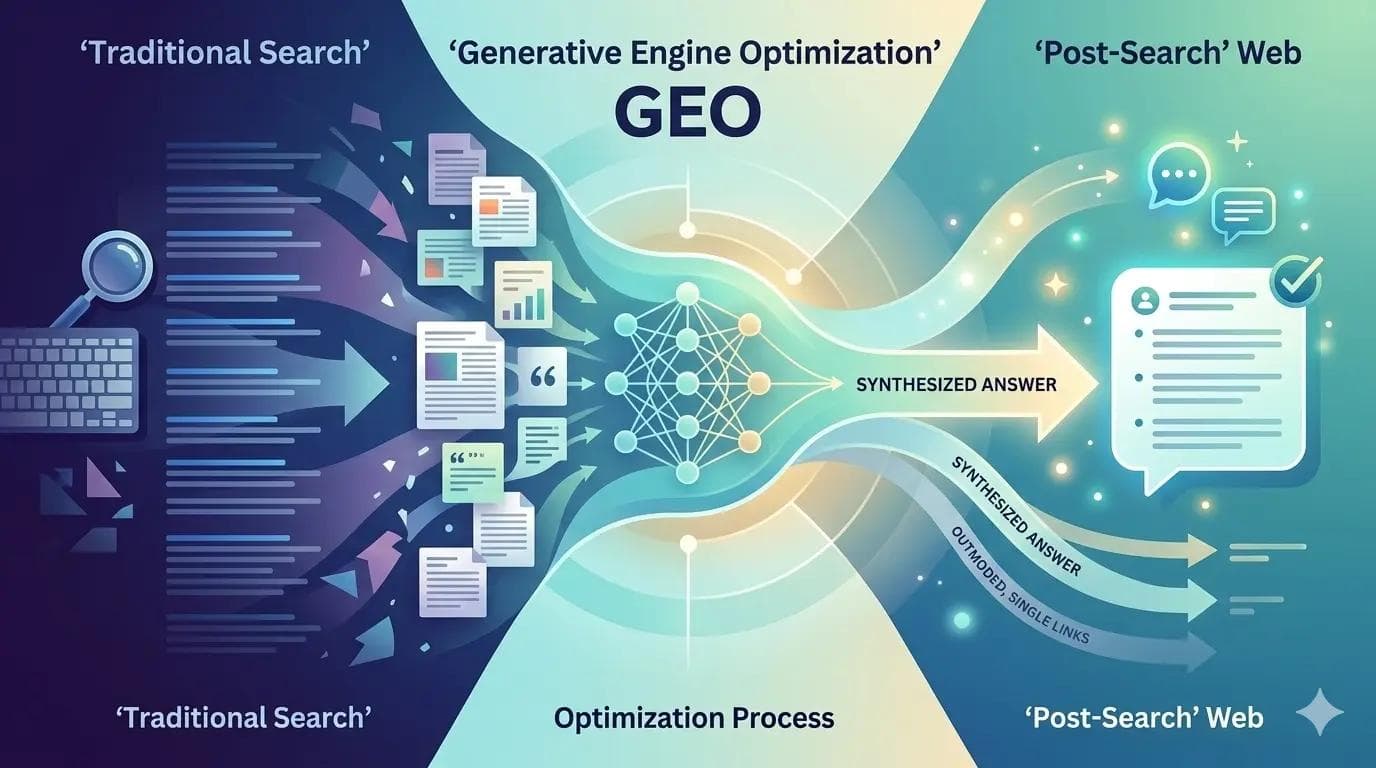
The way we look for information online is fundamentally changing right before our eyes. For decades, typing a phrase into a search bar resulted in a long list of blue links. You had to click through multiple websites and piece together the answer yourself.
That era of manual hunting is rapidly coming to an end. We are now entering the post-search web. Modern platforms no longer just index links; they read, understand, and summarize the internet for you.
When you ask a question today, you get a direct, highly detailed answer compiled from multiple sources right at the top of your screen. This massive shift introduces a completely new set of rules for website owners.
Traditional optimization techniques are no longer enough to guarantee digital visibility. To survive and thrive in this new landscape, you must master a new discipline: Generative Engine Optimization.
What is the Post-Search Web?
The post-search web describes an internet where users bypass traditional search results pages entirely. Instead of hunting for information across different domains, the information is synthesized and delivered directly to them.
Think about how frustrating traditional searching can be today. You ask a simple question, but the top results are hidden beneath heavy advertisements or long, drawn-out introductions. Users are tired of digging for basic facts.
Answer engines solve this exact problem. These advanced language models and smart algorithms act more like knowledgeable researchers than digital directories. They scan millions of pages, pull the most relevant facts, and present a conversational response in seconds.
If your website is not the source of that response, your digital traffic will likely disappear. In the post-search web, being the second or third link on a page matters very little. You either provide the exact data that feeds the intelligent system, or you remain completely invisible.
Understanding Generative Engine Optimization (GEO)
Generative Engine Optimization is the practice of structuring your digital presence so that advanced algorithms choose your website as their primary source of truth.
While traditional methods focused heavily on keyword density, backlinks, and click-through rates, this new methodology focuses on comprehension and authority. Smart systems do not care how many times you repeat a specific keyword phrase.
Instead, they care about whether your text actually answers the user's underlying question. To succeed here, you must shift your mindset completely. You are no longer writing just for human readers or simple web crawlers.
You are writing to educate highly advanced computational models. You must present your expertise in a format that these systems can easily digest, verify, and cite.
The Shift from Keywords to Context
In the past, ranking for "best running shoes" meant repeating that exact phrase in your headers, meta descriptions, and image tags. It was a highly mechanical, repetitive process.
Today, intelligent systems understand semantics. They know that "top footwear for jogging" and "highest-rated sneakers for marathon training" mean the exact same thing. They look for context, related concepts, and comprehensive coverage of a topic.
Your primary goal is to build deep topical authority. Instead of writing ten thin articles targeting ten different keyword variations, you need one definitive, deeply researched guide that covers every possible angle of the subject.
Core Strategies for Generative Engine Optimization
Adapting to the post-search web requires actionable changes to your website architecture and your overall writing style. Here are the foundational strategies you must implement to stay relevant.
Focus on Direct, Conversational Answers
Advanced algorithms are designed to answer questions directly. Therefore, your text must provide clear, concise answers that a system can easily extract and feature.
Start incorporating a clear "question and answer" format into your main pages. When introducing a new concept, ask the question exactly how a user would phrase it verbally. Immediately follow that question with a bold, one-sentence answer.
Once you provide the short answer, use the following paragraphs to dive into the deeper details. This structure gives the algorithm a perfect snippet to use in its summary, while still providing depth for human readers who want to learn more.
Establish Unshakable E-E-A-T
Experience, Expertise, Authoritativeness, and Trustworthiness (E-E-A-T) are more critical now than ever before. Smart algorithms are strictly programmed to prioritize safe, accurate, and reliable information over everything else.
You must prove beyond a shadow of a doubt that you are a legitimate expert in your field. Ensure every article has a clear author byline linking to a highly detailed biography page.
Highlight your professional credentials, years of hands-on experience, and industry awards. Furthermore, ensure your website has clear contact information and transparent privacy policies. Generative engines evaluate the entire reputation of your business, not just a single web page.
Leverage Structured Data and Schema Markup
While advanced models are great at reading natural language, they still appreciate a well-organized database. Structured data is a universal language that helps these systems categorize your information perfectly.
Implement proper schema markup across your entire website. If you run a local business, use Local Business schema. If you publish cooking instructions, use Recipe schema. If you write technical tutorials, use How-To schema.
This hidden code acts as a direct label for your data. It tells the algorithm exactly what kind of information is on the page, removing any guesswork and dramatically increasing the chances that your facts are used in a generated response.
Cite Your Sources and Use Unique Statistics
Advanced systems absolutely love original, verifiable data. If your website only repeats the same opinions found on a hundred other blogs, you offer no unique value to the learning model.
Conduct your own industry surveys, share proprietary case studies, and publish original statistics. When an advanced system compiles a detailed answer, it looks for hard numbers to back up its claims.
If you are the original source of a compelling statistic, the engine will almost always cite your website. Always link out to highly authoritative external sources as well, proving your work is well-researched and grounded in undeniable facts.
Formatting for the Machine and the Human
Your page layout plays a massive role in how well your information is extracted by a crawler. A giant wall of text is incredibly difficult for both humans and intelligent systems to parse.
Break your writing into small, logical sections using clear, descriptive headings. Use bullet points and numbered lists whenever you are explaining a process, listing product benefits, or comparing multiple options.
Keep your sentences punchy and active. Avoid unnecessary fluff or highly decorative language that dilutes your main point. Bold key terms to naturally highlight important concepts for the reader.
When an algorithm compiles a summary, it often pulls directly from these organized lists. By formatting your data this way, you make it incredibly easy for the system to grab your points and feature them prominently at the top of the page.
Real-World Example: Adapting to the New Era
Let us look at a practical example. Imagine a website that sells professional coffee equipment. In the traditional era, they might write a blog post titled "Coffee Grinders 101" stuffed with the keyword phrase "buy coffee grinder."
To adapt to Generative Engine Optimization, they must completely rethink this strategy. The new post should have a highly specific title like "How to Choose the Right Burr Grinder for Espresso."
The article would start with a clear, direct summary: "The best burr grinder for espresso must feature micro-metric adjustments and flat steel burrs to ensure a consistent, fine grind."
The rest of the article would feature a detailed comparison table, original testing data on grind consistency, and a step-by-step numbered list on how to dial in the perfect shot. This highly structured, deeply informative page is exactly what a smart algorithm wants to reference.
Why You Cannot Ignore the Post-Search Era
Ignoring this massive technological shift is simply not an option if you rely on digital traffic. The way people find information has permanently changed, and the old marketing playbooks are losing their effectiveness rapidly.
When a user gets a complete answer at the top of their screen, click-through rates for traditional blue links plummet. If you are ranking in the fifth position on a standard search page, you are practically invisible in the post-search web.
However, this shift also presents a massive opportunity for early adapters. Being cited as a primary source in a generated answer establishes incredible brand authority. Users trust the systems they use, and if that system recommends your website, that trust transfers directly to your brand.
Transitioning Your Existing Content Library
You do not need to delete your website and start over from scratch. You can absolutely optimize your existing library of articles to perform much better in this new environment.
Start by auditing your top-performing pages. Look for opportunities to add an "Executive Summary" or a "Key Takeaways" section at the very top of the article. This provides immediate, accessible answers for smart algorithms to grab.
Next, carefully review your headings. Are they vague, or are they descriptive? Change a heading from "Our Process" to "The Five-Step Process for Water Purification." Total clarity is your best tool for improving extraction rates.
Finally, ensure all your facts and figures are completely updated. Intelligent systems prioritize fresh, accurate data. If your article references statistics from five years ago, update them with current research immediately.
Frequently Asked Questions (FAQ)
Is traditional search engine optimization completely dead?
No, it is not completely dead. Advanced engines still rely on many traditional signals, like website speed, secure connections, and high-quality backlinks, to determine if a site is trustworthy. The foundation remains the same, but the focus has definitively shifted toward direct answers and deep context.
How long does it take to see results from these new strategies?
Digital visibility is always a long-term game. While adding structured data and clear summaries can help algorithms understand your site immediately, building the necessary authority takes time. You should expect to see gradual improvements over several months of consistent, high-quality effort.
What is the most important ranking factor for answer engines?
Accuracy and authority are tied for the absolute most important factor. If an advanced system cannot verify your claims, or if you lack the credentials to speak on a topic, you will not be cited. Providing uniquely valuable, rigorously fact-checked information is mandatory.
How do I track my success in the post-search web?
Tracking methodology is currently evolving. Traditional click-through metrics might drop, but you should monitor brand mentions, direct traffic, and overall engagement rates on your site. If users are arriving at your site after reading a generated summary, they are usually highly qualified and ready to convert.
Conclusion: Embracing the Future of Digital Discoverability
The internet is a living, breathing ecosystem that constantly evolves to meet shifting user demands. The rapid transition to the post-search web is a direct response to our collective desire for faster, more accurate information without the hassle of digging.
Generative Engine Optimization is not a passing trend; it is the absolute new standard for digital discoverability. By shifting your focus from simple, repetitive keywords to deep comprehension and structural clarity, you position your brand as a trusted authority.
Start treating intelligent algorithms as eager students. Provide them with highly structured, factual, and easily digestible information. Establish your unquestionable expertise, cite your sources clearly, and write with a natural, conversational tone.
About the Author

Suraj - Writer Dock
Suraj Kumar is a writer, entrepreneur, and the CEO and founder of this website, sharing simple and practical insights on business, creativity, and personal growth. With experience building digital projects, they enjoy helping others learn, grow, and succeed online.