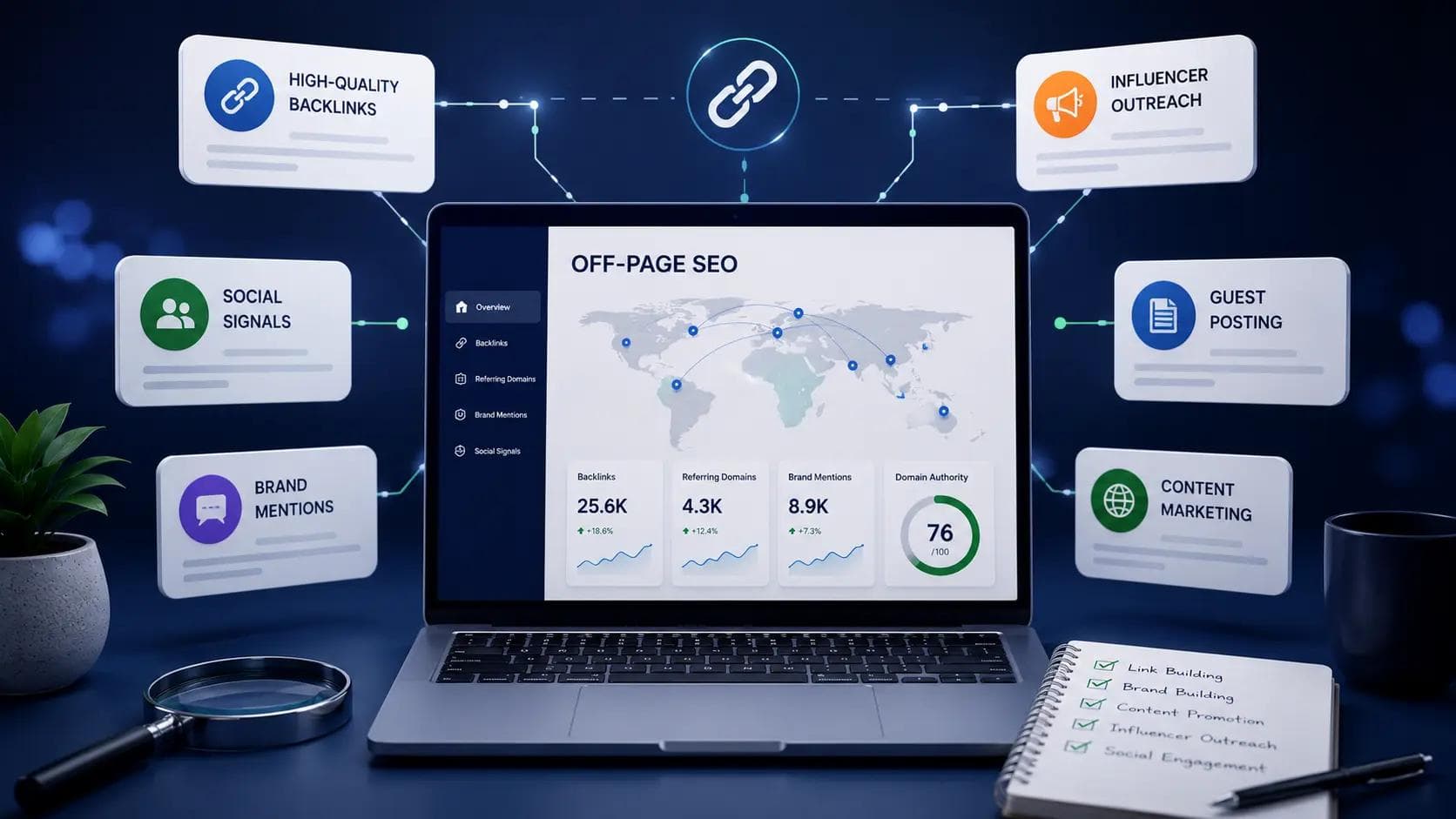
Off-Page SEO: The Ultimate Guide for 2026
Building a beautiful website and filling it with brilliant content feels like a massive victory, but Google won't notice it unless the rest of the web validates your existence. If you rely solely on your on-page optimization, you are playing half the game. Mastering off-page SEO in 2026 requires understanding that search engine rankings depend heavily on external signals of trust, authority, and real human recognition.
When I launched my first major site, I spent months tweaking meta tags and font sizes, expecting a flood of organic traffic that never came. It took a painful year of flatlining analytics to realize that search engines care far more about what others say about you than what you say about yourself. External optimization is the engine that transforms an invisible blog into an authoritative industry destination.
This manual details exactly how to build authentic digital footprint signals that push your rankings higher. You will learn how to earn high-quality backlinks, secure brand mentions, and establish undeniable topical authority. Let's look at the modern playbook for building external trust that search engines can no longer ignore.
Understanding the True Scope of External Optimization
Many marketers mistakenly think this discipline begins and ends with link acquisition. While securing editorial links remains a core pillar, search algorithms now analyze a much wider net of off-site signals to evaluate your overall credibility.
Brand mentions, digital public relations, and user engagement across third-party platforms heavily influence how search engines perceive your entity. If people talk about your company across forums, social media, and industry publications, search algorithms recognize that footprint. They treat these unlinked citations as modern votes of confidence, blending them with traditional algorithmic signals to determine your position in search results.
Building this multi-layered footprint requires a strategic shift. You must move away from isolated link campaigns and focus on creating a cohesive digital presence. When your brand consistently pops up in relevant conversations across the web, your organic performance naturally rises.
The Modern Playbook for Earning High-Quality Backlinks
Link building remains the single most powerful component of any off-site strategy. However, the days of buying cheap guest posts on shady networks are long gone, as outlined in our look at the Google March 2026 Core Update: E-E-A-T and Rankings. Today, search engines aggressively penalize artificial link schemes, favoring authentic editorial placements instead.
Creating Data-Driven Linkable Assets
The most reliable way to get external websites to link to you is by publishing original data or unique research. When you survey your audience or analyze public data sets to uncover fresh trends, you create an uncopyable resource. Writers and journalists constantly look for statistics to back up their claims, and they will naturally credit you as the source.
Strategic Digital PR Campaigns
Digital PR involves pitching compelling stories or expert insights to journalists and mainstream media outlets. Instead of blast-emailing hundreds of reporters, focus on a small group of writers who cover your specific niche. Provide them with ready-to-publish quotes or data visualizations that make their jobs easier, earning you top-tier editorial links.
Contextual Resource Page Outreach
Many authoritative resource pages regularly aggregate helpful links for their audiences. Find these pages by searching for your industry keywords alongside terms like helpful resources or useful links. Reach out to the site editors, point out where their current lists might lack updated insights, and offer your comprehensive guide as a valuable addition.
Building Authority Through Brand Mentions and Entity SEO
Search engines no longer just read strings of text; they map connections between real-world entities. This evolution means that getting your brand name mentioned in the right context is incredibly valuable, even if those mentions don't include a direct hyperlink.
When an industry authority mentions your brand alongside your primary keywords, search algorithms update their internal knowledge graphs to link your business directly to that expertise.
To capitalize on entity-based optimization, focus on building a clean digital footprint across trusted platforms. Ensure your company profiles on sites like Crunchbase, LinkedIn, and specialized industry directories use identical names, addresses, and messaging. This consistency helps search bots confidently identify your business as a legitimate organization, clearing the path for better long-term performance.
Leveraging Digital PR and Thought Leadership
Establishing yourself as an industry expert builds a natural shield against sudden algorithm adjustments. When editors and podcasters frequently invite you to share your knowledge, search engines notice the recurring association between your name and your niche.
I used to think thought leadership was just an ego metric for corporate executives. But after I started contributing tactical breakdowns to respected industry publications, our organic visibility spiked significantly. Those contributions proved to search engines that real professionals trusted our perspectives, which directly boosted our commercial rankings.
You can replicate this by consistently pitching specific case studies to niche podcasts and digital magazines. Don't pitch generic topic ideas; instead, share an unusual problem you solved or a failure you analyzed. Giving editors highly practical, real-world examples makes your pitches stand out and secures high-authority brand alignments.
Content Syndication and Strategic Guest Posting
Publishing content on external platforms helps you reach audiences that might never find your website organically. When done correctly, syndication and guest contributions introduce your brand to established communities while passing valuable authority signals back to your domain.
The biggest mistake you can make here is treating external contributions as a dumping ground for low-quality content. If you wouldn't publish a piece on your own site, do not send it to an external editor. Low-tier guest posting hurts your reputation and wastes your time, often leading to a situation where your blog is not getting traffic because the links carry zero trust.
1[Your High-Quality Article]
2       │
3       ├─► Syndicated to Medium (with rel=canonical back to your site)
4       │
5       └─► Re-purposed for LinkedIn Articles (pointing to your original source)
Always use the rel="canonical tag when syndicating complete articles to platforms like Medium or Substack. This tag explicitly tells search bots that your website holds the original version, ensuring your domain receives the ranking credit while preventing duplicate content issues.
Auditing and Managing Your Link Profile
A great strategy requires regular maintenance to ensure toxic or manipulative links don't drag down your hard work. Negative SEO attacks and automated spam bots can attach low-quality links to your site, making routine backlink profile audits essential.
According to recent data from search performance studies, companies that audit their external profiles quarterly see fewer unexpected ranking drops during core algorithmic evaluations. You need to keep an eye on your referring domains to make sure your link profile looks natural and earned.
Use reliable tracking tools to evaluate your incoming links. Honest platforms like Ahrefs or Semrush provide excellent visibility into your backlink health, while Ubersuggest offers a budget-friendly way to monitor your referring domains. For a deeper breakdown of these tracking options, read our comparison of Ahrefs vs Semrush vs Ubersuggest. If you discover a sudden wave of malicious spam links, keep calm; modern search engines are generally excellent at ignoring automated clutter without requiring manual intervention.
Key Takeaways
- External optimization requires a varied strategy combining editorial link acquisition, unlinked brand citations, and strategic digital PR.
- Publishing original, data-driven research remains the most effective way to secure high-authority links naturally.
- Contextual brand mentions help search engines map your business as a trusted entity within your specific industry niche.
- Consistently delivering authentic thought leadership across external channels creates long-term algorithm resilience.
- Regular profile audits ensure your link growth remains natural, balanced, and free from algorithmic risk.
Conclusion
Earning trust beyond your own domain is what separates small blogs from authoritative industry leaders. Search engines want to reward brands that possess real-world credibility, and your off-page SEO strategy is how you demonstrate that authority. Focus your energy on building genuine partnerships, publishing original research, and earning unlinked citations across your niche. Avoid shortcuts, stop chasing low-tier directory links, and prioritize real editorial value above everything else. If you dedicate just an hour each week to genuine outreach and digital PR, your search prominence will steadily grow.
Frequently Asked Questions
What is the main difference between on-page and off-page SEO?
On-page optimization deals with elements you control directly on your website, like content depth, HTML tags, and site speed. External optimization focuses on actions taken outside your domain to influence your rankings, such as building backlinks, earning brand mentions, and driving digital PR. Both are essential for search success.
How long does it take for backlinks to improve rankings?
In most cases, you will see the impact of a new backlink within two to ten weeks after search bots crawl and index the referring page. The exact timeline depends on the authority of the linking site, your existing domain credibility, and how competitive your target keywords are.
Can unlinked brand mentions improve organic search visibility?
Yes, search engines use advanced natural language processing to identify unlinked brand names on trusted websites. When a respected industry publication mentions your business alongside specific topics, search algorithms associate your brand with that niche, boosting your entity authority even without a hyperlink.
Should I disavow low-quality spam links hitting my website?
Modern search algorithms are designed to automatically ignore or neutralize random comment spam and low-quality scraper site links. You only need to use the Google disavow tool if you have received a formal manual action or if you recently ran an aggressive, artificial link campaign that you need to clean up.
Is guest blogging still a valid off-site ranking strategy?
Guest blogging works well if you contribute genuinely valuable content to respected, relevant websites in your industry. It fails when you publish spun content on low-quality sites built solely for SEO links. Prioritize content quality and audience relevance over sheer link volume.
How many backlinks do I need to rank on the first page?
There is no fixed number of links required to rank on the first page of search results. Your target link volume depends entirely on the strength of the competing pages; ranking for a localized niche requires far fewer links than targeting a highly competitive global term.
How many backlinks do I need to rank on the first page?
There is no fixed number of links required to rank on the first page of search results. Your target link volume depends entirely on the strength of the competing pages; ranking for a localized niche requires far fewer links than targeting a highly competitive global term.
How many backlinks do I need to rank on the first page?
There is no fixed number of links required to rank on the first page of search results. Your target link volume depends entirely on the strength of the competing pages; ranking for a localized niche requires far fewer links than targeting a highly competitive global term.
How many backlinks do I need to rank on the first page?
There is no fixed number of links required to rank on the first page of search results. Your target link volume depends entirely on the strength of the competing pages; ranking for a localized niche requires far fewer links than targeting a highly competitive global term.
About the Author

Madhu - WriterDock
Madhu is a writer and SEO Executive who is passionate about creating informative, engaging, and search-optimized content that helps readers find practical solutions. With expertise in content strategy and SEO, she transforms complex topics into easy-to-understand, valuable blog posts. She loves sharing knowledge through helpful blogs that educate, inspire, and empower audiences.