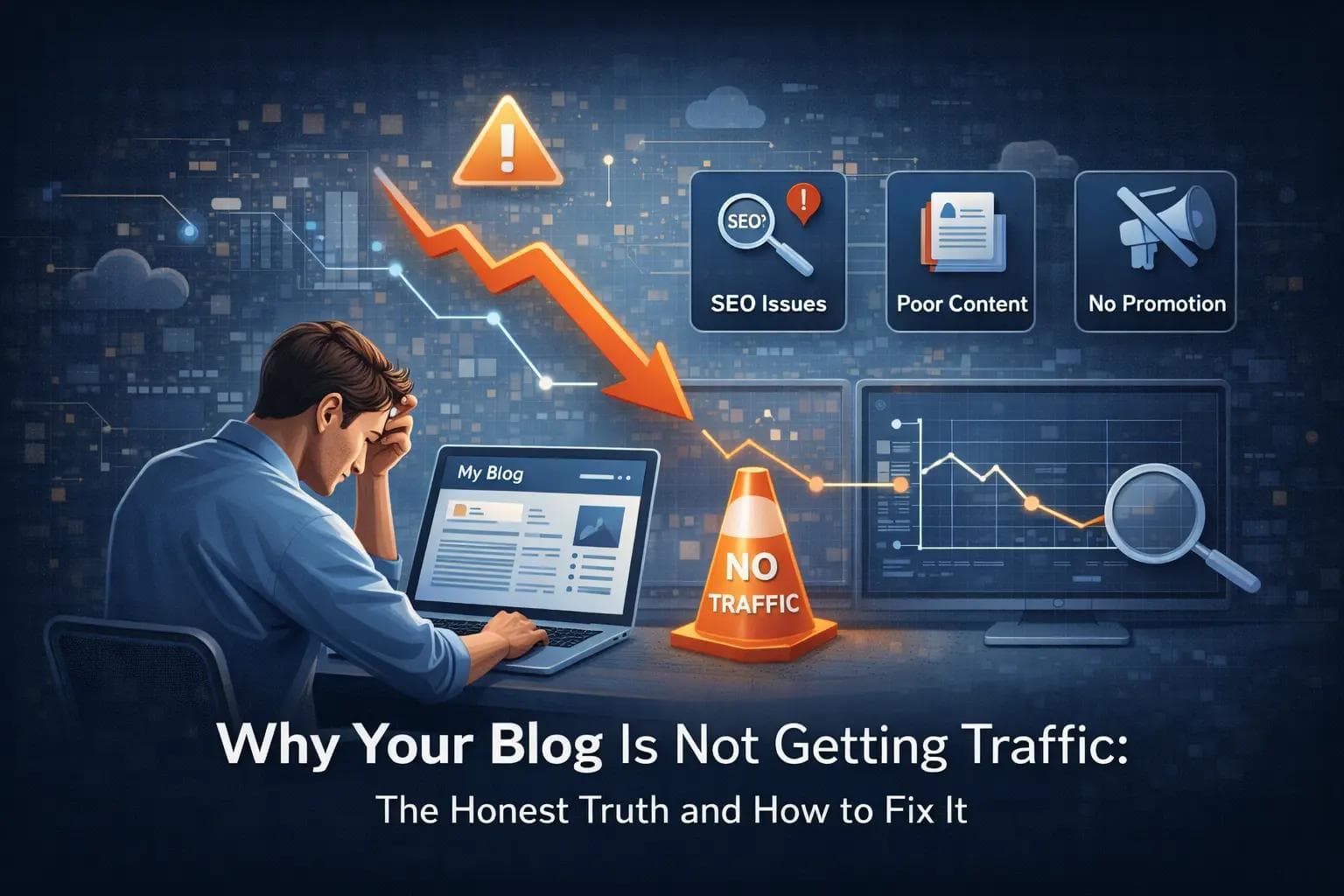
I remember sitting in my home office three years ago, staring at a Google Analytics dashboard that looked like a flatline on a heart monitor. I had just spent twelve hours writing what I thought was a masterpiece on JavaScript performance. I had used perfect grammar, custom-drawn diagrams, and even shared it on my personal Facebook page.
Total visitors after 48 hours? Seven. And I’m pretty sure four of those were me refreshing the page from different devices to check if the tracking code was working.
It’s a crushing feeling. You put your expertise, your time, and your soul into a piece of content, only for it to vanish into the digital void. You start questioning everything. Is the topic boring? Is my writing bad? Is blogging dead?
The truth is, blogging isn't dead, but the "build it and they will come" strategy is. In my experience, most blogs fail not because the content is poor, but because the creator is ignoring the technical and psychological mechanics of how people actually find and consume information in 2026.
Let’s walk through the real reasons your traffic is stalling and how we can turn that flatline into a growth curve.
1. You Are Writing for Yourself, Not for Search Intent
This is the most common mistake I’ve seen, especially among developers and technical experts. We write about what we find interesting today, rather than what people are actually searching for.
Search intent is the "why" behind a search query. If someone types "React hooks" into Google, are they looking for a definition, a tutorial, or a list of advanced patterns? If your blog post provides a philosophical essay on why hooks exist but the user wants a quick code snippet to fix a bug, they will bounce immediately.
How to Fix It:
Before you type a single word, go to Google and type in your primary keyword. Look at the top three results.
- Are they listicles?
- Are they deep-dive tutorials?
- Are they "How-to" guides?
Your content needs to match the format that Google is already rewarding. If you want to rank for "best full-stack frameworks," don't write a story about your personal favorite; write a comprehensive comparison that helps the reader make a choice.
2. Your Technical SEO Is Quietly Killing You
You can have the best prose in the world, but if Google’s "crawlers" (the bots that read your site) can’t understand your page, you will never rank. I’ve seen beautiful blogs with massive traffic potential fail simply because their robots.txt file was misconfigured or their site was too slow.
Google prioritizes user experience. If your site takes five seconds to load on a mobile device, Google will move you to page ten.
The Technical Checklist:
- Core Web Vitals: Does your site pass the speed test?
- Mobile Friendliness: Does it look good on a phone? (Over 60% of web traffic is mobile).
- Internal Linking: Do your posts link to each other?
- Schema Markup: Are you using structured data to tell Google what your content is?
A Quick Code Example: Meta Tags
Check your blog's <head> section. If you don't have properly defined meta tags, social media sites and search engines won't know how to display your content.
1<title>Why Your Blog Is Not Getting Traffic | Fix Your SEO</title>
2<meta name="description" content="Struggling with low blog views? Learn the 7 real reasons your traffic is stalling and how to fix your SEO strategy today.">
3
4<meta property="og:title" content="Why Your Blog Is Not Getting Traffic">
5<meta property="og:description" content="A deep dive into search intent, technical SEO, and content distribution.">
6<meta property="og:image" content="https://yourblog.com/images/seo-guide.jpg">
3. Your Headlines Are "Clever" Instead of "Clear"
In my experience, developers love naming their blog posts something witty. For example, "A Tale of Two Arrays" or "The Ghost in the Machine." While these are fun, they are terrible for traffic.
People don't search for "Tales of Arrays." They search for "How to merge two arrays in JavaScript."
If your headline doesn't contain the primary keyword people are typing into that search bar, you are invisible. A clear headline tells the reader exactly what value they will get.
The Headline Formula:
- Bad: Coding is hard.
- Better: 5 Tips to Learn Coding Faster.
- Best: How to Learn JavaScript in 30 Days: A Step-by-Step Guide for Beginners.
4. The E-E-A-T Gap: Experience, Expertise, Authoritativeness, and Trust
Google recently updated its quality guidelines to emphasize "Experience." They want to see that the person writing the article has actually done the thing they are talking about.
If you write a generic article about "How to start a startup" but you’ve never started a company, Google knows. It looks for signals of real-world experience.
How to Build Trust:
- Share Mistakes: Talk about the time you crashed the production server.
- Use Real Data: Don't say "many people use React." Say "According to the 2025 Stack Overflow survey, 45% of developers prefer React."
- Author Bio: Include a clear bio that explains why you are qualified to speak on this topic.
5. You Are Not Distributing Your Content
This is where I failed most often in the beginning. I thought my job ended when I hit the "Publish" button. In reality, that is only 50% of the work.
The internet is noisy. Even a great post needs a push. If you aren't active where your audience hangs out, they will never find you.
The Rule of Distribution:
For every hour you spend writing, spend 30 minutes distributing.
- LinkedIn: Share a summary of the post with a link in the comments.
- Reddit/Hacker News: Join the conversation, don't just spam links. Answer a question and then link to your post as a "further reading" resource.
- Email List: This is your only owned audience. Even if Google changes its algorithm tomorrow, your email list is yours.
6. The Content Is Not "Scannable"
We need to be honest: people do not read on the internet. They scan. If I land on your blog and see a "wall of text" (a paragraph longer than six lines), I am going to leave.
I’ve seen high-quality information ignored because the layout was claustrophobic. You need to provide "mental breathing room" for your readers.
How to Improve Readability:
- Short Paragraphs: 2 to 4 lines maximum.
- Sub-headings (H2, H3): Use them to break up every major point.
- Bullet Points: Like these! They make lists much easier to digest.
- Bold Text: Bold your key takeaways so someone skimming can still learn.
7. You Are Fighting in an Over-Saturated Niche
If you are trying to rank for "How to lose weight" or "What is Python," you are competing against multi-million dollar media companies with teams of fifty SEO experts. You will lose that fight every time.
To get traffic as a smaller blog, you have to find "The Gap." This means going "Long-Tail."
Example of Niching Down:
- Broad: Python Tutorial (Impossible to rank).
- Niche: Python for Data Science (Very hard).
- Long-Tail: How to use Python to automate Excel reports for real estate agents (Much easier to rank).
The more specific you are, the less competition you have, and the higher the quality of the traffic you will get.
8. Your Images Are Slowing You Down
I once audited a blog that had 10 MB images directly from a DSLR camera. Each page took 12 seconds to load. The owner wondered why their "bounce rate" was 95%.
Images are essential for engagement, but they are the heaviest part of your website.
Practical Advice:
- Compress: Use tools to reduce file size without losing quality.
- WebP Format: Use modern image formats that are 30% smaller than JPEG.
- Lazy Loading: Only load the image when the user scrolls down to it.
Common Mistakes to Avoid
- Buying Backlinks: This is the fastest way to get your site banned by Google. Focus on earning links by writing useful stuff.
- Keyword Stuffing: Writing "Best SEO blog for SEO tips for SEO beginners" sounds like a robot. Write for humans, optimize for bots.
- Ignoring Analytics: If you don't look at your data, you are flying blind. Use Google Search Console to see which keywords are actually bringing people to your site.
- Giving Up Too Soon: SEO takes time. I’ve seen posts take six months to reach the first page of Google. Consistency is your only superpower.
FAQ Section
How long does it take to get traffic from Google?
Generally, for a new blog, it takes 3 to 6 months to start seeing significant organic search traffic. Google needs time to trust your domain and index your content.
Do I need to post every day?
No. Quality is much more important than quantity. One "pillar" post of 2,500 words that solves a real problem is worth more than thirty 300-word fluff pieces. Aim for once a week or once every two weeks.
Is social media traffic better than SEO traffic?
Social media traffic is "spiky"—you get a lot today and nothing tomorrow. SEO traffic is "compounding"—it grows slowly but stays consistent for years. You want both, but SEO should be your foundation.
Should I pay for ads to get traffic?
Only if you are selling something. If you are just trying to build a readership, paid ads are a "leaky bucket." Once you stop paying, the traffic stops. Focus on organic growth first.
Conclusion: Turning the Tide
If your blog is currently a digital ghost town, don't panic. Almost every successful blogger I know started exactly where you are. The difference between those who succeed and those who quit is a willingness to stop "writing" and start "publishing strategically."
Your Immediate Action Plan:
- Audit Your Top 5 Posts: Are they matching search intent? Do they have clear H2 headings?
- Check Your Speed: Run your site through PageSpeed Insights and fix the biggest red flags.
- Update Your Headlines: Make them clear and keyword-rich.
- Pick One Distribution Channel: Don't try to be on Twitter, LinkedIn, and Reddit at once. Master one first.
Blogging is a long game. It’s about building a library of value, one brick at a time. When you stop writing for yourself and start solving problems for your readers, the traffic will follow. I’ve seen it happen for my sites, and I know it can happen for yours.
About the Author

Suraj - Writer Dock
Suraj Kumar is a writer, entrepreneur, and the CEO and founder of this website, sharing simple and practical insights on business, creativity, and personal growth. With experience building digital projects, they enjoy helping others learn, grow, and succeed online.