Google E-E-A-T Explained: What It Means for Your Blog
Traffic drops overnight can break your spirit as a creator. You wake up, open your analytics dashboard, and see a steep, downward line that looks like a ski slope. For many independent bloggers, this painful reality happens because they treat search optimization like a system of technical rules rather than a human relationship. Google wants to show searchers content they can actually trust, especially when making decisions about health, money, or career growth. Understanding Google E-E-A-T explained: what it means for your blog is the single most important step to protect your organic reach and build a sustainable brand. This guide breaks down exactly how the search engine evaluates your real-world experience, professional expertise, authoritativeness, and baseline trustworthiness so you can align your content strategy with what modern search systems demand.
The Anatomy of Search Quality: Breaking Down the Acronym
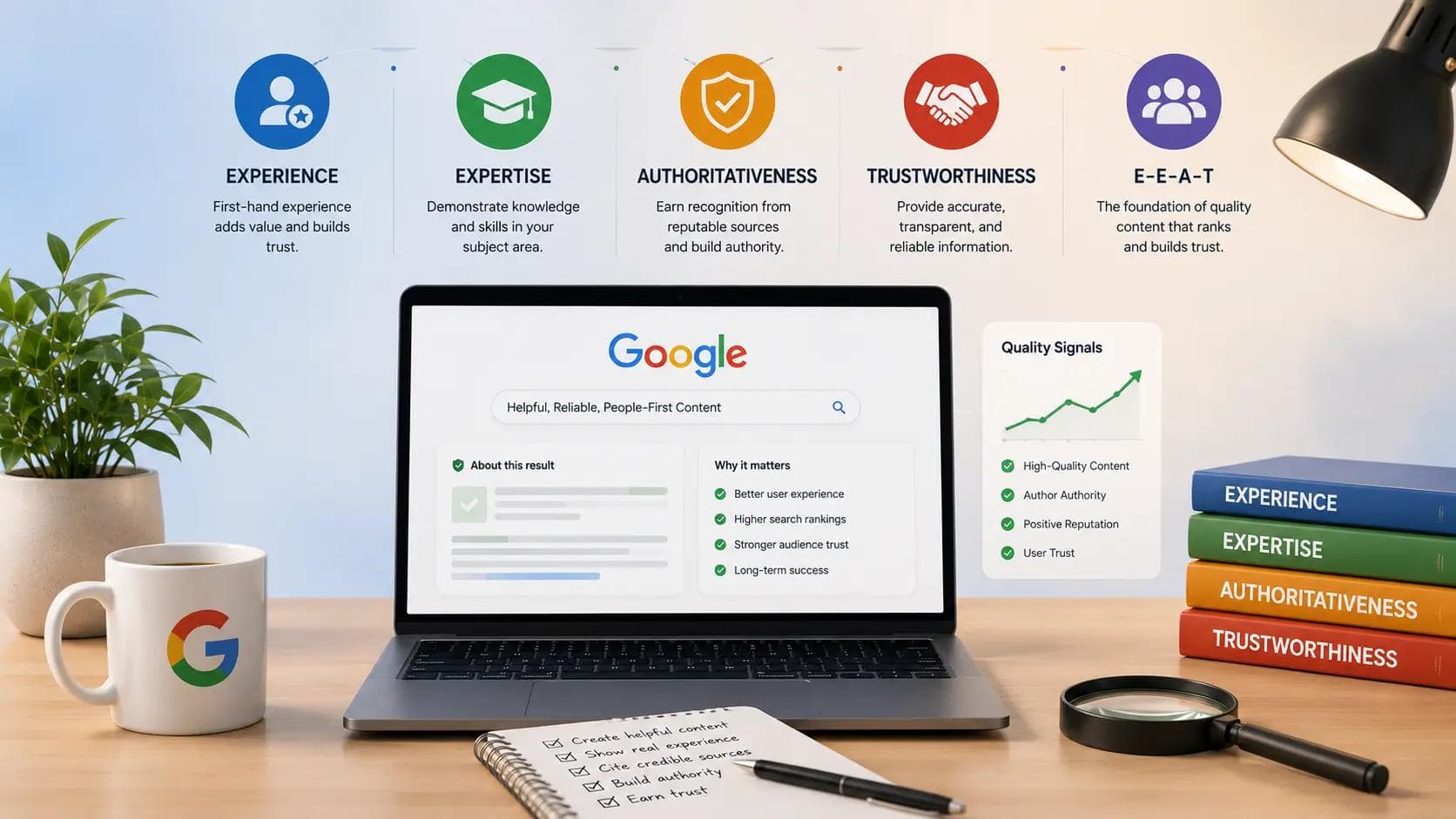
Google uses a massive network of human quality raters to grade search results. These raters follow a public set of guidelines that help train automated ranking systems. The core framework they use is called E-E-A-T, which stands for Experience, Expertise, Authoritativeness, and Trustworthiness. While it is not a direct ranking factor with a single numerical score, it functions as a north star for how the core algorithm measures content value.
The first component, experience, was added to the framework during a major update to reflect the value of first-hand involvement. Google noticed that users often want to hear from someone who has actually used a product, lived through an event, or performed a specific task. Expertise focuses on the formal knowledge, credentials, or deep study of the creator. Authoritativeness evaluates your reputation in your niche, measuring how much other industry voices point to you as a definitive source. Trustworthiness sits at the absolute center of this model; it is the most critical element because an untrustworthy site will fail to rank well, no matter how experienced or expert the writer appears.
When I first started building niche sites years ago, I made the mistake of assuming that smooth prose and basic technical SEO were enough to win long-term. I bought stock photos of fake authors, wrote generic definitions of complex topics, and wondered why my traffic flatlined after a few months. The truth is that search systems have become incredibly smart at spotting shallow content written by people who have never touched the tools they recommend.
Experience vs Expertise: Why First-Hand Proof Matters Now
The distinction between having experience and possessing formal expertise is where many independent publishers get confused. Expertise means you understand the theory, the documentation, and the professional standards of a field. Experience means you have blood on your knuckles from doing the actual work in the real world. A certified financial planner has expertise, but a person who successfully dug themselves out of sixty thousand dollars of debt has experience. Both are incredibly valuable to searchers, but they require different presentation styles on your pages.
To demonstrate experience clearly to automated search systems, you must change how you structure your narratives. Avoid passive, clinical observations. Use clear language that signals your direct involvement with the subject matter. If you are writing a software review, include original screenshots with your custom configurations visible. Mention specific bugs you encountered during setup, unexpected pricing quirks, or unique interface limitations that do not appear on the official product landing page.
Real experience cannot be faked by text generators because it relies on unique, contextual details that only a human operator notices during a live task.
If you want to understand how this plays out during major algorithm shifts, check out our guide on the Google March 2026 Core Update: Navigating E-E-A-T and Rankings to see how first-hand proof protected independent sites. When you mix professional knowledge with clear personal proof, you create content that automated scrapers cannot replicate.
Building Authoritativeness Through Niche Focus and Digital Footprints
Authoritativeness is not something you can claim for yourself on your own pages; it is a metric earned from the wider web. Google determines your authority by looking at how other reputable websites talk about you and your brand. If top-tier publications link to your research, or if recognized industry experts mention your name on social platforms, your authority signals rise significantly.
The fastest way for an independent blogger to lose authority is to write about everything. When you publish an article about fitness on Monday, a recipe on Wednesday, and a software tutorial on Friday, search systems struggle to classify your core area of relevance. You must establish topical authority by covering one single subject area completely before expanding into adjacent categories. Build clean, internal linking structures that connect your basic overviews to deep, highly technical sub-topics.
You can accelerate this process by conducting original surveys or publishing unique data points. According to industry data from a 2025 search performance study, publishers who consistently publish original data sets receive 4x more editorial backlinks than those who only synthesize existing articles. When other writers use your blog as a source for their statistics, search engines recognize your site as a foundational node of authority in that space.
The Trust Factor: Transparency Elements That Protect Your Rankings
Trustworthiness is the foundational pillar that supports the other three elements of the framework. If your blog has brilliant writing but lacks basic transparency details, search systems will classify your site as low quality. This is especially true for topics that fall under the category of Your Money or Your Life (YMYL), which directly impact a reader's physical health, financial stability, or safety.
To build an inherently trustworthy blog, you must treat your site like a transparent media company. Start with a comprehensive, easily accessible About page that details who you are, why you started the site, and what qualifies you to write on these topics. Include links to your active professional social profiles, clear contact options, a physical business address if possible, and explicit editorial policies. Readers and search evaluators need to know exactly who stands behind the content before they trust the advice.
Essential Transparency Improvements for Every Blog Page
- Clear Author Byline: Always display the full name of the writer at the top of the article, linked to a dedicated author bio page.
- Explicit Dates: Show both the original publication date and the exact date the content was last reviewed or updated for accuracy.
- Source Link Policy: Cite your references clearly by linking directly to primary scientific papers, official documentations, or government databases rather than third-party summaries.
If you want to ensure your technical infrastructure matches this level of user trust, take a look at our detailed Technical SEO Checklist for Developers (2026) to keep your foundation pristine. Making it easy for visitors to verify your identity removes a massive layer of friction from the ranking equation.
Practical Steps to Implement E-E-A-T on Your Blog Today
Improving these signals does not require a massive development budget or a team of public relations managers. You can begin updating your existing library using simple, highly effective workflows that put human utility first. The core objective is to replace generic descriptions with specific, actionable knowledge that solves immediate reader problems.
First, audit your existing author bios. Get rid of vague sentences that sound like they were generated by a marketing agency. Write a two-paragraph bio that highlights your specific years of involvement, past professional achievements, and real-world milestones. If you have been configuring databases for ten years, state that clearly instead of saying you are a tech enthusiast.
Second, upgrade your research process by incorporating real software analysis. If your article mentions tools, give honest, brief assessments based on real testing. For example, if you compare optimization tools, you might note that Ahrefs provides superior backlink intelligence for competitive research, Semrush excels at tracking daily keyword fluctuations in volatile markets, while Ubersuggest offers a clean, approachable interface for beginners who do not need enterprise features yet. For a deeper look at this specific software group, read our full breakdown of Ahrefs vs Semrush vs Ubersuggest to choose the right framework for your operation.
Finally, clean up your monetization elements. If your pages are buried under pop-up ads, deceptive affiliate links, or sponsored blocks that look like editorial text, your trust scores will crater. Make sure your affiliate disclosures are clearly visible at the very top of the page, written in plain language that a child can understand.
Navigating the Future of Search and Generative AI Systems
The rise of generative search experiences has changed how users find information online. Traditional search result pages are shifting toward answers that are directly summarized by large language models. In this environment, basic informational content that simply rephrases public documentation is losing all organic value because AI engines can generate those definitions instantly.
To keep your blog relevant as these systems evolve, your content must provide the unique human elements that algorithms cannot manufacture. Focus on edge cases, personal failures, unconventional solutions, and direct quotes from industry practitioners. AI engines look for highly credible sources to reference in their conversational summaries, which means your focus should be on becoming a citable source of truth.
If you are trying to adapt your publication strategy to these modern machine-learning models, read our blueprint on Generative Engine Optimization: Guide to AI-Powered Search to discover how to keep your site visible. By optimizing for authentic human trust, you automatically prepare your blog for whatever technical changes the search platforms introduce next.
Key Takeaways
- Trustworthiness is the single most critical component of the framework, acting as a gateway for your experience and authority to matter.
- First-hand experience must be proven visually and contextually through original screenshots, data, personal metrics, or detailed case studies.
- Topical authority requires a narrow, deep content focus rather than publishing shallow guides across unrelated industry categories.
- Transparency elements like detailed author bios, clear editorial policies, and visible source citations are non-negotiable for stable organic growth.
- AI search engines prioritize citing sources that demonstrate real-world human verification over generic text summaries.
Building a blog that survives major algorithm shifts requires a complete shift away from synthetic, low-effort publishing patterns. When you view your site through the lens of human credibility, you naturally build a brand that search platforms want to recommend. Focus on documenting your actual experiments, keeping your design transparent, and serving your readers with real, verified clarity
Frequently Asked Questions
What is the most important part of the E-E-A-T framework?
Trustworthiness is the central pillar of the entire model. Google explicitly states that if a page is deemed untrustworthy, it cannot achieve a high quality rating regardless of how much experience, expertise, or authority the author claims to have. Every operational choice you make should prioritize reader security and transparency.
How does Google verify an author's real-world experience?
Search systems analyze contextual clues within the text, such as original media, first-person narratives, structured data, and external brand footprints. When you include specific details about a live process, unique data sets, or direct project screenshots, the algorithm recognizes these signals as indicators of genuine, first-hand human involvement.
Can a new blogger build high topical authority quickly?
Building authority takes consistent effort and cannot be achieved overnight, but you can accelerate it by maintaining a strict niche focus. Instead of writing broad guides on large industries, cover a highly specific sub-topic completely. This concentrated approach helps search engines understand your core relevance much faster.
Do affiliate links hurt my blog's trust signals?
Affiliate links do not inherently damage your standing if they are paired with honest, unbiased reviews and clear, upfront disclosures. However, if your site publishes shallow content solely designed to direct users to purchase pages without adding real analysis, your baseline trustworthiness scores will likely fall during core quality reviews.
Should I remove old articles that lack proper author credentials?
You do not need to delete older content unless the information is dangerously outdated or irrelevant to your current niche focus. Instead, run a systematic content audit to update old posts with clear author bios, verified primary sources, fresh data points, and explicit signs of first-hand human review.
About the Author

Madhu - WriterDock
Madhu is a writer and SEO Executive who is passionate about creating informative, engaging, and search-optimized content that helps readers find practical solutions. With expertise in content strategy and SEO, she transforms complex topics into easy-to-understand, valuable blog posts. She loves sharing knowledge through helpful blogs that educate, inspire, and empower audiences.