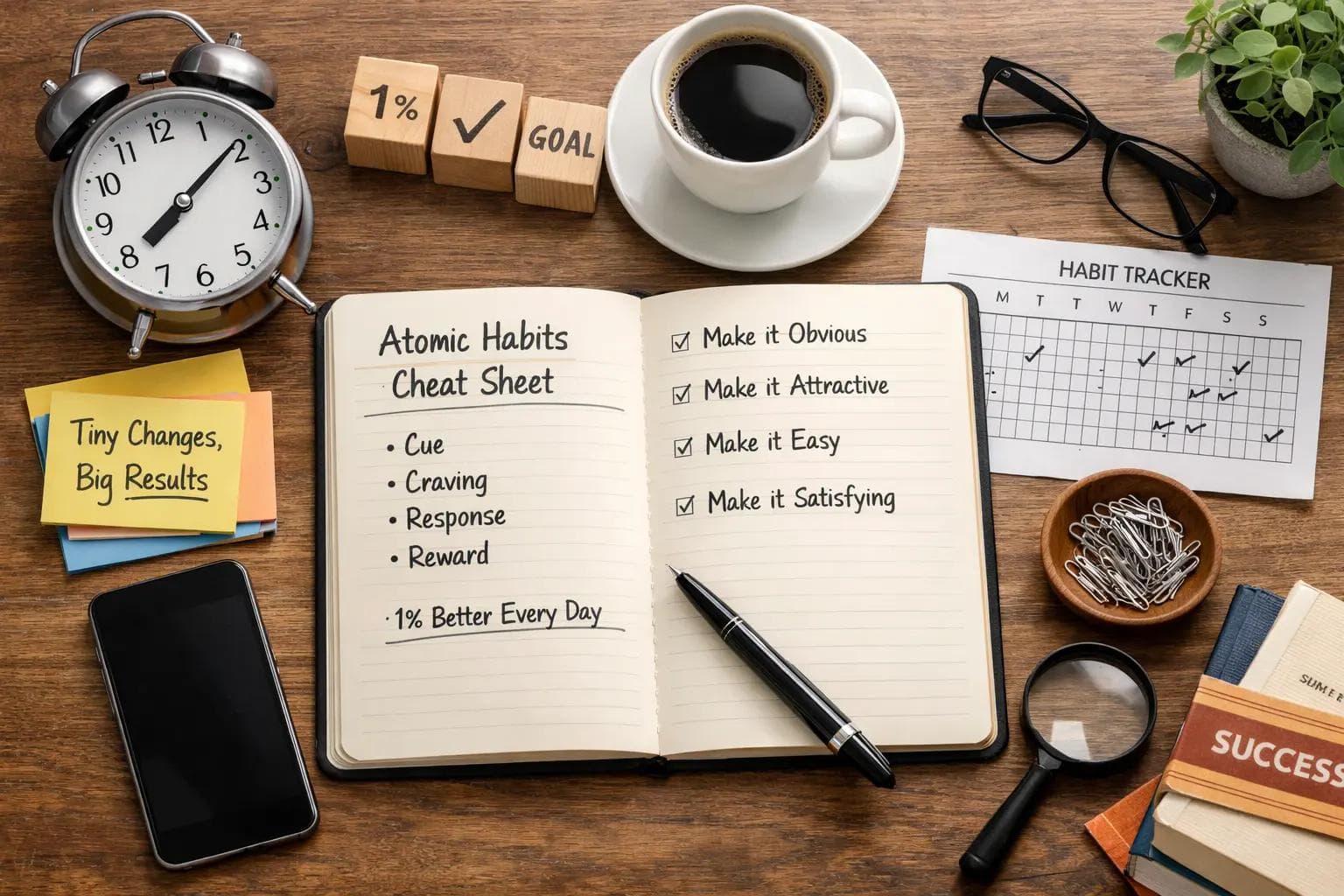
I used to treat my goals like New Year's resolutions on steroids. Every January, I would write down massive, life-changing objectives: "Write a book," "Get six-pack abs," "Learn to code in Python." For three weeks, I would wake up at 5:00 AM, go to the gym, and study for hours.
By February, I was back to sleeping in, eating pizza, and binge-watching TV. I felt like a failure. I thought I lacked willpower. I thought I was just "lazy."
Then I read James Clear’s Atomic Habits. It completely shifted my perspective. I realized my problem wasn't a lack of motivation; it was a lack of systems. I was focused on the destination (the goal) instead of the vehicle (the habit).
If you have ever felt stuck in a loop of starting and quitting, this guide is for you. We are going to break down the core principles of Atomic Habits into a practical, no-nonsense cheat sheet you can use today.
The Core Concept: 1% Better Every Day
The central thesis of Atomic Habits is simple but profound: massive success doesn't come from massive action. It comes from tiny, incremental improvements that compound over time.
Clear calls this the Aggregation of Marginal Gains.
If you get 1% better at something every day for a year, you will end up thirty-seven times better by the time you are done. Conversely, if you get 1% worse every day, you decline nearly down to zero.
In my own life, this meant stopping the attempt to write a whole chapter in one day. Instead, I committed to writing two sentences every morning. Two sentences felt ridiculous. But those two sentences often turned into a paragraph. That paragraph turned into a page. Over a year, that tiny habit built a manuscript.
Identity-Based Habits
Most people try to change by focusing on what they want to achieve (Outcome-based). Clear argues we should focus on who we want to become (Identity-based).
- Outcome: "I want to run a marathon."
- Identity: "I am a runner."
When you identify as a runner, you don't have to force yourself to run. You run because that is what runners do. True behavior change is identity change.
The Four Laws of Behavior Change
The meat of the book—and this cheat sheet—revolves around the "Four Laws." These are the levers you can pull to build a good habit or break a bad one.
The feedback loop of any habit involves four steps: Cue, Craving, Response, and Reward. To build a good habit, we manipulate these steps to make the action easier.
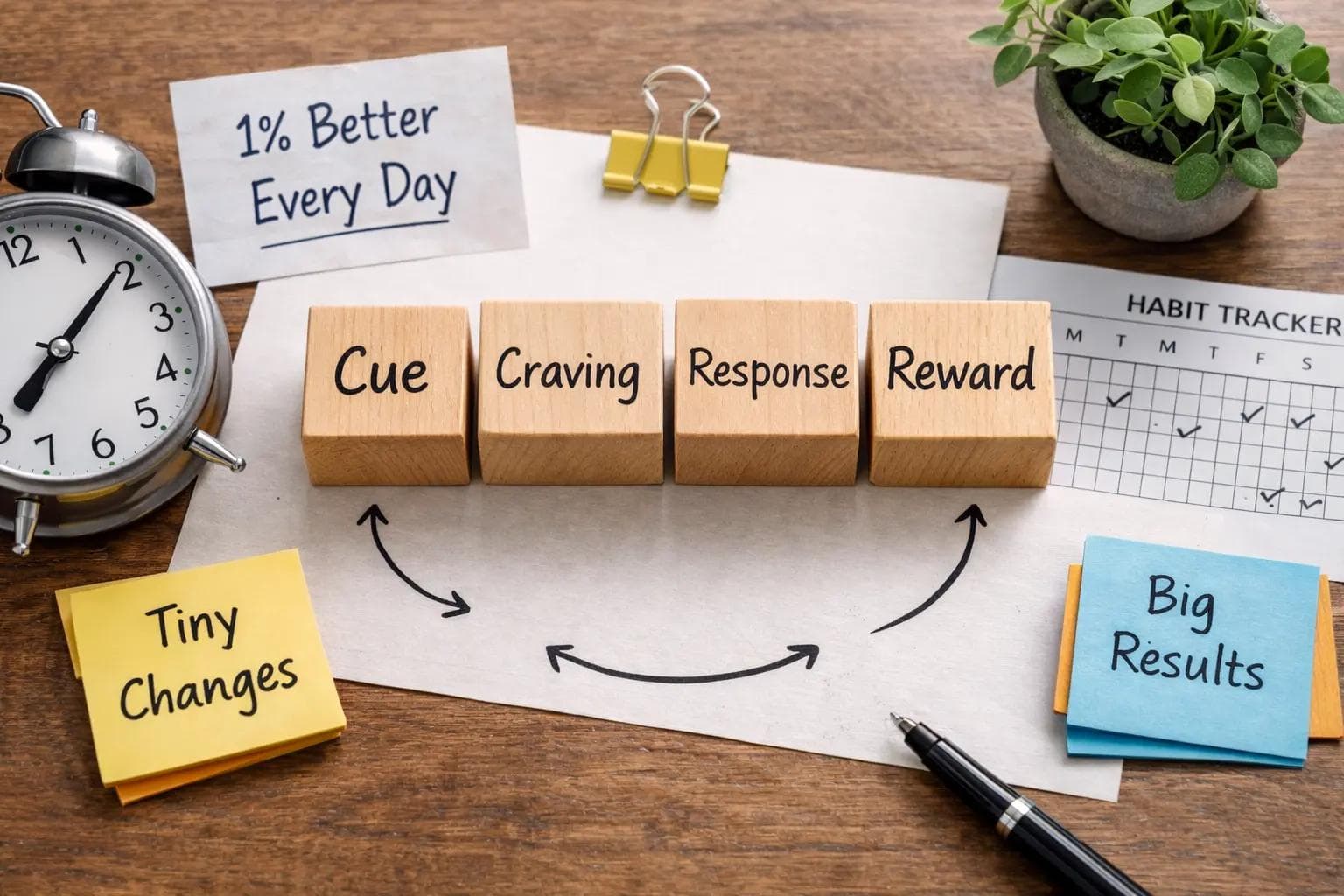
Law 1: Make It Obvious (The Cue)
A habit starts with a trigger. If you want to drink more water, but your water bottle is hidden in a cupboard, you will fail. You need to design your environment so the cue is impossible to miss.
Practical Strategies:
- Habit Stacking: Tie a new habit to an existing one.
- Formula: "After I [Current Habit], I will [New Habit]."
- Example: "After I pour my morning coffee, I will meditate for one minute."
- Environment Design: I used to struggle with eating junk food. Why? Because the cookies were on the counter. I moved the cookies to the highest shelf in the pantry and put a bowl of apples on the counter. Suddenly, I started eating apples.
Law 2: Make It Attractive (The Craving)
We are driven by dopamine. We do things that feel good or promise a reward. If a habit feels like a punishment, you won't stick with it.
Practical Strategies:
- Temptation Bundling: Pair an action you want to do with an action you need to do.
- Example: I only allow myself to listen to my favorite true-crime podcast while I am folding laundry. Now, I actually look forward to laundry day.
- Join the Culture: Surround yourself with people where your desired behavior is the normal behavior. If all your friends are hikers, you will eventually start hiking.
Law 3: Make It Easy (The Response)
This is where I see most people fail. We try to do too much, too soon. We confuse "motion" (planning) with "action" (doing). The key is to reduce friction.
Practical Strategies:
- The 2-Minute Rule: When you start a new habit, it should take less than two minutes to do.
- "Read 30 books" becomes "Read one page."
- "Run 3 miles" becomes "Put on my running shoes."
- This establishes the habit of showing up. You can't improve a habit that doesn't exist.
- Prime the Environment: If you want to work out in the morning, lay out your gym clothes the night before. If you want to draw, keep your sketchbook open and a pen next to it.
Law 4: Make It Satisfying (The Reward)
What gets rewarded gets repeated. What gets punished gets avoided. The problem is that bad habits (smoking, scrolling social media) offer immediate rewards, while good habits (saving money, exercising) offer delayed rewards.
Practical Strategies:
- Immediate Reinforcement: Give yourself a small, immediate reward right after the habit.
- Example: When I finish a deep work session, I allow myself 5 minutes of scrolling Twitter.
- Habit Tracking: Use a calendar or a journal to mark an "X" every day you complete the habit. The visual chain of X's becomes a reward in itself. You don't want to break the chain.
How to Break Bad Habits (The Inversion)
The beauty of the Four Laws is that you can invert them to destroy bad habits. If you are struggling with distraction or unhealthy choices, simply flip the script.
- Make It Invisible (Cue): Hide the phone. Delete the app. Unplug the TV. If you don't see the cue, the craving often never starts.
- Make It Unattractive (Craving): Reframe your mindset. Highlight the benefits of avoiding the bad habit. I tell myself, "I'm not 'depriving' myself of a cigarette; I'm 'saving' my lungs."
- Make It Difficult (Response): Increase friction. I use a website blocker that makes me type a 20-character password to access Facebook. Usually, I'm too lazy to type it, so I get back to work.
- Make It Unsatisfying (Reward): Get an accountability partner. Create a contract where you have to pay a friend $50 if you skip the gym. The immediate pain of losing money outweighs the laziness.
When Atomic Habits Works Best
I have applied these rules to everything from fitness to coding. In my experience, this system shines in three specific areas.
1. Skill Acquisition
Learning a language or a programming framework requires consistency, not intensity. Studying for 20 minutes a day is infinitely better than studying for 5 hours once a week. The 2-Minute Rule is a lifesaver here.
2. Health and Fitness
Physical changes lag behind effort. You can run for two weeks and see no change in the mirror. Atomic Habits helps you focus on the system (running) rather than the result (weight loss), preventing discouragement during the "Valley of Disappointment."
3. Creative Projects
Writing a book or building an app feels overwhelming. Breaking it down into "atomic" units—writing one function, drafting one page—removes the fear.
When It Fails or Feels Frustrating
However, Atomic Habits is not a magic wand. There are times when following the rules can feel rigid or ineffective.
The "Boredom" Trap
Once a habit becomes easy, it becomes boring. This is the greatest threat to success. You stop getting that dopamine hit.
- The Fix: You must fall in love with boredom. The only difference between the professional and the amateur is that the professional shows up even when the work is boring.
The Lack of Urgency
If you have a deadline tomorrow, you don't need atomic habits; you need a sprint. This system is for long-term growth, not emergency crisis management. In a crisis, I switch to the Eisenhower Matrix to prioritize immediately.
Combining with Other Productivity Systems
Atomic Habits is the "engine" of your productivity, but it works even better when paired with other frameworks.
Atomic Habits + The Pomodoro Technique
Pomodoro (25 minutes work, 5 minutes break) is a great way to "Make It Easy."
- Scenario: I don't want to write.
- Habit: I set a timer for 25 minutes.
- Result: The timer reduces the friction of starting.
Atomic Habits + GTD (Getting Things Done)
GTD helps you capture and organize tasks. Atomic Habits helps you actually do them.
- GTD: "Organize garage" is on my project list.
- Atomic Habit: "I will take one box to the recycling bin every time I walk to my car."
Real-World Workflow: A Writer's Routine
To show you how this looks in practice, here is how I used these laws to build a daily writing habit that I have kept for three years.
The Goal: Write one article per week.
- Make It Obvious: I set my laptop on the kitchen table the night before. I can't eat breakfast without moving it.
- Make It Attractive: I brew a specific high-end coffee that I only drink while writing. I crave the coffee, so I sit down to write.
- Make It Easy: My rule is "Write 50 words." That’s it. Anyone can write 50 words. Usually, once I start, I write 500.
- Make It Satisfying: After I write, I mark a big red "X" on my wall calendar. Seeing the chain of X's gives me a sense of pride.
Common Mistakes People Make
I have coached many people through this, and I see the same errors repeated constantly.
1. Focusing on the Goal, Not the System
You obsess over losing 20 pounds. When you step on the scale after a week and only lost 0.5 pounds, you quit. The Lesson: Forget the goal. Focus on the system of eating healthy today. The score takes care of itself.
2. Trying to Change Everything at Once
You try to quit smoking, start running, and learn Spanish all on Monday. By Wednesday, you are exhausted. The Lesson: Change one thing at a time. Let the habit stick before adding another.
3. All-or-Nothing Thinking
You miss one day of the gym, so you think, "Well, I ruined the week," and you skip the next four days. The Lesson: Never miss twice. Missing once is an accident. Missing twice is the start of a new habit. Get back on track immediately.
FAQs
How long does it take to form a habit?
The old myth says 21 days. In reality, studies show it takes anywhere from 18 to 254 days, with the average being about 66 days. It depends on the difficulty of the habit. Don't look for a magic number; just keep going.
What if I have no willpower?
That is the point of the book. Willpower is unreliable. Design your environment so you don't need willpower. If you want to stop checking your phone, put it in another room. That is environment design, not willpower.
Can I use this for bad habits like smoking?
Yes. Use the inversion. Make it invisible (hide the cigarettes), make it unattractive (read about lung disease), make it difficult (don't buy them), and make it unsatisying (bet a friend money you won't smoke).
Is habit tracking necessary?
For the first month, yes. It provides visual proof of your new identity. Once the habit is automatic (like brushing your teeth), you can stop tracking it.
Conclusion: Tiny Changes, Remarkable Results
The most dangerous belief in productivity is that you are one "big break" away from success. We think we need a radical transformation to change our lives.
Atomic Habits teaches us the opposite. You don't need to revolutionize your life overnight. You just need to make a 1% adjustment today, and then do it again tomorrow.
I used to beat myself up for not being perfect. Now, I just focus on showing up. Even if I only do two minutes. Even if it’s messy.
Your Immediate Takeaway:
Don't close this article and promise to change your life "someday." Do this right now:
- Pick one tiny habit you want to start (e.g., flossing one tooth, doing one pushup).
- Use the 2-Minute Rule: Scale it down until it is ridiculously easy.
- Use Habit Stacking: Decide exactly when you will do it ("After I brush my teeth...").
Success is not an event. It is a habit. Start your first rep today.
About the Author

Suraj - Writer Dock
Suraj Kumar is a writer, entrepreneur, and the CEO and founder of this website, sharing simple and practical insights on business, creativity, and personal growth. With experience building digital projects, they enjoy helping others learn, grow, and succeed online.