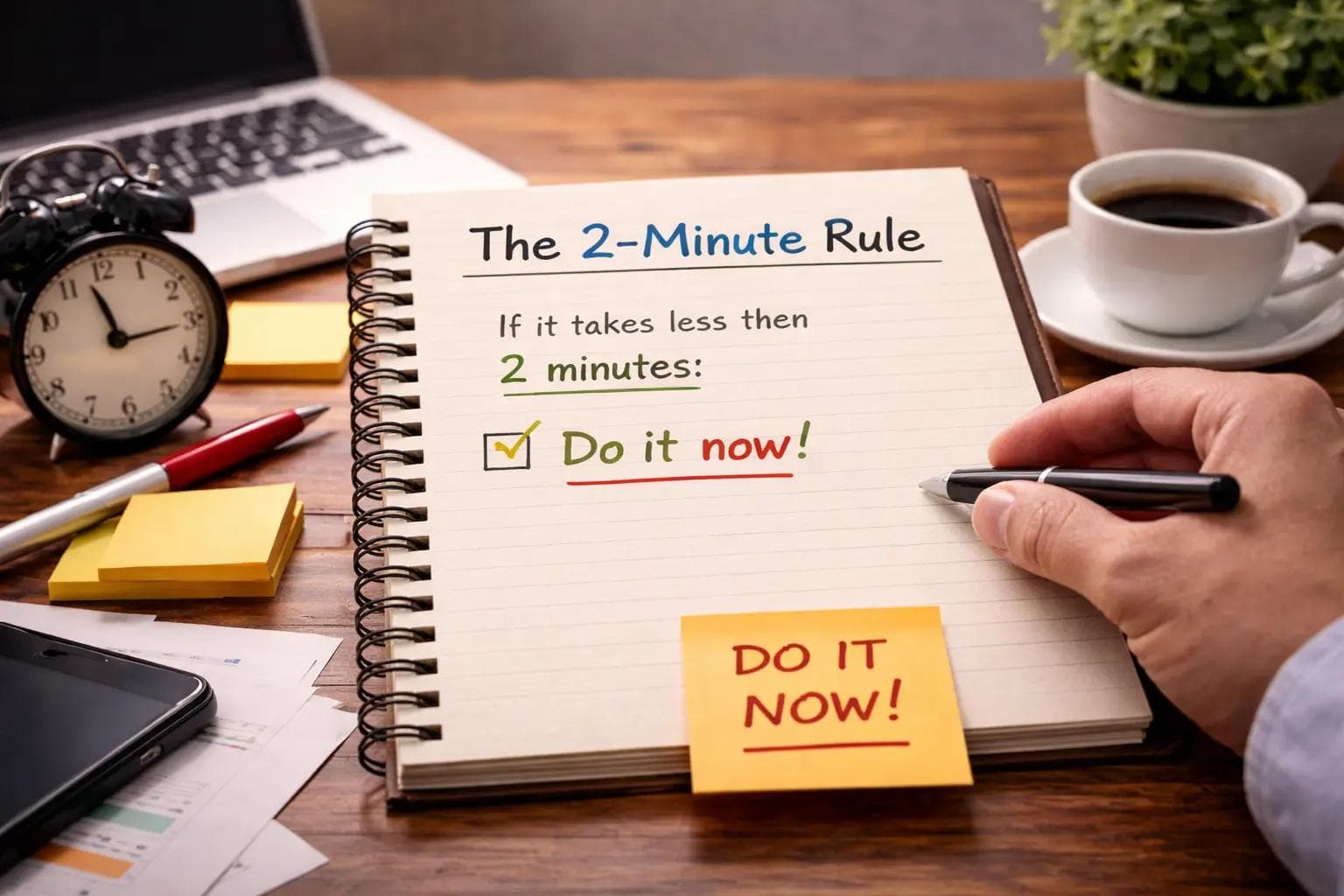
I used to have a "later" pile.
It started as a small stack of mail on the corner of my desk. Then it became a folder in my email inbox labeled "To Process." Eventually, it morphed into a mental list of tiny, nagging obligations that followed me everywhere I went.
I wasn't procrastinating on the big stuff. I delivered my major projects on time. I showed up for meetings. I did the "hard" work.
But I was drowning in the small stuff. The email that needed a quick reply. The dish left in the sink. The appointment I needed to reschedule. Individually, these tasks were harmless. Collectively, they were a heavy anchor dragging down my mental energy.
I felt constantly behind, not because I was lazy, but because I was inefficient with the small moments of my day.
Then I stumbled upon a concept popularized by David Allen in his book Getting Things Done. It was a simple heuristic called the 2-Minute Rule.
It sounds too simple to be effective. I was skeptical, too. But once I adopted it, my "later" pile disappeared, and my brain finally quieted down.
If you feel like you are dying a death by a thousand cuts—overwhelmed by tiny tasks that never seem to go away—this guide is for you. Let’s look at how two minutes can change your entire workday.
What Is the 2-Minute Rule?
The 2-Minute Rule is a strategy to overcome procrastination and laziness by making the barrier to entry so low that you can't say no.
There are actually two different ways to interpret this rule, and I use both of them daily.
Interpretation 1: The "Do It Now" Version (Productivity)
This comes from the Getting Things Done (GTD) methodology. The rule states:
"If a task takes less than two minutes to complete, do it immediately."
Do not write it on your to-do list. Do not defer it. Do not delegate it. Just do it.
Why? Because the time it takes to write the task down, track it, and remember to do it later is often longer than the time it takes to just finish it right now.
Interpretation 2: The "Start It Now" Version (Habit Formation)
This version was popularized by James Clear in Atomic Habits. The rule states:
"When you start a new habit, it should take less than two minutes to do."
You can't run a marathon in two minutes. But you can put on your running shoes. You can't write a book in two minutes. But you can write one sentence.
This version is about overcoming the physics of procrastination. It is about "Gateway Habits" that lead to deep work.
The Psychology: Why It Works
You might be thinking, "I'm a professional. I don't need a trick to help me answer an email."
But you do. We all do. Because procrastination isn't about laziness; it's about emotional regulation and friction.
Overcoming Inertia (Newton’s First Law)
Sir Isaac Newton taught us that an object at rest stays at rest. This applies to productivity. The hardest part of any task is starting.
Once you are moving, it is easy to keep moving. The 2-Minute Rule is the shove that breaks the static friction. By committing to a tiny action, you bypass the brain's fear of a large project.
Reducing Cognitive Load
Every undone task in your life takes up a small amount of RAM in your brain. This is called the Zeigarnik Effect—the psychological tendency to remember uncompleted tasks better than completed ones.
If you have 50 tiny emails you need to reply to "later," your brain is subconsciously scanning those 50 items all day. By using the 2-Minute Rule to clear them immediately, you free up that mental RAM for complex problem solving.
When This Method Works Best
I have found the 2-Minute Rule to be a superpower in specific environments.
1. Processing Your Inbox
This is the classic use case. When I sit down to process email, I go through them one by one.
- Is it a complex request? Defer it (put it on the to-do list).
- Is it a quick confirmation or a simple question? Do it now.
I can usually clear 20 emails in 30 minutes using this method, leaving me with only the 3 or 4 that actually require deep thought.
2. Household Chores
This saved my sanity at home.
- Putting a dish in the dishwasher? Less than 2 minutes.
- Hanging up a coat? Less than 2 minutes.
- Wiping down the counter? Less than 2 minutes.
By doing these instantly, the mess never accumulates. You never have to spend four hours cleaning on Saturday because you spent 2 minutes cleaning twenty times during the week.
3. Starting Intimidating Projects
I often procrastinate on writing technical documentation. It feels boring and huge. So, I use the habit version: "I will spend two minutes opening the document and typing the header." Once the header is typed, I usually keep going. The rule tricked me into starting.
When It Fails or Feels Frustrating
However, the 2-Minute Rule is not a magic bullet. In fact, if you use it at the wrong time, it can destroy your productivity.
The Context Switching Trap
If you are a developer or a writer, you need "Deep Work." You need long stretches of uninterrupted focus.
If you are in the middle of writing complex code, and an email pops up that takes 2 minutes to answer, do not use the 2-Minute Rule.
Why? Because even though the task takes 2 minutes, the "Context Switching" penalty is huge. It takes the human brain about 23 minutes to get back into focus after an interruption. If you answer three "quick" emails, you have lost an hour of focus.
My Rule: Only apply the 2-Minute Rule during dedicated "Admin" or "Processing" blocks. Never use it during Deep Work blocks.
The "Fake Productivity" Loop
It is easy to spend your entire day doing 2-minute tasks. You answer emails, Slack messages, and phone calls. You feel busy. You feel like a hero.
But at 5:00 PM, you realize you haven't touched your major project. You prioritized the urgent over the important.
Comparisons: How It Fits With Other Systems
The 2-Minute Rule is rarely a standalone system. It works best as a "plugin" for other frameworks.
The 2-Minute Rule vs. The Eisenhower Matrix
The Eisenhower Matrix helps you sort tasks into four quadrants based on Urgency and Importance.
- Quadrant 1: Urgent & Important (Do First).
- Quadrant 2: Not Urgent & Important (Schedule).
- Quadrant 3: Urgent & Not Important (Delegate).
- Quadrant 4: Not Urgent & Not Important (Delete).
Where does the 2-Minute Rule fit? It is the filter you use before the matrix. Before you even categorize a task, ask: "Can I do this in 2 minutes?" If yes, just do it. It doesn't need to enter the matrix at all. It handles the "noise" so the matrix can handle the "signal."
The 2-Minute Rule vs. The Pomodoro Technique
The Pomodoro Technique asks you to focus for 25 minutes. I use the 2-Minute Rule to start a Pomodoro.
If I don't want to work, I tell myself, "I will just do this for two minutes." Once I start, I set the Pomodoro timer. The 2-Minute Rule is the ignition; Pomodoro is the engine.
Real-World Workflow: A Developer's Morning
Let’s look at how I apply this in a real morning routine to stay efficient without getting distracted.
08:00 AM - The Brain Dump I look at my phone. I have 15 notifications.
- Slack message from boss: "Can you check this link?" (Takes 30 seconds). I do it.
- Email from client: "Here are the assets." (Takes 10 seconds to download and save). I do it.
- Jira Ticket: "Fix critical bug." (Takes 4 hours). I do NOT do it. I add it to my list.
08:15 AM - The Deep Work I close my email. I close Slack. I start working on the Jira ticket.
- Idea pops up: "I need to pay the internet bill."
- Does it take 2 minutes? Yes.
- Do I do it? NO.
- Why? Because I am in Deep Work. I write it on a notepad to do later.
11:00 AM - The Admin Block I open my notepad. "Pay internet bill." It takes 2 minutes. I do it now.
See the difference? I use the rule to clear the decks before deep work, and I use it to clear the notepad after deep work.
Common Mistakes People Make
I have seen many people try this rule and give up. Usually, it is because they fall into one of these traps.
1. Underestimating Time
We are terrible at estimating time. You think writing that email will take 2 minutes, but it actually takes 10. Then you realize you need to check a spreadsheet, which takes another 10. Suddenly, you have lost 20 minutes.
The Lesson: If you start a "2-minute task" and realize 60 seconds in that it is actually a "10-minute task," stop. Put it on your to-do list and move on. Be ruthless about the time limit.
2. Using It for "Someday" Habits
You can't use the 2-minute rule to achieve a massive goal immediately. You can't "Get fit in 2 minutes." The Lesson: Use the rule to establish the habit, not to get the result. The goal is not to get fit; the goal is to become the type of person who puts on workout shoes every day.
3. Letting Others Dictate Your Day
If you instantly respond to every 2-minute request from coworkers, you teach them that you are always available. They will interrupt you more often. The Lesson: Batch your 2-minute responses. Don't be a buzzer that anyone can press.
FAQ Section
Does it have to be exactly two minutes?
No. It is a guideline, not a law. Some people use a "5-Minute Rule." The point is that the time spent doing it should be roughly equal to the time spent organizing it. If it takes longer to put it in your planner than to finish it, just finish it.
What if I have twenty 2-minute tasks?
If you do them all, that's 40 minutes. That might be your whole morning. In this case, group them. Schedule a "Power Hour" where you do nothing but blast through these small tasks. Don't let them sprinkle throughout your day and interrupt your big projects.
Can I use this for my personal life?
Absolutely. It is the best way to keep a clean house. "Never leave a room empty-handed" is a variation of the 2-Minute Rule. If you see a sock on the floor, pick it up. It takes 5 seconds.
Conclusion: Stop Managing, Start Doing
The modern world is obsessed with "Task Management." We have complex apps, color-coded calendars, and Kanban boards. We spend hours organizing our work instead of actually working.
The 2-Minute Rule is the antidote to over-management. It cuts through the complexity. It reminds you that productivity is ultimately about action, not planning.
I used to have a list of pending tasks that made me feel heavy every time I looked at it. Today, I don't have that list. Not because I do less work, but because I don't let the small things become big things.
Here is your challenge for today:
Look at your to-do list. Look at your unread emails. Look at the messy pile on your desk.
Scan them for anything that takes less than two minutes.
- Sending that confirmation text?
- Paying that bill?
- Filing that document?
Don't prioritize them. Don't schedule them. Don't think about them.
Just do them. Right now.
You will be amazed at how much lighter you feel ten minutes from now.
About the Author

Suraj - Writer Dock
Suraj Kumar is a writer, entrepreneur, and the CEO and founder of this website, sharing simple and practical insights on business, creativity, and personal growth. With experience building digital projects, they enjoy helping others learn, grow, and succeed online.