You have a great idea in the shower. By the time you sit down at your desk, it is gone.
You read a fascinating article, highlight half of it, and never think about it again. You attend a meeting, take notes, and cannot find them three weeks later when you actually need them.
Sound familiar? Most people live this way. And it is not a personal failure — it is just how human memory works. Our brains are excellent at making connections and generating ideas. They are terrible at storing and retrieving specific information on demand.
That is exactly the problem that the "second brain" concept was built to solve.
This guide explains what a second brain is, how personal knowledge management works, and how you can start building your own system in 2026 — whether you are a student, a professional, a writer, or just someone who wants to stop losing good ideas.
What Is a Second Brain?
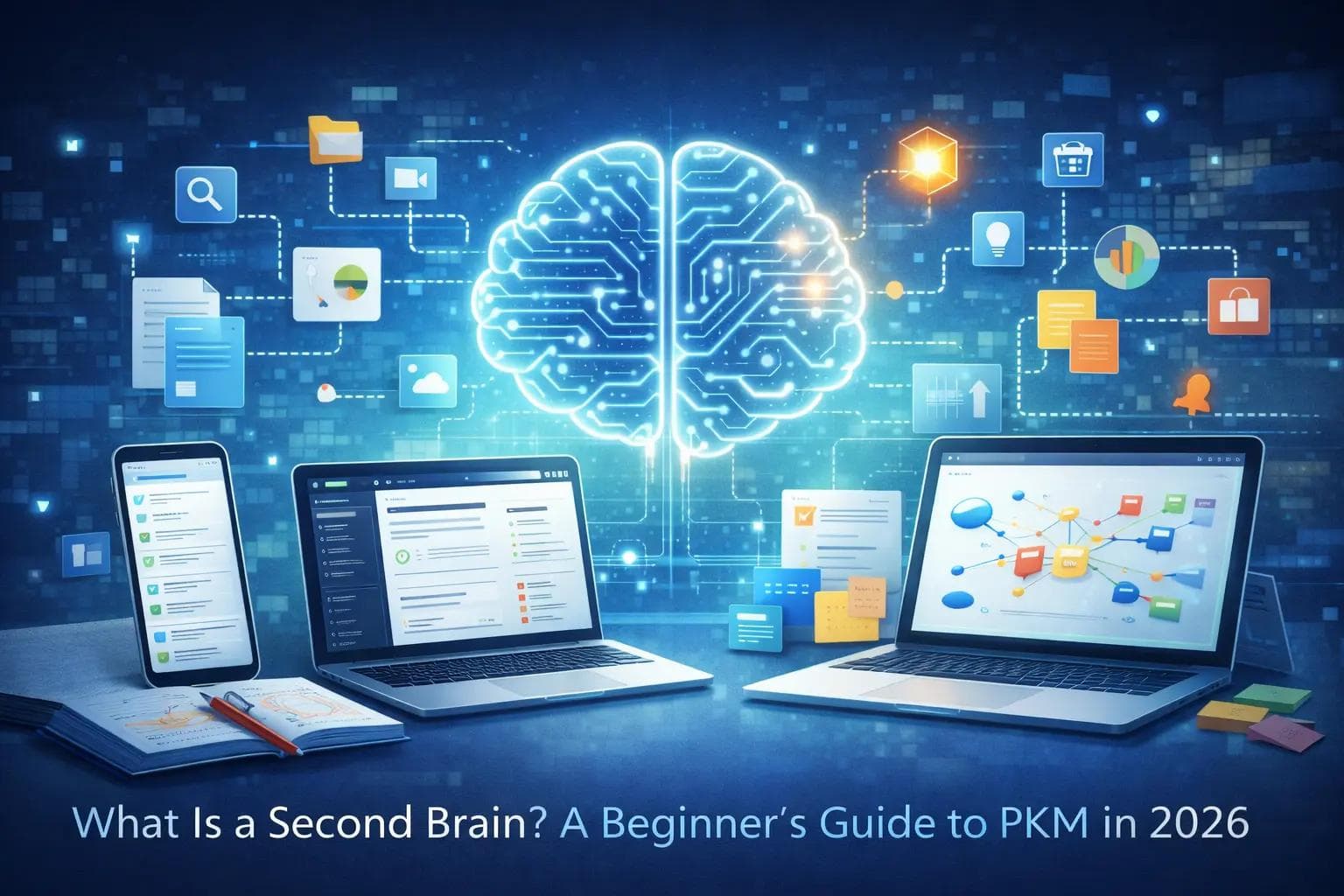
A second brain is an external, organized system where you capture, store, and retrieve information that matters to you. Think of it as a personal digital library — one that grows alongside your thinking and makes your knowledge actually usable.
The term was popularized by productivity expert Tiago Forte, who developed a methodology around it. But the core idea is older than that. Writers have kept commonplace books for centuries. Scientists like Charles Darwin filled notebooks obsessively. The tools have changed; the need has not.
In practical terms, your second brain might live inside a note-taking app, a folder system, a wiki, or a combination of tools. What matters is not the software. What matters is the system behind it.
A second brain does three things your biological brain cannot do reliably:
- It stores information permanently, without decay
- It organizes that information so you can find it later
- It connects ideas across time, topics, and projects
When built well, it becomes more than a filing cabinet. It becomes a thinking partner.
What Is Personal Knowledge Management (PKM)?
Personal knowledge management — usually shortened to PKM — is the practice of collecting, organizing, and using information in a way that serves your goals and projects.
It sounds formal, but it is really just a structured approach to one thing: making sure that what you learn actually sticks around and does something useful.
PKM sits at the intersection of learning and productivity. It is not about reading more. It is about getting more out of what you already read, hear, and experience.
Here is a simple way to think about it:
- Capture: You come across something interesting — save it
- Organize: Put it somewhere logical so you can find it later
- Distill: Extract the core idea, not the whole raw document
- Express: Use that information in your work, writing, or decisions
That four-step cycle — Capture, Organize, Distill, Express — forms the backbone of most PKM systems, including Forte's popular CODE framework.
Why PKM Matters More Than Ever in 2026
The amount of information the average person encounters in a single day is staggering. Articles, podcasts, newsletters, videos, meetings, social posts — the volume never stops.
Most of it disappears. Not because people are careless, but because there is no system in place to catch it.
In 2026, knowledge work has become the dominant form of professional activity. Writers, marketers, developers, consultants, researchers, educators — all of them are paid, essentially, to think well and produce valuable output. A PKM system gives knowledge workers a serious edge.
Beyond professional life, PKM also helps with:
- Learning retention: Revisiting and connecting notes reinforces memory far better than passive reading
- Creative projects: Ideas stored in one place start to cross-pollinate in ways that spark new thinking
- Stress reduction: When you trust your system, your mind stops trying to hold everything — and relaxes
- Decision-making: Accumulated notes on a topic give you better context when it matters most
The people who build strong second brains are not necessarily smarter. They have just built better systems.
The Core Components of a Second Brain
Building a second brain does not require a particular app or a perfect setup from day one. It requires understanding the core components and putting them in place gradually.
1. A Capture System
This is your front door. Anything worth keeping should enter your system quickly and without friction.
The best capture systems are fast. If saving something takes more than thirty seconds, you will stop doing it. Use tools that fit your workflow — a quick inbox note on your phone, a browser extension that clips web pages, a dedicated email address that forwards to your notes app.
The key rule: do not organize at the point of capture. Just save it. Sorting comes later.
2. An Organization Structure
Once information is captured, it needs a home. The most widely used organizational framework for second brains is the PARA method, also developed by Tiago Forte.
PARA stands for:
- Projects: Active tasks with a deadline or defined outcome
- Areas: Ongoing responsibilities without a specific end date (health, finances, relationships)
- Resources: Topics you are interested in or researching (photography, cooking, history)
- Archive: Anything inactive that you want to keep for reference
Here is what that might look like in a folder or note system:
1Second Brain/
2├── Projects/
3│   ├── Launch Website Redesign
4│   ├── Write Annual Report
5│   └── Plan Team Retreat
6├── Areas/
7│   ├── Health & Fitness
8│   ├── Personal Finances
9│   └── Career Development
10├── Resources/
11│   ├── Reading Notes
12│   ├── Productivity Methods
13│   └── Writing Craft
14└── Archive/
15    ├── Completed Projects
16    └── Old Reference Material
This structure keeps things findable. Projects stay separate from long-term interests, and nothing gets buried in a pile of random folders.
3. A Distillation Habit
Raw information is not the same as useful knowledge. A twenty-page PDF dumped into your notes app is not a resource — it is a burden.
Distillation means extracting what actually matters and putting it in your own words. When you read something worth keeping, try this:
- Highlight the one or two sentences that capture the main idea
- Write a two-line summary in your own words
- Note why it matters to you specifically
This extra five minutes transforms passive reading into active learning. And when you revisit that note six months later, your distilled version will make sense immediately.
4. A Review and Retrieval Habit
A second brain you never look at is just a storage unit. The system only becomes valuable when you actually use it.
Build small review habits:
- Weekly: Scan your Projects folder — what moved forward, what is stuck?
- Monthly: Look through your Resources — is there anything worth revisiting or connecting?
- Quarterly: Archive completed projects and clear out anything that no longer serves you
Retrieval is the other side of review. When you are starting a new project, search your second brain first. Chances are you have already captured something relevant that you forgot about. That is the moment the system pays you back.
Popular Tools for Building Your Second Brain
The tool you choose matters less than the system you build. That said, here are the most widely used options in 2026 and what each is best suited for.
Obsidian
Obsidian is a local, markdown-based note-taking tool with powerful linking features. It lets you connect notes together using wiki-style links, building a visual graph of how your ideas relate.
Best for: Writers, researchers, and anyone who wants deep control over their system without depending on a cloud service.
1# Note: The Feynman Technique
2
3## What it is
4A learning method where you explain a concept in simple terms
5to identify gaps in your understanding.
6
7## Why it works
8Simplifying forces clarity. If you cannot explain it simply,
9you do not understand it yet.
10
11## Related Notes
12[[Learning Methods]] [[Active Recall]] [[Teaching as Learning]]
Notion
Notion is a flexible workspace that combines notes, databases, task management, and wikis. It is more visual and beginner-friendly than Obsidian.
Best for: People who want an all-in-one workspace and prefer a clean visual interface.
Logseq
Logseq is an open-source, outline-based tool with a focus on daily journaling and bidirectional linking. Everything lives as bullet points, and connections form naturally through tags and links.
Best for: Daily note-takers who think in lists and want a privacy-first setup.
Apple Notes / Google Keep
For true beginners, the simplest approach works fine. Both tools are fast, always available, and good enough to start capturing information immediately.
Best for: Getting started without overthinking.
How to Start Building Your Second Brain Today
You do not need to set up a perfect system before you begin. Perfection is the enemy of progress here. Start small and build as you go.
Week 1: Choose one capture tool
Pick one place to save things. Just one. It can be a basic notes app. The goal is to create a habit of capturing, not to build the perfect system.
Week 2: Set up your PARA folders
Create four folders: Projects, Areas, Resources, Archive. Move anything you already have into the right category. Do not overthink it — a rough sort is better than no sort.
Week 3: Add distillation to your reading
The next time you read something worth keeping, write a two-sentence summary in your own words before saving it. Do this for one week and see how much stickier the information becomes.
Week 4: Do your first weekly review
Spend fifteen minutes on Friday looking through your Projects folder. What did you work on? What is next? This simple habit brings the whole system to life.
From there, you refine. You add tools, adjust your structure, develop your own workflows. But the core habits — capture, organize, distill, review — are what drive results.
Common Mistakes Beginners Make
Building a second brain sounds simple in theory. In practice, a few patterns trip people up repeatedly.
Over-organizing too early
Spending three hours designing the perfect folder structure before you have anything to put in it is a very common trap. The structure should emerge from real use, not be designed in advance.
Capturing without distilling
Saving hundreds of articles and highlights without ever summarizing or connecting them creates a digital junk drawer, not a second brain. Distillation is what separates useful knowledge from noise.
Choosing the most complex tool first
Obsidian with plugins is powerful. It is also overwhelming for someone just starting out. Begin simple. Complexity can come later when you understand what you actually need.
Never revisiting the system
Notes that sit untouched for months lose their value. Build the review habit early — even if the review is just ten minutes per week.
FAQ: Second Brain and PKM in 2026
Q: Is a second brain just fancy note-taking?
It is much more than storing notes. A second brain is a dynamic system for capturing ideas, connecting knowledge across time, and turning information into output. The review and linking habits are what separate it from a passive folder of saved articles.
Q: Do I need to pay for expensive software?
No. You can build an effective second brain with free tools like Obsidian (free tier), Notion (free tier), or even Apple Notes. The system matters more than the software.
Q: How long does it take to see results?
Most people notice a difference within the first few weeks — mainly the relief of not trying to keep everything in their head. Deeper benefits, like making unexpected connections between old notes, usually show up after two to three months of consistent use.
Q: Can I use a physical notebook as my second brain?
Yes, with limitations. Physical notebooks are excellent for thinking and daily journaling. The challenge is search and retrieval — finding a specific note written eight months ago is much harder on paper than in a searchable digital system. Many people use both: paper for daily thinking, digital for long-term storage.
Q: What if I already have thousands of disorganized notes?
Do not try to organize everything at once. Create your PARA structure, and only move notes into it when you actually need them. New notes get organized properly from day one. Old notes can be migrated gradually — or simply archived and searched when needed.
Conclusion: Your Knowledge Deserves Better Than Your Memory
Your experiences, readings, conversations, and insights have real value. Leaving them scattered across random apps, forgotten highlights, and half-remembered ideas is one of the most overlooked forms of waste in modern life.
A second brain gives all of that a place to live and grow.
The barrier to starting is lower than most people think. One capture tool. Four folders. A few minutes of distillation each week. A short review on Fridays. That is enough to begin.
The goal is not a perfect system. The goal is a working one — a system that gradually makes you sharper, better prepared, and more creative than you would be relying on memory alone.
Your second brain is not built in a weekend. It is built note by note, idea by idea, over time. Start with one note today. The system will grow from there.
About the Author

Suraj - Writer Dock
Suraj Kumar is a writer, entrepreneur, and the CEO and founder of this website, sharing simple and practical insights on business, creativity, and personal growth. With experience building digital projects, they enjoy helping others learn, grow, and succeed online.