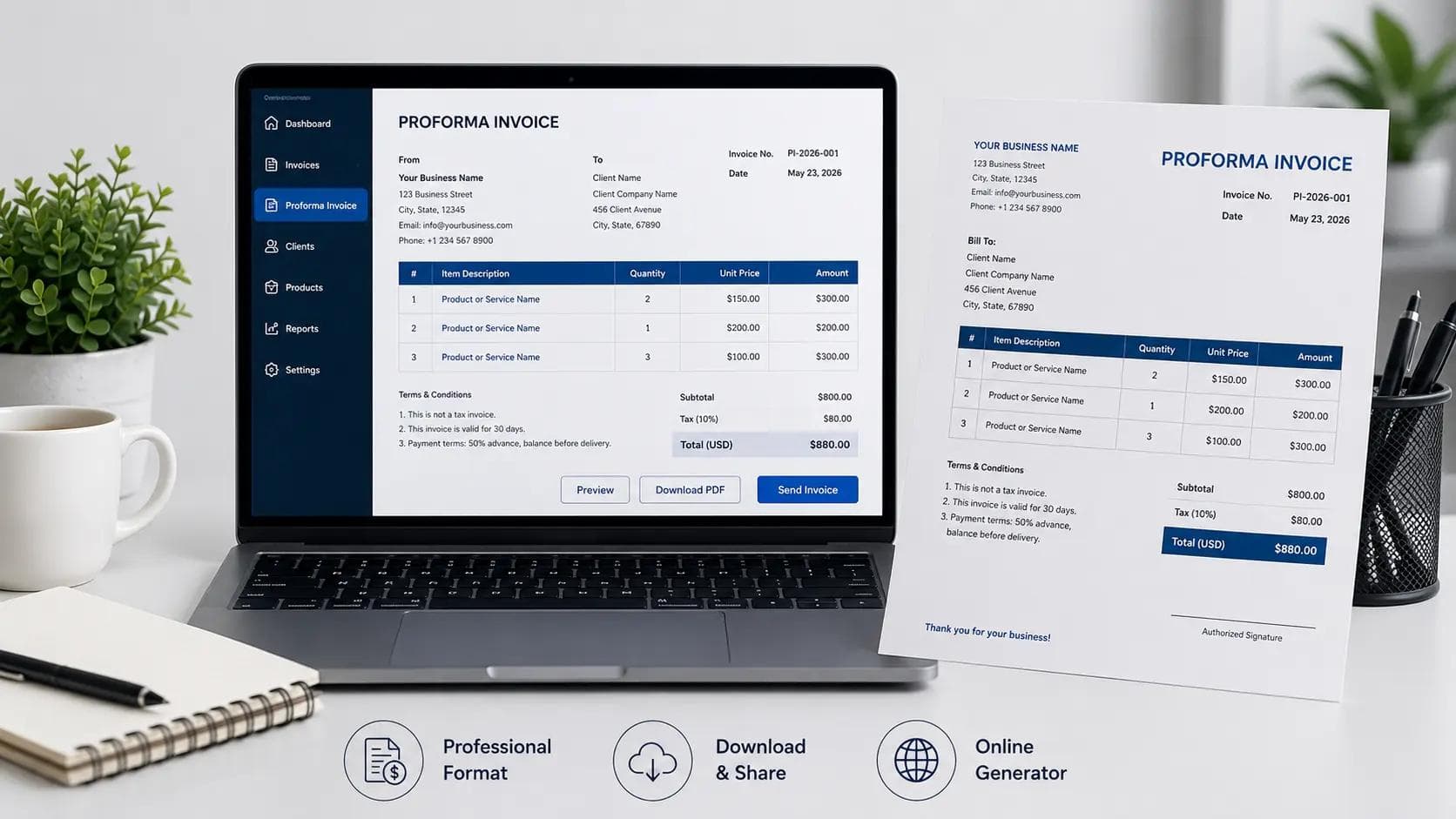
You quote a client, they say yes, and then they ask for "something official before we send the payment." That's the exact moment most freelancers panic and either send a regular invoice too early or wing it in Word. The proforma invoice format exists precisely for that gap — a document that confirms the deal without triggering tax or accounting obligations. This article walks through what a proper proforma invoice actually contains, where people get it wrong, and how to generate one in under two minutes using a free tool instead of rebuilding a template from scratch every time.
What a Proforma Invoice Actually Is (and Isn't)
A proforma invoice is a preliminary bill of sale. It tells a buyer what they're getting, how much it costs, and on what terms — before the deal is finalized and before any money changes hands in most cases. It looks almost identical to a tax invoice, which is exactly why so many freelancers and small business owners get confused about it.
Here's the distinction that actually matters: a proforma invoice is not a legal demand for payment, and it doesn't get recorded in your books as revenue. It's a good-faith estimate. I've had clients ask for a proforma invoice just to get internal budget approval before they even sign a contract — nothing had been agreed yet, but their finance team needed a number on paper.
In my experience, the confusion usually comes from clients using "invoice" loosely. When someone says "send me an invoice" before any work has started, what they usually mean is a proforma invoice — something to justify a purchase order or release funds internally, not a document that puts you on the hook for GST filing.
The Proforma Invoice Format: What Every Section Needs to Include
A clean proforma invoice format has fewer legal requirements than a tax invoice, but skipping sections makes it look unprofessional and can cause payment delays. Here's what should be on it, in order.
Header and labeling. The document must clearly say "Proforma Invoice" at the top — not just "Invoice." This single line prevents a world of accounting confusion later, especially if the client's bookkeeper files it as a real invoice by mistake.
Seller and buyer details. Your business name, address, GSTIN (if registered), and contact details, followed by the client's name and address. If this is an export deal, include the buyer's country and any import reference codes they've shared with you.
Invoice number and date. Use a separate numbering series from your tax invoices — something like PF-2026-001 — so proforma documents never collide with your actual invoice sequence in GST returns.
Itemized description. Line items with quantity, unit price, and subtotal, exactly like a real invoice. Vague descriptions like "consulting services" invite scope disputes later.
Taxes, if applicable. Show estimated GST or applicable taxes even though this isn't a tax document — it gives the buyer a true final cost.
Validity period. A line stating how long the quoted prices are valid, usually 15 to 30 days. Prices change, and without this, you can get stuck honoring an old quote months later.
Payment and delivery terms. Bank details, accepted payment methods, and expected delivery or project timeline.
A clear disclaimer. A short note stating this is not a tax invoice and no payment is due based on this document alone.
Proforma Invoice vs Tax Invoice vs Quotation
These three documents get mixed up constantly, and the differences matter more than people think.
A quotation is the loosest of the three — a price estimate with no fixed format requirement, often just a few lines in an email. A proforma invoice is a formal, invoice-shaped version of that same estimate, used when the buyer needs something more official for internal approval, customs, or a purchase order. A tax invoice is the legally binding document issued after the sale, the one that actually gets reported in your GSTR filings and triggers your tax liability.
A proforma invoice confirms intent to sell; a tax invoice confirms the sale actually happened.
The practical test I use: if money is expected to move because of this document, and it needs to show up in your tax filings, it's a tax invoice. If it's there to get sign-off or satisfy a formality before the deal is final, it's proforma.
When You Actually Need a Proforma Invoice
Not every transaction needs one, and adding unnecessary paperwork slows deals down. A proforma invoice earns its place in a few specific situations.
International or export deals. Customs authorities in many countries require a proforma invoice before goods can even be shipped, since it declares value for duty calculations.
Advance payment requests. When you need part or full payment before starting work, a proforma invoice gives the client something concrete to authorize the transfer against, without you having to book the revenue prematurely.
Corporate procurement processes. Larger clients often need a document to attach to an internal purchase order request before their finance team will release funds. Their internal system frequently won't accept a "quotation" as a valid attachment — it wants something invoice-shaped.
Client-requested cost clarity. Sometimes a client just wants a formal-looking cost breakdown before signing a contract, even for a domestic freelance gig.
Common Mistakes When Creating a Proforma Invoice
I've made most of these mistakes myself in the early days of freelancing, so this list comes from direct experience rather than a textbook.
The biggest one: forgetting to label the document as "Proforma Invoice" and using the same numbering series as real invoices. This causes serious headaches later, because bookkeeping software and clients alike may treat it as a real transaction, inflating your reported revenue or triggering premature tax questions.
Another common issue is omitting the validity period. Without it, a client can come back three months later expecting the original price even though your costs or rates have changed. I now put a bold-faced validity line on every proforma document I send, because I once honored a stale quote for a project that had grown well beyond its original scope.
A third mistake is treating the proforma invoice as optional paperwork and skipping the disclaimer line. Some clients — especially larger companies — will not release any advance payment without that specific "not a tax invoice" statement, because their compliance team needs it on file.
How to Generate a Proforma Invoice Online (Free Tools)
You don't need design software or a finance background to put together a correct proforma invoice format. A few tools handle this well, and each has a slightly different strength depending on your situation.
Google Sheets or Docs templates work fine for a one-off document, but you'll be manually re-entering client details and GST numbers every time, which gets tedious past your third or fourth client.
Zoho Invoice offers a solid free tier with proforma invoice support baked in, and it's a reasonable pick if you're already inside the Zoho ecosystem for other business tools.
Billtrio, the invoicing tool I built after running into these exact formatting problems myself, includes a free proforma invoice generator built specifically around GST fields — GSTIN, HSN/SAC codes, and validity periods are pre-structured so you're not reconstructing the format from scratch each time. I built it after getting tired of manually fixing the same three mistakes across client documents.
Whichever tool you pick, the actionable tip here is simple: save your proforma invoice as a reusable template with your business details pre-filled, so creating the next one takes under two minutes instead of fifteen.
GST and Proforma Invoices: What Indian Freelancers Need to Know
For Indian freelancers and small agencies, GST compliance is where proforma invoices most often go wrong. A proforma invoice, on its own, has no GST reporting obligation — it doesn't need to appear in your GSTR-1 return because no supply has legally occurred yet.
The trouble starts when a proforma invoice is mistaken for a tax invoice at filing time. Once actual payment is received and work begins, you're required to issue a proper GST-compliant tax invoice, and that's the document that goes into your returns — not the proforma. Keeping the two clearly separated, both in labeling and in your numbering series, avoids a mismatch that a GST auditor would flag.
If you're dealing with exports, a proforma invoice is often the document your buyer's customs authority asks for before the shipment clears, separate from the GST tax invoice you'll issue domestically once the export is complete.
Key Takeaways
- A proforma invoice is a preliminary, non-binding cost estimate — not a tax document.
- Label it clearly, use a separate numbering series, and always include a validity period.
- It's most useful for exports, advance payments, and corporate procurement approvals.
- Never let it get filed into your GST returns; only the final tax invoice belongs there.
- Free tools like Zoho Invoice or Billtrio can generate a compliant proforma invoice format in minutes.
Conclusion
Getting the proforma invoice format right comes down to three things: labeling it correctly, separating it from your tax invoice numbering, and including a validity period so old quotes don't come back to haunt you. It's a small document, but getting it wrong creates real GST filing confusion down the line. If you send even a handful of these a month, save yourself the repeated formatting work and generate your next proforma invoice using a free online tool built for this instead of starting from a blank template.
About the Author

Suraj - Writer Dock
Suraj Kumar is a writer, entrepreneur, and the CEO and founder of this website, sharing simple and practical insights on business, creativity, and personal growth. With experience building digital projects, they enjoy helping others learn, grow, and succeed online.