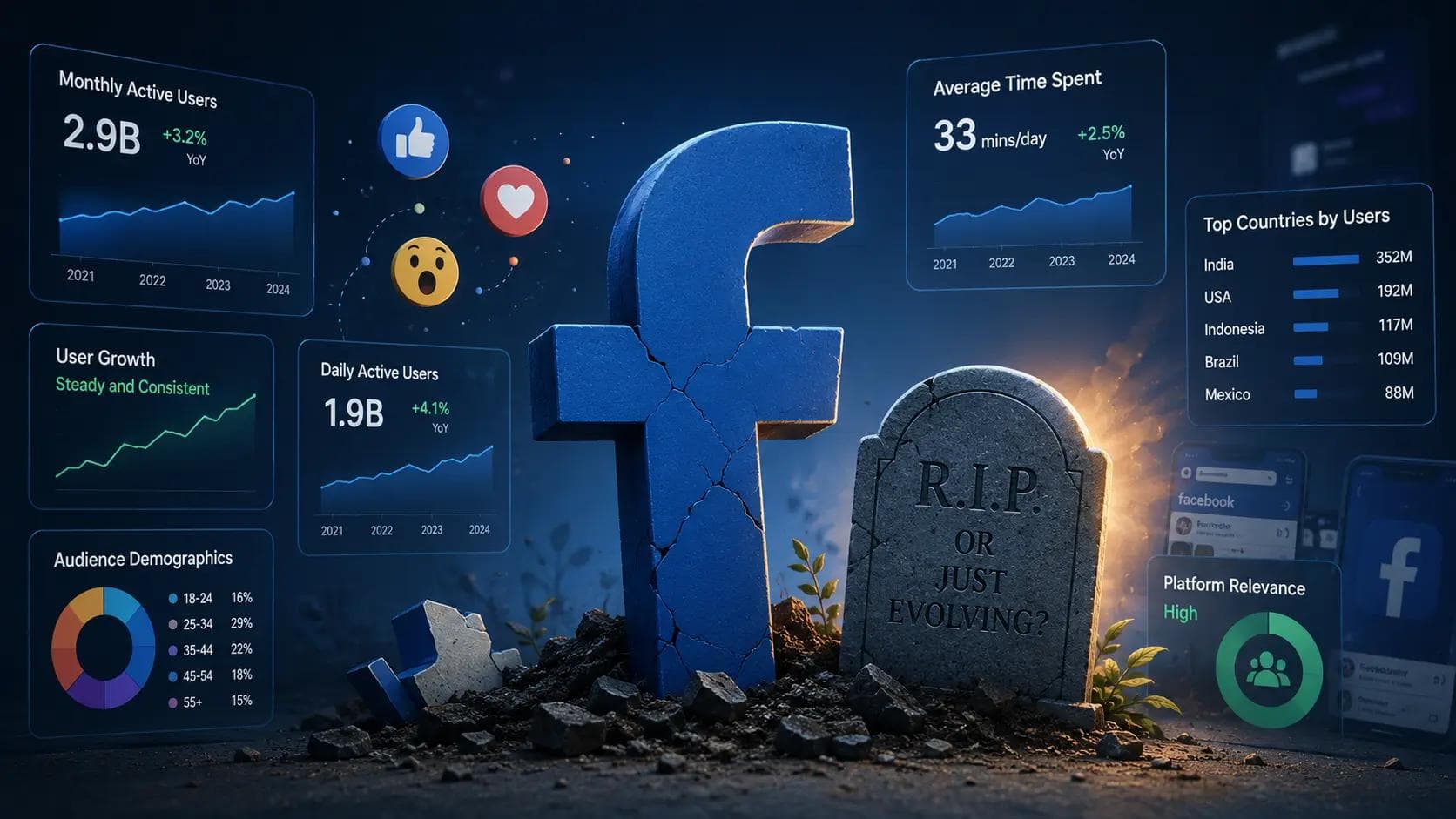
Every few months someone asks me this at a client meeting, half-joking, half-serious: is Facebook dead? The honest answer depends entirely on which Facebook you're asking about — the one your nephew stopped checking three years ago, or the one still pulling in more ad revenue than almost any other platform on earth. Both of those things are true at once, and that contradiction is exactly what this article untangles. By the end, you'll know where Facebook is genuinely shrinking, where it's quietly dominant, and whether it still deserves a spot in your marketing plan.
I manage social channels for a handful of SaaS and freelance clients, and Facebook comes up in nearly every strategy conversation. Nobody asks whether Instagram or TikTok are dead. They ask about Facebook specifically, because the platform has spent almost a decade being declared irrelevant while somehow refusing to disappear.
Why Everyone Assumes Facebook Is Dying
The perception problem is mostly generational. If your own feed is full of 20-somethings, you probably haven't opened Facebook in years, and it's reasonable to assume the whole platform followed you out the door. Younger users left first and left loudest, complaining publicly on other platforms about how "boomer" Facebook had become.
That narrative got repeated so often it hardened into common knowledge, even among people who never checked whether it held up. In my experience, most "Facebook is dead" claims come from people describing their own feed, not the platform's actual numbers.
There's also a media incentive at play. Stories about a scrappy new app dethroning an old giant get more clicks than stories confirming an incumbent is still enormous. That's not a conspiracy, just an editorial pattern worth knowing about before you take any single headline at face value.
The Numbers Say Facebook Isn't Dead — By a Wide Margin
Here's where the "dead" narrative runs into a wall. Facebook still reports over 3 billion monthly active users, making it the largest single social platform in the world, ahead of Instagram, TikTok, and every competitor by a wide margin. Meta's overall ad business generated more than $200 billion in 2025, and Facebook remains a core part of that engine, not a shrinking side project being propped up by Instagram alone.
Facebook Marketplace now draws over a billion monthly shoppers, and roughly one in three Facebook users browses listings each month — a scale most dedicated marketplace apps would envy. Facebook Groups pulls in close to 1.8 billion monthly participants, remaining one of the highest-engagement corners of the entire platform.
None of this looks like a dying product. It looks like a platform that stopped being the place people post personal updates and became something else entirely — a utility layer for buying, selling, and joining communities, sitting quietly underneath the more visible apps people talk about.
Where Facebook Is Actually Dying: Gen Z and Cultural Relevance
The nuance that gets lost in both directions of this debate is that Facebook can be enormous and irrelevant to a specific generation at the same time. Survey data on how different age groups feel about Facebook in 2026 tells a clear story: among 18-to-24-year-olds, only about a quarter consider the platform essential for staying connected, and roughly a third say it plays no role in their social life at all.
Even the 25-to-34 group, once Facebook's core demographic, is drifting. Half of that age bracket now say they prefer other platforms entirely, and close to a third say they simply don't need Facebook anymore. That's not a rounding error — that's an entire cohort quietly opting out of active participation while still technically counting as a "user" because their account exists and gets pinged by a notification once a month.
This is the part of Facebook that's genuinely dead: it's no longer where younger users build their social identity or share daily updates. It survives among that demographic mostly through Marketplace and the occasional Reel, not through the feed-and-friends model that originally made it famous.
What's Actually Keeping Facebook Alive
Three specific product bets explain why Facebook's overall numbers stayed strong instead of collapsing along with its youth appeal.
Reels absorbed the short-form video shift instead of ignoring it, and Gen Z users who do open the app now spend the majority of their time there watching video rather than scrolling status updates. Groups turned Facebook into a utility for hobbyist communities, local buy-and-sell circles, and parenting or neighborhood networks that never had a strong reason to migrate anywhere else. Marketplace quietly became one of the biggest social commerce surfaces in the US, competing directly with dedicated classifieds apps.
Each of these is a different product wearing the same login screen. A teenager ignoring their feed and a 45-year-old actively posting in three local Groups are both counted as the same "monthly active user," which is part of why the raw numbers and the vibe on the ground feel so disconnected from each other.
The Ad Business: Why Marketers Can't Write Facebook Off
I'll be direct here: if you run paid social for a client and you're skipping Facebook because "it's for old people," you're leaving reach and often cheaper cost-per-click on the table. Average cost-per-click on Facebook still sits around a dollar across most industries, and organic Reels content on the platform is outperforming standard video posts by a meaningful margin.
Older demographics aren't a consolation prize, either. Adults aged 30 to 49 remain Facebook's most active US age bracket, and that group has real, often growing, purchasing power. A common mistake I see newer marketers make is assuming Facebook ad budget should shrink every year by default — when for plenty of B2B and local-service clients, it's still one of the highest-ROI channels available precisely because younger competitors have abandoned it there.
The actionable move: before cutting Facebook spend, check your own audience's actual age distribution in Meta Business Suite rather than assuming your target demographic mirrors the loudest voices online.
So — Is Facebook Dead?
No, not in any way the data supports, but the version of Facebook that's alive is not the version most people picture when they ask the question. It's not the friends-and-status-updates network anymore. It's closer to a hybrid of a marketplace, a community forum, and a video feed, held together by an ad engine that still works extremely well.
Facebook isn't dying — it's being quietly repurposed by the generation that never left, while a new generation mostly ignores it.
That distinction matters more for strategy than a simple yes-or-no answer ever could. Treating Facebook as dead means missing real reach among adults 30 and older. Treating it as unchanged means missing the fact that it's lost its grip on culture entirely.
Key Takeaways
- Facebook still has over 3 billion monthly active users and remains the largest social platform globally.
- Gen Z engagement has collapsed — most 18-to-24-year-olds don't consider it essential anymore.
- Marketplace, Groups, and Reels are the three products keeping overall usage numbers strong.
- Ad performance and cost-per-click remain competitive, especially for reaching adults 30 and older.
- The right question isn't "is Facebook dead," it's "is Facebook right for this specific audience."
Conclusion
Is Facebook dead? Not by the numbers, and not for advertisers targeting anyone over 30 — but it's functionally dead as a cultural hub for the generation currently defining what's next online. The real mistake is treating this as a single yes-or-no question instead of checking where your own audience actually falls. If you manage a brand's social presence, pull your Meta Business Suite demographics this week before deciding whether to cut or keep your Facebook budget. The platform rewards people who look at their own data instead of repeating what everyone else assumes.
Frequently Asked Questions
Is Facebook dead in 2026?
No. Facebook still reports over 3 billion monthly active users and remains the largest social platform worldwide by that measure. It has, however, lost significant relevance among users under 25, who increasingly treat it as optional rather than essential.
Why do people think Facebook is dying?
Mostly because younger users left first and left visibly, complaining about the platform on other apps. That created a strong public narrative of decline even though the platform's overall user base and ad revenue kept growing throughout that same period.
Is Facebook still worth using for business marketing?
Yes, particularly for reaching adults 30 and older, local audiences, and Marketplace shoppers. Cost-per-click remains competitive, and Reels content is currently outperforming standard posts, making the platform still relevant for many advertising goals.
What age group still uses Facebook the most?
Adults aged 30 to 49 are the most active US demographic on Facebook, followed closely by the 50-to-64 group. Older users also show more consistent long-term habits than younger cohorts, who tend to log in less predictably.
Are people quitting Facebook Groups too?
No — Groups is one of the platform's strongest areas, with close to 1.8 billion monthly participants. Community-based, interest-specific spaces have held up far better than the general news feed, which is where most disengagement is concentrated.
Should I remove Facebook from my social media strategy entirely?
Only if your target audience skews heavily under 25 with no interest in Marketplace or community Groups. For most other audiences, especially local businesses and B2B brands, Facebook still delivers reach and ad performance worth keeping in the mix.
Related Articles
About the Author

Suraj - Writer Dock
Suraj Kumar is a writer, entrepreneur, and the CEO and founder of this website, sharing simple and practical insights on business, creativity, and personal growth. With experience building digital projects, they enjoy helping others learn, grow, and succeed online.