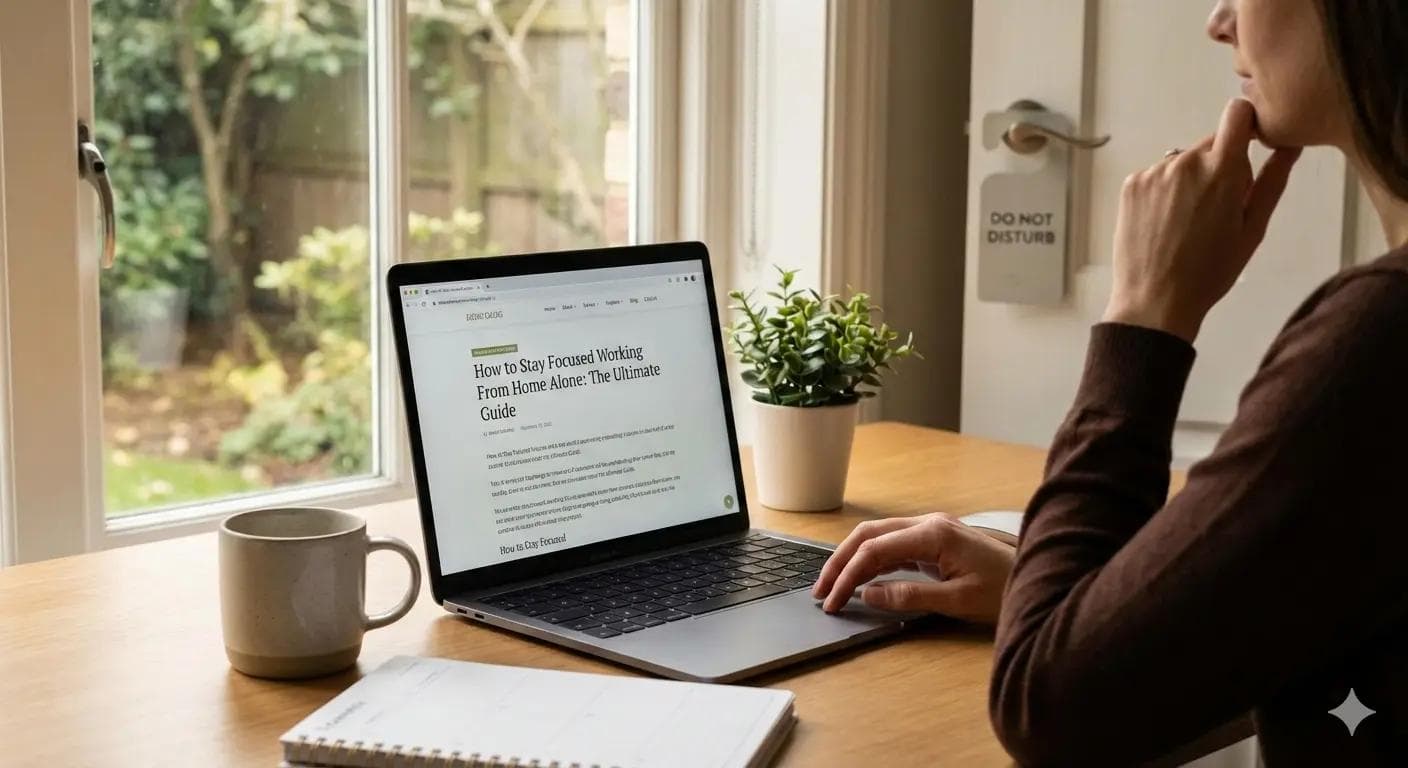
Introduction: The "Freedom" Trap
I remember the first week I started working remotely. It felt like I had hacked the system. No commute, no dress code, and full control over my schedule. I imagined myself being hyper-productive, finishing my work by 2 PM, and spending the rest of the day learning a new language or going for long runs.
Fast forward three months, and the reality was very different. I was still in my pajamas at 4 PM. I had opened the fridge twelve times in the last hour. I was working late into the night because I had spent the morning scrolling through social media. I felt busy, but I wasn't getting anything done.
If this sounds familiar, you are not alone. By 2026, working from home has become the standard for millions of us, but the novelty has worn off. We are now facing the real challenge: how do you maintain discipline when no one is watching?
In this guide, I want to share the practical strategies I used to go from a distracted, anxious freelancer to a focused, high-performing remote worker. We aren't going to talk about generic advice like "make a to-do list." We are going to talk about psychology, environment design, and biological hacks to keep your brain locked in.
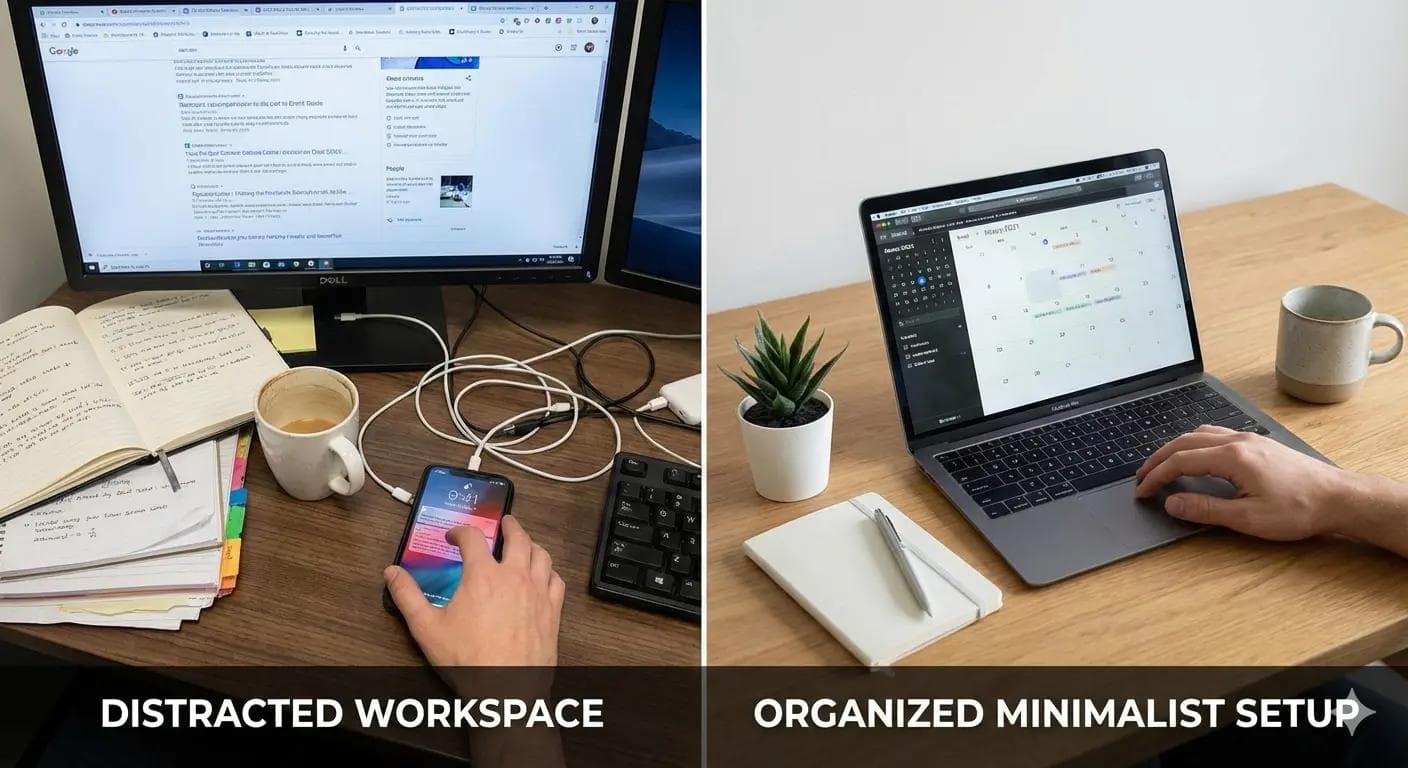
The Psychology of the "Empty House"
To fix your focus, you first have to understand why you are losing it. When you work in an office, you rely on "social friction" to keep you on track. You don't watch Netflix at your desk because your boss might walk by. You don't take a two-hour nap because your colleagues would notice.
When you are home alone, that external pressure vanishes. You are the CEO and the employee at the same time. The CEO wants to work, but the employee wants to play video games.
The secret to staying focused isn't willpower. Willpower is a battery that runs out by lunch. The secret is building a system that makes focusing easier than getting distracted. You have to design your day so that working is the path of least resistance.
1. Design Your Environment for "Deep Work"
The biggest mistake I see new remote workers make is treating their whole house as their office. They answer emails in bed, take calls on the couch, and write reports at the kitchen table.
This creates "context confusion." Your brain associates your bed with sleep and your couch with relaxation. If you try to work in those places, your brain will fight you.
Create a Dedicated Workspace
You don't need a separate room, though that helps. You just need a dedicated zone. It could be a specific corner of a room or even a specific chair at the dining table.
The Golden Rule: When you sit in this chair, you work. When you stop working, you must leave the chair.
I once lived in a small studio apartment where I didn't have space for a desk. I used a specific placemat at my dining table. When the placemat was out, it was office time. When I put it away, work was over. This physical trigger told my brain it was time to switch modes.
Control Your Sensory Input
Offices are designed for work. Homes are designed for comfort. To focus, you might need to change the sensory input of your room.
- Lighting: I use a bright, cool-toned lamp when I work. It mimics daylight and keeps me alert. In the evening, I switch to warm, dim light to signal rest.
- Sound: Silence can be deafening when you are alone. It allows your mind to wander. I use "Brown Noise" or instrumental lo-fi beats to create a consistent background texture that drowns out the hum of the refrigerator or the traffic outside.
2. Master the "Digital Commute"
One of the things I missed most when I left the office was the commute. Not the traffic, but the ritual. The drive to work allowed me to mentally prepare for the day. The drive home allowed me to decompress.
When you work from home, the distance between your pillow and your laptop is ten seconds. There is no ramp-up time.
You need to manufacture a "Digital Commute." This is a series of actions that signals to your body that the workday has started.
My Morning Routine Example:
- Shower and dress: I never work in sweatpants. Putting on jeans and shoes (yes, shoes inside the house) changes my posture and mindset.
- The "Fake" Commute: I walk out my front door, walk around the block once, and come back in. It sounds silly, but that breath of fresh air and physical movement resets my brain.
- The Startup Ritual: I pour my coffee, sit at my desk, and write down my top three goals for the day. Only then do I open my laptop.
Find a sequence that works for you and perform it religiously. It creates a Pavlovian response where your brain starts focusing simply because you put on your shoes.
3. Manage Your Dopamine Levels
In 2026, the biggest enemy of focus isn't noise; it's dopamine. Your phone, social media, and news feeds are engineered to be more interesting than your spreadsheet.
If you start your day by scrolling through your phone in bed, you are flooding your brain with cheap dopamine. When you finally sit down to do deep work, the task feels boring and painful by comparison. This is why you feel that magnetic pull to pick up your phone every five minutes.
The "Phone Foyer" Method
I have a strict rule: My phone does not enter my workspace. I leave it on a charger in the hallway or the kitchen.
If I need to check it, I have to physically get up and walk to another room. This adds friction. Most distractions happen because they are effortless. If you make the distraction hard to reach, you will do it less often.
Use Browser Blockers
I rely heavily on software to protect me from myself. I use website blockers to lock me out of news sites and social media during my core work hours (9 AM to 1 PM). Do not rely on self-control. Outsourcing your discipline to software is a smart move.
4. The Power of Time Blocking and Energy Management
A common trap when working alone is the "marathon mentality." You sit down at 9 AM and try to grind until 5 PM without stopping.
By 2 PM, your brain is mush. You are staring at the screen, but nothing is happening.
Humans operate in "Ultradian Rhythms"—cycles of high energy followed by low energy. Usually, we can focus intensely for about 90 minutes before we need a break.
The Modified Pomodoro Technique
You have probably heard of the Pomodoro technique (25 minutes work, 5 minutes break). In my experience, 25 minutes is too short for complex tasks like coding or writing.
I prefer 50/10 or 90/20 splits.
- Focus Block (50 mins): Phone away, email closed, single task only.
- Recharge Block (10 mins): Step away from the screen. Do not scroll social media. Look out a window, stretch, or wash a dish.
Eat the Frog
There is a productivity concept called "Eating the Frog." It means doing your hardest, most intimidating task first thing in the morning.
When you are alone, procrastination is easy. If you put off the hard task, it hangs over you all day, draining your energy. I tackle my biggest task before I even check my email. To identify that task, I use the Eisenhower Matrix to separate the urgent busywork from the truly important goals. Once "the frog" is eaten, the rest of the day feels easy.
5. Combatting Isolation and "Drift"
Loneliness is the silent killer of productivity. When you don't speak to anyone for eight hours, you can start to feel detached. This leads to "drift," where you lose motivation and purpose.
The Concept of "Body Doubling"
Body doubling is a technique often used by people with ADHD, but it works for everyone. It involves working alongside someone else, even if you aren't talking. The presence of another person creates a subtle accountability field.
Since you are at home, you can do this virtually.
- Virtual Co-working Spaces: There are platforms where you can join a video call with strangers who are also working. Everyone is on mute, but seeing others focused helps you stay focused.
- The Accountability Partner: I have a friend who also works from home. We text each other at 9 AM: "I am writing the report." We text again at noon: "Report done." Knowing I have to send that second text keeps me honest.
6. Establish a Hard "Shutdown" Time
One of the paradoxes of working from home is that you often end up working more, not less. Without a train to catch or a janitor turning off the lights, work bleeds into your evening.
If your brain knows that work could last forever, it will pace itself. It will allow you to be distracted because "I can just finish this tonight."
If you set a hard stop at 5:00 PM, you create scarcity. You force yourself to be efficient because you know the clock is ticking.
My Shutdown Ritual
At 5:00 PM, I do the reverse of my morning routine:
- Close all tabs: I close every window on my computer.
- Tidy the desk: I put away my notebook and pens.
- The Transition: I change out of my "work clothes" and into comfortable clothes.
- Physical separation: I leave the workspace and go for a walk or start cooking.
This tells my brain: "We are done. You can relax now."
Common Mistakes to Avoid
In my years of remote work, I have made every mistake in the book. Here are the ones that will derail you the fastest.
- Grazing All Day: Working near the kitchen makes it easy to snack constantly. This causes blood sugar spikes and crashes, leading to brain fog. Schedule your lunch and snacks just like you would in an office.
- Working from Bed: I cannot stress this enough—do not do it. It ruins your sleep hygiene and kills your productivity posture.
- Checking Email First: If you open your inbox the moment you wake up, you are starting your day in "reactive" mode. You are solving other people's problems instead of prioritizing your own.
- Ignoring Ergonomics: In the office, you likely had a decent chair. At home, working from a dining chair will destroy your back. Invest in a good chair and a monitor stand. Physical pain is a massive distraction.
FAQ Section
How do I handle family or roommates interrupting me?
You need a "Do Not Disturb" signal. It could be a closed door, or if you don't have a door, wearing noise-canceling headphones. Teach your household that headphones on means "I am at work, do not speak to me unless the house is on fire."
What if I have a slow day and get nothing done?
Forgive yourself. It happens in the office too; you just don't notice it as much because you are "at work." If you are having a terrible focus day, stop fighting it. Take a long break, reset, and try to get just one meaningful thing done.
Should I listen to music or podcasts while working?
Podcasts and lyrical music are generally bad for deep work because your brain tries to process the words. This competes with your internal thought process. Stick to instrumental music, video game soundtracks, or white noise for heavy concentration tasks.
Conclusion: It’s a Skill, Not a Talent
Staying focused while working from home alone is not a personality trait. It is a skill that you build.
I remember thinking I was "lazy" because I couldn't focus at home. I wasn't lazy; I just had a bad system. I was trying to rely on willpower in an environment designed for relaxation.
Once you start viewing your environment and your routine as tools that you can manipulate, everything changes. You stop fighting against yourself.
Here is my challenge to you for tomorrow:
Don't try to implement everything in this guide at once. Start with just one thing: The Digital Commute.
Tomorrow morning, wake up, get dressed in real clothes, walk around the block, and sit down at a dedicated spot with a plan. You will be amazed at how much that simple shift changes your ability to focus.
The freedom of working from home is incredible, but only if you have the discipline to handle it. Take control of your space, and you will take control of your work.
About the Author

Suraj - Writer Dock
Suraj Kumar is a writer, entrepreneur, and the CEO and founder of this website, sharing simple and practical insights on business, creativity, and personal growth. With experience building digital projects, they enjoy helping others learn, grow, and succeed online.