I remember sitting in a project kickoff meeting early in my career. The client was excited, waving their hands and saying, "The app needs to let users upload photos, send messages, and buy products!" We all nodded and started scribbling down notes. We felt like we had a perfect plan.
Three months later, the app launched. It did exactly what the client asked: users could upload photos and buy things. But there was a massive problem. The photo upload took forty-five seconds. The search bar crashed if more than ten people used it at once. The "Buy" button worked, but the site was so slow that nobody stayed long enough to click it.
That was the day I learned the hard way that a successful product isn't just about what it does. It is just as much about how it behaves. In the industry, we call these Functional and Non-Functional Requirements.
If you want to build software that users actually love (and that doesn't keep you awake at 3:00 AM fixing crashes), you need to master both. Let’s walk through this together.
The Simple Breakdown: What vs. How
At its simplest level, the difference between these two is straightforward:
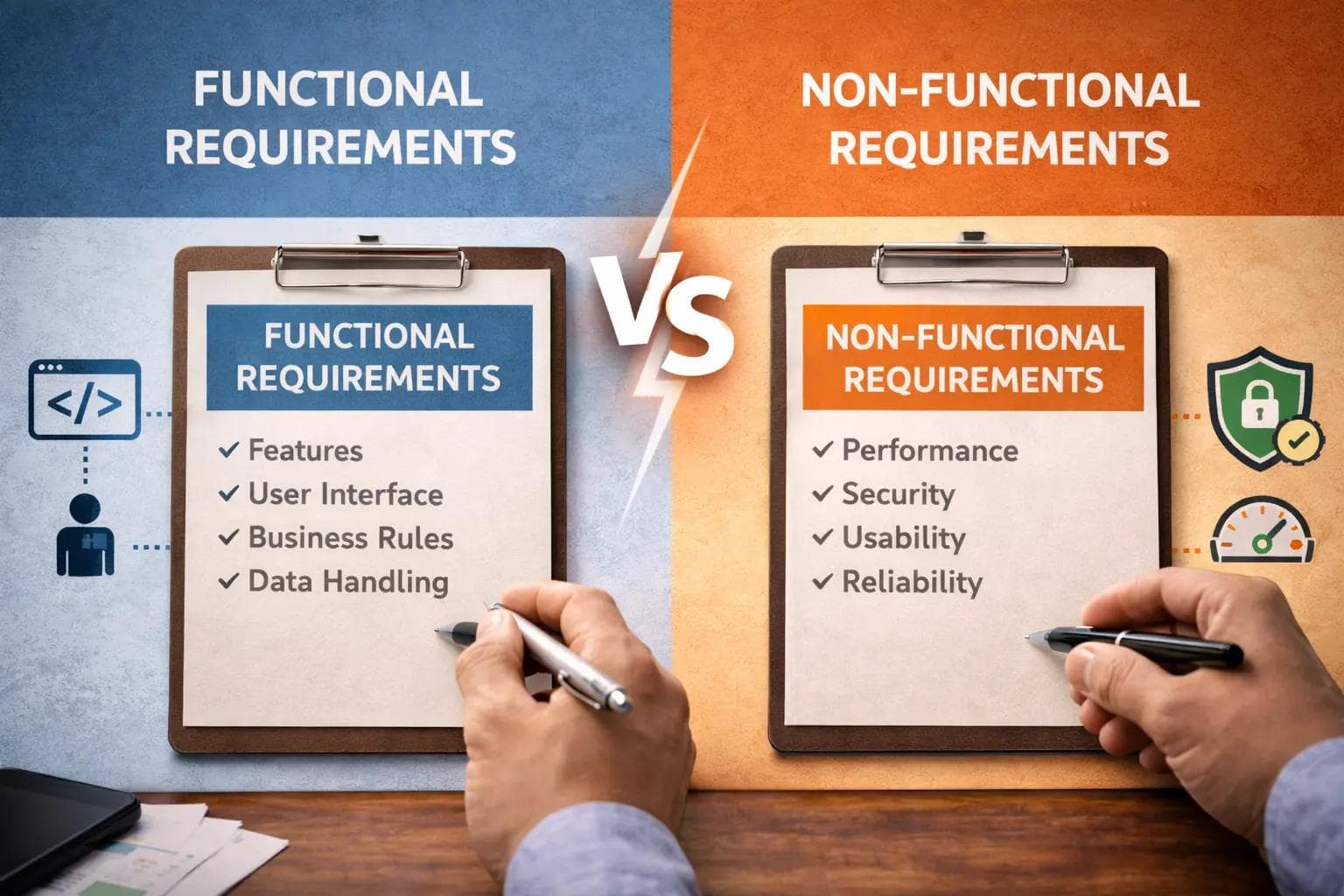
Functional Requirements define what the system does. They are the specific features or functions. If you think of a car, the functional requirements are things like: the car must steer, it must brake, and it must have headlights that turn on.
Non-Functional Requirements (NFRs) define how the system is. They describe the qualities, constraints, and characteristics of the system. Sticking with the car analogy, these are things like: the car should go from 0 to 60 mph in six seconds, it should be painted blue, and it should be safe in a collision.
I often see teams ignore the "how" because they are so focused on the "what." But I’ve seen enough projects fail to tell you that a feature that doesn't perform well is effectively a broken feature.
Diving Deep into Functional Requirements
Functional requirements are the backbone of your project. They are usually the easiest to identify because they come directly from the user's needs. When a product manager hands you a list of "User Stories," they are giving you functional requirements.
Characteristics of Good Functional Requirements
In my experience, a functional requirement is useless if it’s vague. I always look for three things:
- Precision: It should clearly state the input and the expected output.
- Verifiability: Can I write a test case for this? If I can’t prove it works, it’s not a requirement.
- Completeness: It should cover the "happy path" (what happens when things go right) and the "edge cases" (what happens when a user types a letter in a phone number field).
Common Examples
Let’s look at a few real-world examples I’ve dealt with recently:
- Authentication: "The system shall allow users to log in using an email address and a password."
- Transaction Processing: "The system shall send a confirmation email within 60 seconds of a successful purchase."
- Data Export: "The admin must be able to download the monthly sales report in CSV format."
These are "binary" requirements. Either the system does them, or it doesn't. There isn't much room for debate.
The World of Non-Functional Requirements (The "Ilities")
Non-functional requirements are often called "Quality Attributes." In the dev world, we often refer to them as the "Ilities" because so many of them end in those letters.
While functional requirements are the "bones" of the software, NFRs are the "nerves" and "muscles." They determine if the user experience is smooth or frustrating.
Scalability
Can the system handle growth? If your app works for 100 users, will it work for 100,000? I’ve seen many startups die because they built a functional product that couldn't scale when they finally got featured on a major news site.
Performance (Speed)
How fast does the system respond? We usually measure this in milliseconds. A common NFR I write is: "The homepage must load in under two seconds on a 4G connection."
Availability (Uptime)
How often is the system "up"? You’ve probably heard of "five nines" (99.999% uptime). This is a non-functional requirement that dictates how much you invest in backup servers and failover systems.
Security
This isn't just "the app has a login." It’s "all data must be encrypted at rest and in transit." It’s about how the system handles threats and protects privacy.
Why Do We Tend to Ignore Non-Functional Requirements?
I’ve asked myself this many times. Why do smart teams keep forgetting about NFRs?
The reason is that functional requirements are "visible." You can see a button. You can see a login screen. You can show a demo of a new feature to a stakeholder, and they will applaud.
You can't "demo" scalability very easily. You can't show a stakeholder a "lack of crashes." Because NFRs are often invisible until things go wrong, they get pushed to the bottom of the priority list.
In my experience, the cost of fixing a functional bug is relatively low. But the cost of fixing a non-functional flaw—like a system that wasn't designed to be secure—often requires a complete rewrite of the architecture.
Capturing Requirements: The Whiteboard Strategy
When I’m starting a new project, I like to draw a line down the middle of a whiteboard. On one side, we list the "Action Items" (Functional). On the other, we list the "Standards" (Non-Functional).
How to Write Them Down
Don't just say "The app should be fast." That’s a wish, not a requirement. Instead, use specific metrics.
- Bad NFR: The search should be quick.
- Good NFR: The search results must be displayed within 500ms for a database of up to 1 million records.
- Bad NFR: The app should be secure.
- Good NFR: The system must use OAuth 2.0 for all API calls and perform a vulnerability scan before every production release.
Being specific makes these requirements actionable for developers and measurable for the QA (Quality Assurance) team.
The Interplay Between the Two
It is a mistake to think of these as two separate piles of work. They are deeply intertwined.
Every functional requirement has non-functional implications. If the functional requirement is "The user can search for flights," the non-functional requirement is "The search must be accurate and return results within 3 seconds, even during peak holiday travel times."
When I review a project plan, I’m always looking for this balance. If I see 50 functional features and zero NFRs, I know the project is in trouble before the first line of code is written.
Real-World Case Study: Building a Banking App
Let's imagine we are building a simple mobile banking app. How do these requirements look in the real world?
Functional Requirements
- Users can view their account balance.
- Users can transfer money to other accounts.
- Users can deposit checks by taking a photo.
- The system displays a transaction history for the last 90 days.
Non-Functional Requirements
- Security: The app must require biometric authentication (face or fingerprint) for any transfer over $500.
- Reliability: The transfer function must have a success rate of 99.99%.
- Auditability: Every transaction must be logged with a timestamp and a unique ID for legal compliance.
- Usability: The app must be accessible to users with visual impairments, following WCAG 2.1 standards.
Notice how the banking app wouldn't just be "bad" without the NFRs—it would be illegal and dangerous.
Managing Stakeholder Expectations
One of my biggest jobs as a senior developer is "translation." Stakeholders often only talk in functional terms. They want the "shiny stuff."
I’ve learned that I have to explain NFRs in terms of risk and money.
- Instead of saying "We need to optimize the database," I say "If we don't optimize this now, the site will crash on Black Friday, and we will lose $50,000 an hour."
- Instead of saying "We need to write more tests," I say "Investing in testability now will reduce our maintenance costs by 30% next year."
When you speak the language of the business, getting approval for non-functional work becomes much easier.
Common Pitfalls and How to Avoid Them
Over the years, I’ve seen teams fall into the same traps over and over again. Here is how to avoid them.
Pitfall 1: Over-Engineering NFRs
I’ve seen developers spend weeks building a system that can handle 10 million users when the business only has 100. Don't build a NASA-grade security system for a local pizza shop's internal menu app. Balance your requirements against the actual needs of the project.
Pitfall 2: Postponing NFRs Until "Phase 2"
"We'll make it fast in Phase 2." I have heard this a thousand times. It almost never happens. Performance and security need to be "baked in" from the start. It’s like trying to add a basement to a house after you’ve already finished the roof. It’s possible, but it’s expensive and messy.
Pitfall 3: Lack of Documentation
Requirements often live in people's heads. I’ve seen projects grind to a halt because the only person who knew the "Security Requirements" left the company. Write them down in a shared space where everyone can see them.
Tools for Requirement Gathering
You don't need fancy software to do this well, but a few tools can help keep the team aligned:
- Jira/Azure DevOps: Great for tracking functional requirements as "tickets."
- Confluence/Notion: Excellent for documenting high-level NFRs and architectural standards.
- User Stories: A simple format: "As a [user type], I want to [action] so that [benefit]."
- Quality Attribute Workshops: A structured meeting where the team specifically focuses on brainstorming non-functional needs.
Frequently Asked Questions (FAQ)
Can a requirement be both functional and non-functional?
Sometimes the line is blurry. Take "Logging" for example. "The system must log every user login" sounds functional (it’s an action). But "The logs must be stored for seven years for compliance" is non-functional (it’s a constraint). Usually, I categorize it by the primary intent.
Who is responsible for defining these?
Functional requirements usually come from Product Owners or Clients. Non-functional requirements are usually the responsibility of the Software Architect and the Engineering Team.
Which is more important?
Neither. A system that does everything but is too slow to use is a failure. A system that is incredibly fast and secure but does nothing useful is also a failure. You need both to succeed.
How do I prioritize NFRs?
I use a "Risk-Based" approach. Which failure would be the most catastrophic? If a leak of data would ruin the company, security is priority #1. If a minute of downtime costs millions, availability is priority #1.
Do small projects need NFRs?
Yes, but they should be proportional. A small blog might only need "The site must load in under 3 seconds" and "The site must be mobile-friendly."
Conclusion: Building for the Long Term
If you take only one thing away from this discussion, let it be this: Features bring users to your app, but quality keeps them there.
Functional requirements are about the "now." They get the product out the door. Non-functional requirements are about the "future." They ensure the product can survive, grow, and remain profitable.
In my experience, the best developers aren't just the ones who can write complex algorithms. They are the ones who step back from the keyboard and ask, "Wait, what happens if the database goes down?" or "How will this affect our page load time?"
When you start thinking about software as a living system that needs to be fast, secure, and reliable, you stop being a "coder" and start being an "engineer."
About the Author

Suraj - Writer Dock
Suraj Kumar is a writer, entrepreneur, and the CEO and founder of this website, sharing simple and practical insights on business, creativity, and personal growth. With experience building digital projects, they enjoy helping others learn, grow, and succeed online.