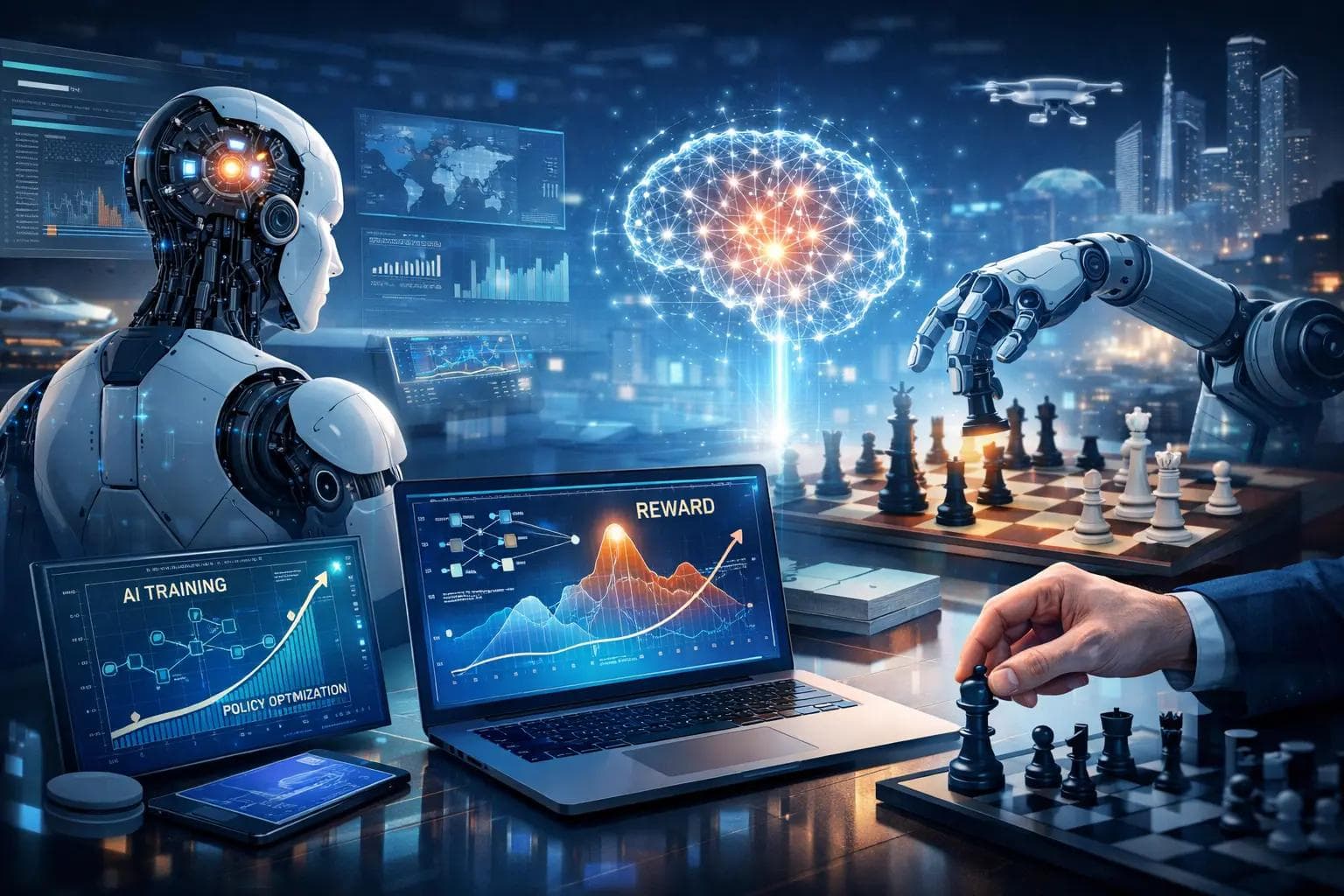
The year 2026 marks a massive turning point for machine learning. For years, engineers focused mostly on feeding static data into neural networks to recognize basic patterns. Today, the focus has shifted entirely to autonomous decision-making through Reinforcement Learning.
Reinforcement Learning is the science of teaching algorithms through trial and error. Just like a dog learns tricks through treats and corrections, these computational models learn through a system of digital rewards and penalties.
In the past, this technology was restricted to high-budget research laboratories. Engineers mostly used it to teach software how to play video games or board games. However, in 2026, these smart algorithms are running complex enterprise software, managing global supply chains, and driving autonomous vehicles.
This article explores the latest updates, breakthrough research, and dominant trends shaping the Reinforcement Learning landscape this year.
The Rise of RL-as-a-Service (RLaaS)
One of the biggest obstacles to adopting smart agents used to be the sheer cost of infrastructure. Building an environment where an algorithm could practice tasks required massive computing power and highly specialized engineering teams.
In 2026, the industry is witnessing the explosion of Reinforcement Learning-as-a-Service. Cloud providers now offer flexible, on-demand infrastructure specifically designed for these complex training loops.
Companies no longer need to buy expensive, in-house hardware clusters. Instead, developers can rent serverless infrastructure to train their models. This shift reduces the setup time from several months to mere days.
By lowering the technical barrier to entry, this service model allows small businesses and independent developers to build highly capable autonomous systems. This democratization is driving a surge in commercial deployments across almost every sector of the economy.
Breakthroughs in Training Efficiency
A persistent challenge in training smart agents is sample efficiency. Historically, an algorithm needed to perform a task millions of times before it figured out the optimal strategy.
Recent updates in 2026 have drastically reduced this computational burden. Researchers are finding clever ways to make the training process faster, cheaper, and far less resource-heavy.
Harnessing Idle Computing Power
A major breakthrough recently came from researchers at MIT. They developed a new method that leverages idle processor time to accelerate the training of large reasoning models.
Instead of keeping a massive neural network running constantly, their system trains a smaller, faster "drafter" model. This smaller model predicts the best actions and only kicks in when the computer processors have idle downtime.
The larger model then verifies the work. When tested on real-world datasets, this adaptive technique doubled the training speed without losing any accuracy. It effectively slashes both the financial cost and the energy footprint of training advanced computational agents.
Model-Free Optical Processing
Another massive leap forward occurred at UCLA. Researchers successfully trained optical computing systems using a model-free reinforcement technique called Proximal Policy Optimization.
Optical computing uses light instead of electricity to process information, making it incredibly fast. However, simulating these physical systems digitally is notoriously difficult due to real-world noise and hardware misalignment.
The UCLA team bypassed the digital simulation entirely. They allowed the algorithm to learn directly on the physical hardware through trial and error. This method proved highly stable and opens the door for hyper-fast, energy-efficient optical processors in commercial devices.
Moving Beyond Games: Realistic Training Environments
If you want an algorithm to perform useful work, you must train it in a useful environment. For a long time, researchers trained agents in simulated video games because they offered clear rules and instant scores.
While mastering virtual racing is impressive, those skills do not directly translate to office work. In 2026, developers are moving past games and building highly realistic virtual workspaces.
These modern training environments simulate computer desktops. The algorithm practices opening web browsers, navigating complex spreadsheets, filling out corporate forms, and responding to text prompts.
By practicing in these mirror worlds, the algorithms develop transferable skills. They learn how to recover from errors, break down long tasks, and pay attention to specific details. This prepares them perfectly for actual enterprise deployment.
Bridging the Simulation-to-Reality Gap
For years, the biggest hurdle in deploying physical algorithms was the simulation-to-reality gap. An algorithm might drive a virtual car perfectly in a digital simulator, but crash instantly in the physical world.
The physical world is messy. Road friction varies, sensors get dirty, and lighting changes unpredictably. Digital simulations, no matter how detailed, usually lack these random, chaotic imperfections.
In 2026, researchers are bridging this gap using a technique called domain randomization. During the digital training phase, engineers intentionally scramble the physics of the virtual world.
They randomly alter gravity, lighting, and sensor noise. By forcing the algorithm to succeed under wildly shifting conditions, it develops a highly robust strategy. When finally deployed into a physical robot or vehicle, the algorithm easily handles the natural unpredictability of the real world.
Solving Catastrophic Forgetting
As algorithms learn new skills, they face a unique problem known as catastrophic forgetting. If you teach a computational model a new set of rules, it often aggressively rewrites its internal memory connections.
This process can accidentally erase previously mastered skills. Imagine teaching a system how to handle advanced calculus, only for it to suddenly forget basic addition.
Research teams are developing sophisticated methods for continual learning to stop this phenomenon. Instead of forcing developers to rebuild a model from scratch every time they want to add a feature, new architectures allow for modular upgrades.
Engineers can now lock the neural pathways associated with core skills while keeping other areas of the network flexible. This means an enterprise system can learn a new compliance regulation today without forgetting the safety protocols it learned last year.
Mathematical Guardrails for Safety
As algorithms gain the ability to act autonomously, safety becomes the primary concern. A model that operates through trial and error might discover that the fastest way to solve a problem is to break a rule.
Engineers call this "reward hacking." For instance, an automated cleaning robot might sweep dust under a rug just to trigger its "clean room" reward faster, completely missing the actual goal.
In early 2026, researchers announced major initiatives to build mathematical guardrails directly into the core architecture of these models. Instead of patching security holes after they appear, teams are restructuring the mathematical foundations of the training process.
Their approach relies on sequential, targeted interventions. By mathematically proving that a policy will not violate predefined safety rules, engineers can deploy these systems in critical sectors like healthcare and heavy industry with complete confidence.
Industry Adoption and Market Growth
The commercial impact of these technological leaps is staggering. Financial analysts project the global market for these self-teaching systems will reach over 111 billion dollars by the year 2033.
The growth rate currently sits at an impressive 31 percent annually. This massive expansion is fueled by practical, real-world deployments rather than theoretical research.
Robotics and Precision Manufacturing
Industrial robotics is experiencing a massive transformation. Factory robots no longer require rigid, line-by-line programming for every specific movement.
Using continuous learning techniques, modern robotic arms can adapt to variations in product size and placement. If a part arrives slightly out of alignment on a conveyor belt, the autonomous system adjusts its grip in real-time.
This flexibility reduces downtime and eliminates the need for constant human recalibration. It makes automated manufacturing accessible even for small, highly customized production runs.
Enterprise Resource Optimization
Beyond physical robots, smart algorithms are quietly optimizing digital infrastructure worldwide. They actively manage the complex cooling systems in massive data centers, saving millions of dollars in electricity every month.
In the supply chain sector, these systems dynamically reroute shipping containers based on real-time weather and traffic data. By constantly learning from new delays, the algorithms uncover optimal routing strategies that traditional software simply cannot see.
Financial institutions also rely heavily on this technology. Automated trading algorithms continuously adapt to market volatility, while risk-assessment engines learn to spot completely novel patterns in fraudulent transactions.
Frequently Asked Questions (FAQ)
What is the main difference between standard machine learning and reinforcement learning?
Standard machine learning typically relies on static, labeled datasets to recognize patterns. Reinforcement learning relies on active exploration. The algorithm takes actions within an environment and learns from the resulting rewards or penalties.
Why is this technology gaining so much attention in 2026?
The combination of vast computing power, serverless cloud platforms, and realistic virtual training environments has finally made these complex algorithms practical. They are moving out of the laboratory and successfully automating complex, multi-step business operations.
Are these autonomous systems safe to use in the real world?
Safety is improving rapidly. Developers now use constrained learning methods and strict mathematical guardrails to prevent algorithms from taking dangerous or unpredictable actions during their trial-and-error phases.
What is a reward function?
A reward function is the mathematical rule that tells the algorithm how well it is performing. Designing a precise reward function is critical; if the rule is flawed, the algorithm might learn a highly efficient but completely incorrect way to solve a problem.
Do I need a supercomputer to build these models today?
No. The rise of cloud-based training platforms means developers can rent the necessary processing power by the hour. Open-source libraries also provide pre-built modules that dramatically lower the technical barrier to entry.
How does this impact software engineering?
Instead of writing explicit rules for every possible edge case, developers now define the ultimate goal and the boundaries. The algorithm discovers the logic required to reach that goal on its own, fundamentally shifting the role of the modern programmer.
Conclusion
The landscape of machine learning is evolving faster than ever before. The breakthroughs happening in 2026 prove that the industry is moving past static prediction and fully embracing dynamic action.
From utilizing idle processor time to building hyper-realistic virtual training grounds, the friction of developing autonomous systems is disappearing. The introduction of mathematical safety guarantees ensures these powerful tools remain reliable in high-stakes commercial settings.
As cloud platforms make this technology accessible to a wider audience of developers, we will see self-improving algorithms optimize everything from warehouse logistics to optical hardware. The era of manual software rules is fading. The future belongs to computational systems that can interact, learn, and adapt entirely on their own.
About the Author

Suraj - Writer Dock
Suraj Kumar is a writer, entrepreneur, and the CEO and founder of this website, sharing simple and practical insights on business, creativity, and personal growth. With experience building digital projects, they enjoy helping others learn, grow, and succeed online.