If 2024 was the year of the "Chatbot Gold Rush," 2026 is shaping up to be the year of the "Local AI Rebellion."
For the past few years, we have been conditioned to think of Artificial Intelligence as a massive, cloud-based monolith. To get smart answers, you had to pay a monthly subscription, send your data to a server in Virginia, and hope your internet connection held up. You were renting intelligence.
But a quiet revolution has taken place. While companies like OpenAI and Google were building bigger and bigger models, the open-source community was figuring out how to make them smaller.
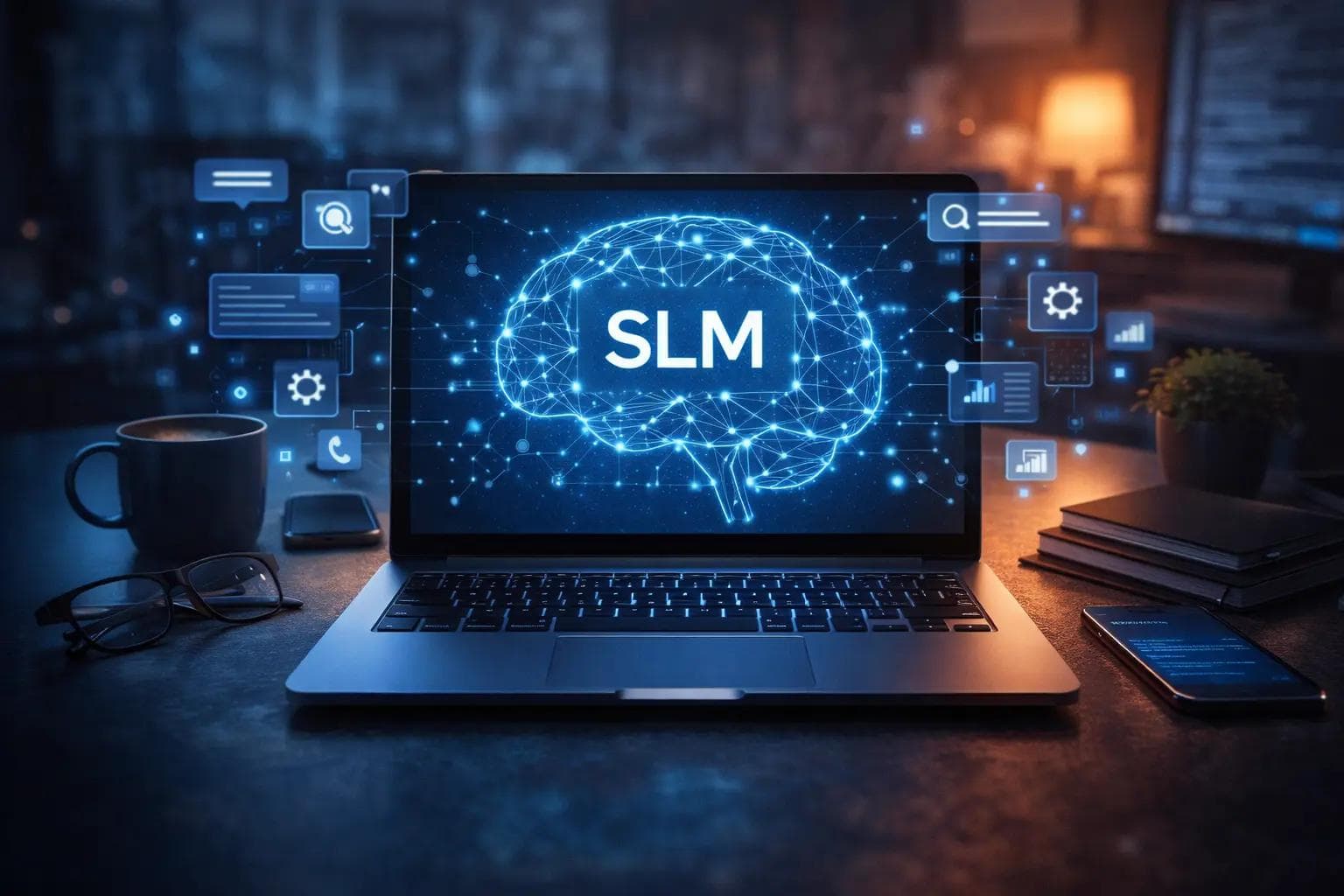
Enter Small Language Models (SLMs). These are highly capable AI brains that fit entirely on your laptop, run offline, and cost exactly $0 to use.
This guide explains what SLMs are, why they are replacing cloud subscriptions for many professionals, and how you can turn your laptop into a private AI powerhouse today.
What Are Small Language Models (SLMs)?
To understand SLMs, we need to talk about "parameters." Parameters are roughly equivalent to the synapses in a brain—connections that store knowledge.
- GPT-4: Estimated to have over 1.7 trillion parameters. It requires a warehouse full of supercomputers to run.
- SLMs (e.g., Llama 3, Phi-4): Typically have between 3 billion and 14 billion parameters. They can run on a standard consumer laptop.
The Encyclopedia vs. The Specialist Handbook
Think of a massive model like GPT-4 as the entire Library of Congress. It knows everything about everything—from quantum physics to 14th-century French poetry. It is impressive, but it is heavy and slow to search.
An SLM is like a specialized medical handbook. It might not know French poetry, but if you ask it a medical question, it answers just as accurately as the big library, but instantly and without needing a ladder to reach the top shelf.
In 2026, models like Microsoft’s Phi-4 and Google’s Gemma 3 have proven that you don't need trillions of parameters to be smart. You just need high-quality data.
Why Run AI Locally? (The "Why Bother?" Question)
Why download a 5GB file to your computer when you can just visit a website? The answer usually comes down to three things: Privacy, Speed, and Cost.
1. Absolute Privacy (The "Therapist" Factor)
When you use a cloud chatbot, every word you type is sent to a server. For developers pasting proprietary code, lawyers drafting contracts, or individuals journaling about their mental health, this is a nightmare.
Local AI is air-gapped. You can pull the ethernet cable out of your wall, turn off Wi-Fi, and the AI still works. Your data never leaves your SSD. It is the only way to have a truly private conversation with a machine.
2. Zero Latency
Cloud models have to receive your request, queue it, process it, and stream it back. This introduces lag. Local models run on your own processor. The text appears instantly—often faster than you can read.
3. No Monthly Fees
The "subscription fatigue" is real. Instead of paying $20/month indefinitely, you download an open-source model once and own it forever.
The Tech Behind the Magic: How Do They Fit?
How did we go from needing a supercomputer to running AI on a MacBook Air? Two key technologies made this possible.
Quantization: The Art of Compression
Imagine you have a high-resolution 4K photo. It looks amazing, but the file size is huge. If you convert it to a high-quality JPEG, it looks 99% the same to the human eye but is one-tenth the size.
Quantization does this for AI. It reduces the precision of the model’s math (from 16-bit to 4-bit numbers).
- Result: A model that used to need 24GB of RAM now fits comfortably in 8GB, with almost no loss in intelligence.
The Rise of the NPU
If you bought a laptop in late 2024 or later, it likely has an NPU (Neural Processing Unit). Just as a GPU is designed for graphics, an NPU is a specialized chip designed solely to run AI math. It allows you to run these models in the background without draining your battery or overheating your laptop.
The Best Small Models in 2026
The landscape changes weekly, but as of early 2026, these are the kings of the hill for local deployment.
1. Microsoft Phi-4 (The Efficiency King)
Microsoft trained this model on "textbook quality" data. It is shockingly smart for its size (around 3.8B parameters). It punches way above its weight, often beating much larger models in logic and math.
- Best For: Logic puzzles, summary, and running on older laptops.
2. Meta Llama 3 (8B Version)
The "standard" for open-source AI. It is the most balanced model available. It is chatty, creative, and generally refuses fewer prompts than its competitors.
- Best For: Creative writing, chatting, and general assistance.
3. Google Gemma 3 (9B)
Built from the same research as Gemini. It excels at following complex instructions and formatting text perfectly (e.g., "Write this response as a JSON file").
- Best For: Data formatting and complex instruction following.
4. Mistral "Nemo" (12B)
A collaboration between NVIDIA and Mistral. It requires a bit more RAM (16GB recommended), but it offers a larger "context window"—meaning it can read longer documents without forgetting the beginning.
- Best For: Reading long PDFs or analyzing large blocks of text.
How to Get Started (It’s Easier Than You Think)
You do not need to be a coder to do this. If you can install Spotify, you can install a local AI.
Option 1: The "One-Click" Solution (LM Studio)
LM Studio is a desktop app that looks just like ChatGPT.
- Download LM Studio.
- Use the search bar to find "Llama 3."
- Click "Download."
- Start chatting. It handles all the complex settings for you.
Option 2: The Developer Favorite (Ollama)
Ollama is a command-line tool that has become the industry standard for Mac and Linux users (and now Windows).
- Download Ollama.
- Open your terminal.
- Type ollama run llama3.
- You are now chatting with the AI.
Pro Tip: Once you have Ollama running, you can connect it to other apps. There are plugins for Obsidian (note-taking) and VS Code (programming) that let you use your local AI directly inside those tools.
Hardware Requirements: Can My Laptop Run It?
You don't need a $4,000 gaming rig, but specs do matter. The most critical component is RAM (Unified Memory).
- 8GB RAM: You can run tiny models (Phi-4, Gemma 2B). It works, but don't expect it to write a novel.
- 16GB RAM: The "Sweet Spot." You can run standard models (Llama 3 8B, Mistral 7B) comfortably while keeping your browser open.
- 32GB+ RAM: Power user territory. You can run "Medium" models (14B–30B parameters) which rival GPT-4 in intelligence.
Mac vs. PC: Apple Silicon Macs (M1/M2/M3/M4) currently have an advantage here due to Unified Memory. The GPU shares memory with the CPU, allowing Macs to run surprisingly large models that would choke a standard PC gaming card with limited VRAM.
Real-World Use Cases
Who is actually doing this?
1. The "Paranoid" Coder Software engineers often cannot paste company code into ChatGPT because of data leak risks. With a local model (like Qwen 2.5 Coder), they can have an AI refactor their proprietary code without a single byte leaving their machine.
2. The Fantasy Author Authors use tools like "SillyTavern" (a frontend for local AI) to build complex character profiles and roleplay with them to unblock writer's block. Since it is local, there are no "content filters" telling them what they can or cannot write about.
3. The Offline Traveler Digital nomads working from airplanes or remote cabins use local AI to translate languages, summarize offline documents, or draft emails without needing a satellite connection.
FAQ
Q: Is a local model as smart as GPT-4? No. GPT-4 is still the "smartest" for very complex reasoning. However, for 90% of daily tasks (summarizing emails, rewriting text, basic coding), a local model is indistinguishable.
Q: Will this drain my battery? Yes, it is computationally heavy. However, modern laptops with NPUs are getting much better at this. Expect your battery life to drop by about 30-50% while actively generating text.
Q: Is it safe to download these models? Yes, if you stick to reputable repositories like Hugging Face. Tools like Ollama automatically pull from verified sources.
Conclusion: The Future is Hybrid
We are not going to stop using cloud AI. For massive tasks, like analyzing a million-row spreadsheet, the cloud is still king.
But the future of AI is Hybrid.
Imagine asking your computer a question. A tiny, fast model on your laptop (the "SLM") tries to answer it first. It answers instantly and privately. If the question is too hard—like "Explain the socio-economic impact of 17th-century trade routes"—your laptop realizes it doesn't know, and then it securely pings the cloud for help.
You are no longer just a user of AI. With SLMs, you are an owner of it. You have a supercomputer in your backpack. It’s time to turn it on.
About the Author

Suraj - Writer Dock
Suraj Kumar is a writer, entrepreneur, and the CEO and founder of this website, sharing simple and practical insights on business, creativity, and personal growth. With experience building digital projects, they enjoy helping others learn, grow, and succeed online.