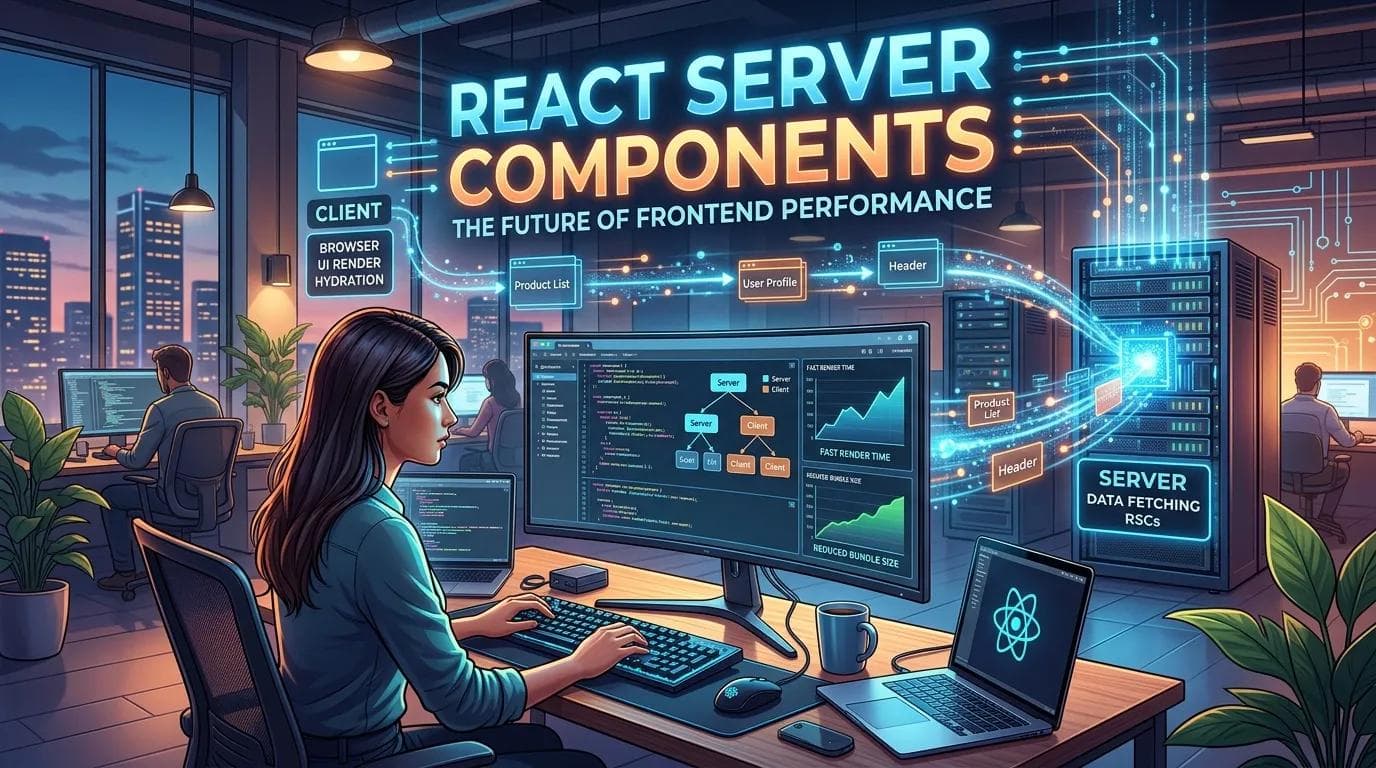
Modern web development is undergoing a paradigm shift, and React Server Components are at the heart of this evolution. By moving rendering logic and data fetching from the client to the server, developers can now deliver faster, more efficient applications that meet the growing performance demands of the modern internet. This article explores how meta-frameworks and server-side paradigms are fundamentally changing how we build, deploy, and scale frontend architecture at the edge.
What is React Server Components?
React Server Components (RSC) represent a new architecture for React applications that allows developers to run components exclusively on the server, keeping them out of the client-side JavaScript bundle. Unlike traditional components that hydrate in the browser, RSCs are rendered into a serialized format on the server, significantly reducing the amount of code shipped to the user's device. This architectural change enables developers to fetch data directly from databases or APIs within the component itself, bypassing the need for complex state management or client-side waterfall requests.
Key Characteristics of RSC
- Zero-bundle-size components: Server-side logic does not ship to the client.
- Direct database access: Perform data fetching closer to the source.
- Automated code splitting: Reduces initial load times by excluding server-only code.
- Seamless integration: RSCs work in tandem with Client Components to maintain interactivity.
How React Server Components Works (Step-by-Step)
Understanding the lifecycle of a request in this new architecture is crucial for frontend performance optimization. Here is the step-by-step process of how the system renders a page:
- Request Initiation: The user navigates to a URL. The request hits your meta-framework (e.g., Next.js, Remix, or SvelteKit) running on the edge.
- Server-Side Execution: The framework identifies the required Server Components. It fetches data directly from your backend services or database.
- Component Rendering: The components are rendered into a specific JSON-like format that represents the UI structure, including placeholders for Client Components.
- Streaming: The server streams the rendered UI to the client as it becomes available. This allows the browser to start painting parts of the page before the entire payload is finished.
- Selective Hydration: Once the browser receives the stream, it processes the Server Components and hydrates only the specific Client Components that require interactivity, ensuring the page remains responsive.
Benefits of React Server Components
The primary advantage of adopting this architecture is the drastic reduction in total client-side JavaScript. Large bundles are the leading cause of slow Time to Interactive (TTI) scores. By offloading logic to the server, you effectively remove large dependency trees—such as data fetching libraries or formatting utilities—from the user's browser.
Furthermore, this approach improves your Core Web Vitals. Because the server constructs the page, the initial HTML is more meaningful and faster to render. This boosts Largest Contentful Paint (LCP) and Cumulative Layout Shift (CLS) scores, which are critical for search engine rankings in 2026 and beyond.
Real-World Examples of React Server Components
In a complex e-commerce dashboard, you might have a product listing page. In a traditional React app, you would fetch product data on the client using a library like TanStack Query. With RSC, you can query the database directly inside your Page component.
Another scenario involves content-heavy websites such as blogs or documentation portals. By using server-side markdown parsing and rendering, you ensure that the browser receives only the finalized HTML. This approach prevents the need to ship a heavy Markdown parsing library to the client, saving hundreds of kilobytes in the initial payload.
Meta-Frameworks and the Rise of Distributed Rendering
Meta-frameworks like Next.js, Remix, and SvelteKit are the engines that make distributed rendering a reality. These frameworks have evolved from simple static site generators into sophisticated runtimes that manage the complex coordination between the client and the edge. By utilizing edge computing, these frameworks can execute logic in a data center closest to the user, minimizing latency.
Comparing Modern Meta-Frameworks
- Next.js: Currently leads the charge in RSC integration, offering the most mature ecosystem for server-centric development.
- Remix: Prioritizes web standards and loaders, providing a robust model for data mutations and server-side redirects.
- SvelteKit: Known for its performance and small runtime footprint, it leverages unique approaches to reactivity that complement edge-based rendering.
Challenges or Risks of Adopting RSC
While the performance gains are significant, the transition is not without challenges. One major shift is the restriction on interactivity. Server Components cannot use hooks like useState or useEffect because they never run in the browser. Developers must carefully partition their application into "Server Components" (for data and static UI) and "Client Components" (for interactivity and event listeners).
Additionally, debugging can be more complex. When an error occurs in an RSC, the stack trace might point to server-side code that is hidden from the browser console, requiring developers to be proficient with server-side logging and observability tools.
Future of React Server Components and Edge Computing
Looking toward the future, we expect deeper integration between edge functions and server components. The concept of "resumability"—where the state of the application is preserved and resumed on the client without a full re-run of the code—will likely become the standard for high-performance web applications. As infrastructure providers continue to improve edge latency, the distinction between the server and the browser will continue to blur, making distributed rendering the default choice for all scalable web applications.
Frequently Asked Questions
What makes React Server Components faster than traditional React?
They eliminate the need to ship the entire component tree to the client. By rendering on the server and sending only the result, the browser's main thread remains unblocked and lightweight.
Do I need to stop using Client Components?
No. Client Components are essential for interactivity, such as forms, buttons, and animations. You should treat them as a layer on top of your server-rendered base.
Can I use RSC with any meta-framework?
Most modern meta-frameworks like Next.js fully support RSC. Other frameworks like Remix and SvelteKit have their own variations of server-side data loading that achieve similar performance outcomes.
Does RSC improve SEO?
Yes. Because the content is rendered on the server before it reaches the browser, search engines receive fully populated HTML, which is significantly easier to crawl and index compared to client-side rendered content.
Key Takeaways
- React Server Components shift heavy logic to the server, resulting in smaller, faster client-side bundles.
- Meta-frameworks are essential for managing the boundary between server-side rendering and client-side interactivity.
- Distributed rendering at the edge reduces latency and significantly improves Core Web Vitals.
- Effective architecture requires a clear separation between data-fetching components and interactive UI components.
Conclusion
The architectural shift toward React Server Components and distributed rendering is not just a trend; it is a necessary evolution to meet the performance demands of modern users. By leveraging the power of meta-frameworks and edge computing, developers can move away from monolithic, client-heavy applications toward a leaner, more performant web. As we look at the trajectory of web architecture in 2026, it is clear that those who master these paradigms will be the ones delivering the most scalable and user-friendly digital experiences.
About the Author

Suraj - Writer Dock
Suraj Kumar is a writer, entrepreneur, and the CEO and founder of this website, sharing simple and practical insights on business, creativity, and personal growth. With experience building digital projects, they enjoy helping others learn, grow, and succeed online.