There is a statistic that haunts every entrepreneur: 90% of startups fail. It is a harsh reality. But the most surprising part isn’t that they fail—it is why they fail.
According to extensive research on failed companies, the number one reason is not running out of money. It is not team conflict. It is not even bad marketing. The number one reason startups fail is "no market need."
In simple terms, founders spend months or years building a product that nobody wants. They fall in love with their solution before they fully understand the problem.
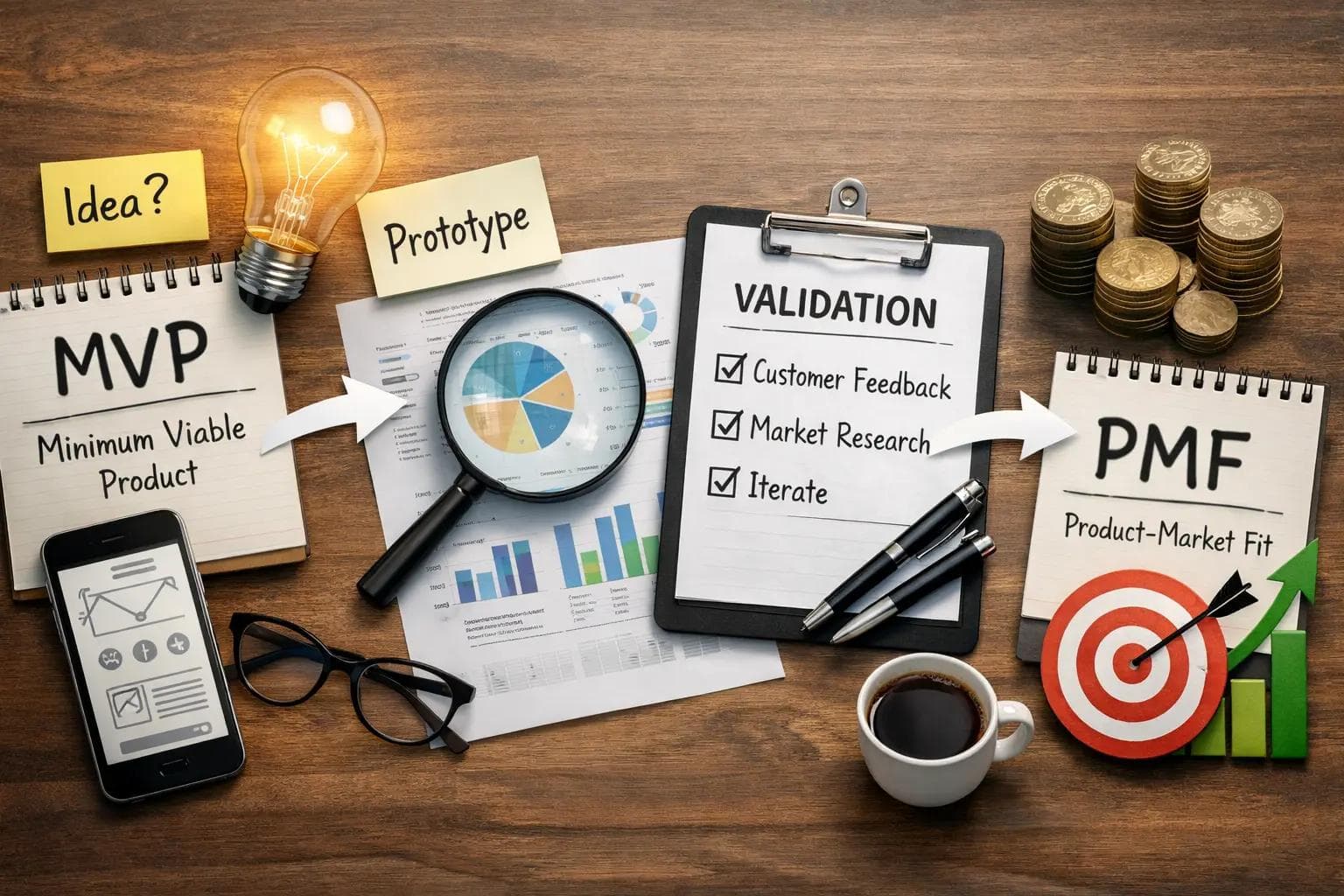
This guide is designed to save you from that fate. The journey from a raw idea to a successful company follows a specific path: validating the concept, building a Minimum Viable Product (MVP), and iterating until you reach Product-Market Fit (PMF).
Here is how to navigate that journey without wasting your time or money.
Phase 1: The Pre-Game – Stop! Do Not Write Code Yet
The biggest mistake new founders make is rushing to "build." They have an idea in the shower, and by noon, they are looking for a developer or designing a logo. This is dangerous.
Before you write a single line of code, you must validate that the problem actually exists. This stage is about customer discovery, not product development.
1. Identify the "Hair on Fire" Problem
A successful startup does not just solve a problem; it solves a painful problem. Think of it this way: if your customer has a headache, they might buy a vitamin, but they will buy an aspirin. You want to build aspirin.
A "hair on fire" problem meets three criteria:
- It is urgent: The customer needs to solve it now.
- It is expensive: The problem costs them money, time, or status.
- It is frequent: They face this problem often (daily or weekly).
2. Define Your Ideal Customer Profile (ICP)
You cannot sell to "everyone." If you try to target everyone, you will reach no one. Be specific.
Instead of saying, "My app is for people who want to lose weight," say, "My app is for new mothers who want to return to their pre-pregnancy fitness levels within six months."
The more specific you are, the easier it is to find these people and ask them questions.
3. Talk to Humans (The Right Way)
Once you know who your customer is, you need to talk to them. But be careful. If you tell your friends your idea, they will lie to you. They will say, "That sounds great!" because they don't want to hurt your feelings. This is called "false validation."
To get the truth, use a technique often called "The Mom Test."
- Don't mention your idea: Ask about their life and their problems.
- Ask for specific past behaviors: Don't ask, "Would you use an app that tracks calories?" Ask, "When was the last time you tried to diet? What was the hardest part?"
- Listen for emotions: If they complain angrily about their current solution, you have found gold.
Phase 2: Testing Demand with "Smoke Tests"
You have confirmed the problem exists. Now, you need to confirm that people will pay for a solution. You still do not need to build the product yet. You can use "smoke tests" to gauge interest.
The Landing Page Test
Create a simple one-page website. You can use tools like Carrd, Webflow, or WordPress.
- Headline: State the benefit clearly.
- Body: Explain how it works.
- Call to Action (CTA): "Join the Waitlist" or "Pre-order Now."
Drive traffic to this page using social media or a small budget ($50) on Google Ads. If 100 people visit the page and zero people click the button, you have a problem. It is better to fail now than after six months of coding.
The "Fake Door" Experiment
This is a bold strategy. Add a button to your website that says "Buy Now" or "Download Feature." When users click it, show a message saying, "We are still building this! Enter your email to be notified when it's ready."
This measures intent. Clicking a "Buy" button is a much stronger signal of interest than just saying, "I might buy that."
Phase 3: Building the Minimum Viable Product (MVP)
If your smoke tests are successful and you have a list of waiting customers, it is time to build. But you must be disciplined.
What Does "Minimum" Really Mean?
An MVP is not a half-finished product. It is not a buggy mess. It is the smallest version of your product that delivers value to the customer.
Think of it like a skateboard. If your goal is to build a car, don't start by building just a wheel. A wheel is useless on its own. Start by building a skateboard. It gets the user from Point A to Point B. It’s not a car, but it works. Then build a scooter. Then a bicycle. Then a car.
The "Wizard of Oz" MVP
In the movie The Wizard of Oz, a scary giant head speaks to the heroes, but it turns out to be just a man behind a curtain pulling levers.
You can run your startup this way. On the front end, it looks like a fully automated software platform. On the back end, it is just you doing the work manually.
Example: If you are building an AI-powered travel planner, don't build the AI yet. Let users fill out a form. Then, you personally spend two hours researching their trip and email them the PDF.
- Pros: You save money on development. You learn exactly what customers want.
- Cons: It is not scalable (but you don't need to scale yet).
The Concierge MVP
This is similar to the Wizard of Oz, but you are transparent about the manual work. You act as a personal consultant to your first ten customers. You solve their problem by hand.
If you can't solve the problem manually, software won't solve it either. Automation is just doing a manual process faster.
Phase 4: The Feedback Loop (Build-Measure-Learn)
You have launched your MVP. Now the real work begins. Your goal is not to get millions of users; it is to learn.
Quantitative Metrics (The Data)
Avoid "vanity metrics." Vanity metrics make you feel good but tell you nothing. Examples include "total registered users" or "page views."
Focus on "actionable metrics":
- Retention Rate: Do people come back after one day? One week?
- Engagement: Are they using the core feature?
- Conversion Rate: What percentage of free users upgrade to paid?
Qualitative Feedback (The Voice)
Data tells you what is happening. Users tell you why.
- Add a live chat widget to your app.
- Email every new user personally.
- Ask, "What is the one thing preventing you from getting value out of this?"
The Pivot
Based on this feedback, you might realize your initial assumption was wrong. That is okay. This is where you "pivot."
- Zoom-in Pivot: A single feature of your product becomes the whole product.
- Zoom-out Pivot: Your product becomes a single feature of a larger platform.
- Customer Segment Pivot: You realize your product solves the problem, but for a different group of people than you expected.
Phase 5: Reaching Product-Market Fit (PMF)
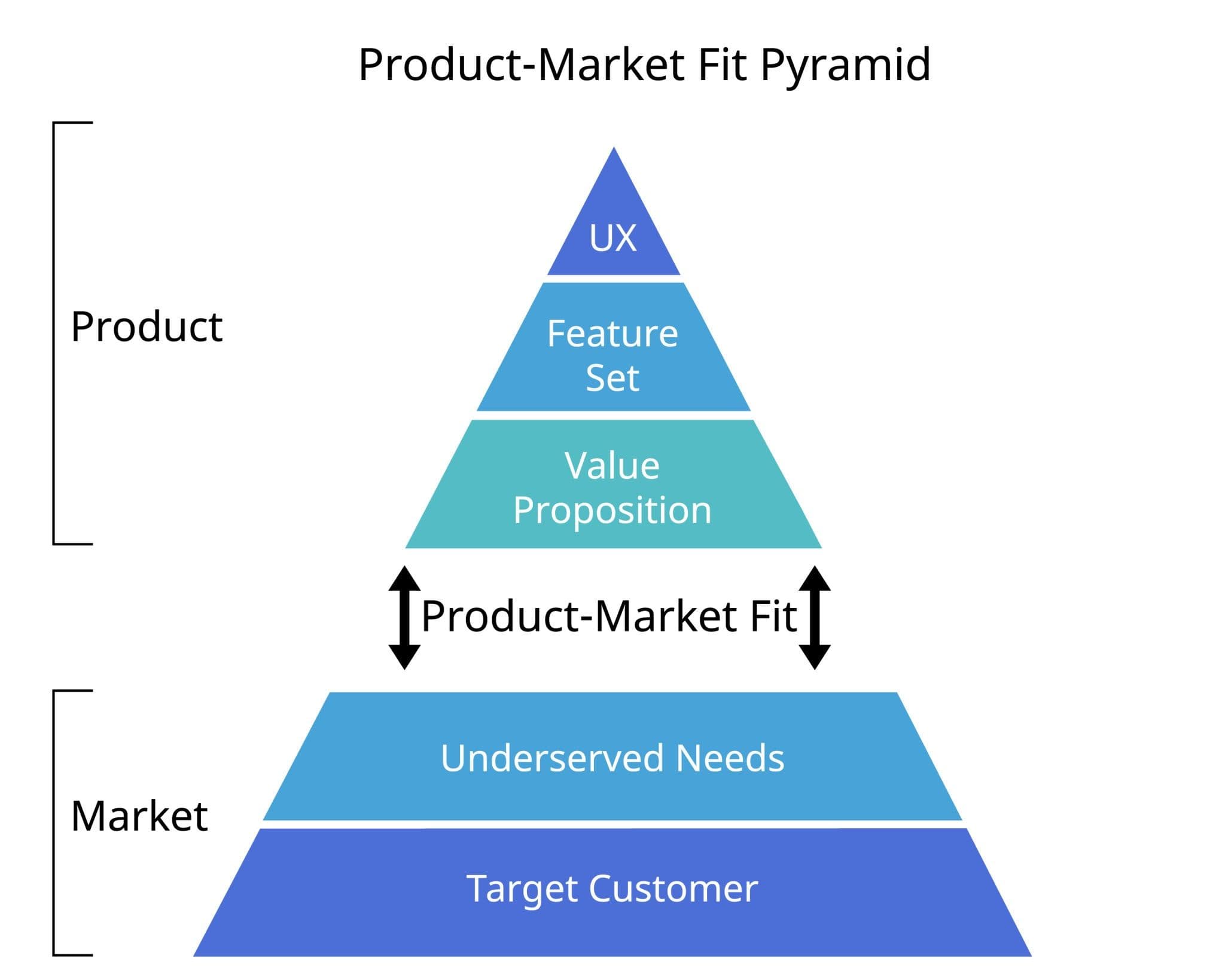
Product-Market Fit is the holy grail. It is the moment when the market pulls the product out of you.
What PMF Feels Like
Marc Andreessen, the legendary investor who coined the term, describes it vividly.
- Before PMF: You are pushing a boulder up a hill. You have to beg people to sign up. Retention is low. Sales are hard.
- After PMF: You are chasing the boulder down the hill. Customers are buying faster than you can add servers. You are hiring support staff as fast as possible. Press is calling you.
The 40% Rule (The Sean Ellis Test)
How do you measure this scientifically? Use the Sean Ellis test. Survey your existing users and ask this question:
"How would you feel if you could no longer use this product?"
- Very disappointed
- Somewhat disappointed
- Not disappointed
If 40% or more of your users say they would be "Very Disappointed," you have likely found Product-Market Fit. If you are under 40%, you are not ready to scale. You need to keep iterating on the product.
The Danger of Premature Scaling
A common death trap is trying to scale before PMF. If you have a "leaky bucket" (people are leaving as fast as they join), pouring more water (marketing money) into it won't help. You will just burn cash.
- Rule of Thumb: Do not spend money on heavy advertising until you have retention. Fix the product first.
Real-World Examples of MVP to PMF
History is full of giants who started with humble, manual MVPs.
1. Zappos (The Shoe Store with No Inventory)
Nick Swinmurn wanted to sell shoes online. Instead of spending millions on a warehouse and inventory, he went to local shoe stores.
- The MVP: He took photos of shoes at the store and posted them on a simple website.
- The Process: When a customer ordered a shoe, Nick went to the store, bought it at full price, and mailed it to the customer.
- The Validation: He lost money on every sale, but he proved that people were willing to buy shoes online without trying them on first.
2. Dropbox (The Explainer Video)
Drew Houston faced a problem: building the file-syncing technology for Dropbox was incredibly hard. He couldn't just build a quick prototype.
- The MVP: He made a 3-minute video showing how it would work. He posted it on Hacker News.
- The Validation: His beta waiting list went from 5,000 to 75,000 people overnight. He validated the demand before writing the complex code.
3. Buffer (The Landing Page)
Joel Gascoigne wanted to build a tweet scheduling tool.
- The MVP: A two-page website. Page 1 explained the tool. Page 2 was a pricing plan.
- The Validation: When people clicked a pricing plan, they were told, "We aren't ready yet, leave your email." Once enough people tried to pay, he wrote the code in seven weeks.
Practical Tools to Build Your MVP
You live in a golden age for founders. You do not need to be a software engineer to build an MVP. "No-Code" tools allow you to drag and drop your way to a functional product.
- Websites: Webflow, WordPress, Carrd.
- Databases & Logic: Airtable, Zapier, Make.
- Mobile Apps: Bubble, Adalo, FlutterFlow.
- User Management: Memberstack, Outseta.
Using these tools, you can build a functional version of your idea in weeks rather than months, costing hundreds rather than thousands.
Frequently Asked Questions (FAQ)
How much money do I need to build an MVP?
Technically, you can do it for under $100 if you use no-code tools and do the work yourself. If you hire a developer, a simple MVP usually costs between $5,000 and $15,000. Avoid spending $50,000+ on version one.
How long should it take to build an MVP?
Aim for 4 to 8 weeks. If your timeline is 6 months, you are building too much. Cut features until you can launch in a month. Speed is your advantage.
What if someone steals my idea?
This is a common fear, but it is irrational. Ideas are cheap; execution is everything. Google wasn't the first search engine. Facebook wasn't the first social network. Competition validates that there is a market. Don't let paranoia stop you from getting feedback.
When should I quit?
If you have pivoted multiple times, changed your customer segment, and still cannot get anyone to pay or stay, the market might just not be there. There is no shame in closing shop and moving to the next idea. The goal is to succeed eventually, not necessarily with this specific idea.
Conclusion: The Market Always Wins
The journey from MVP to PMF is not a straight line. It is a messy, winding road full of U-turns and dead ends. But it is the only reliable way to build a business.
Too many founders treat their startup like a lottery ticket—they build it in secret, launch it with a bang, and hope they win. The "Lean Startup" approach treats a startup like a science experiment. You have a hypothesis, you run a test, you analyze the data, and you adjust.
Remember, the market is the ultimate judge. You cannot force the market to want your product. You can only listen to the market and mold your product into what it needs.
Start small. Talk to customers. Validate before you build. If you follow this process, you won't just be building a product; you will be building a business that is designed to survive.
What is the one "hair on fire" problem you are going to validate today?
About the Author

Suraj - Writer Dock
Suraj Kumar is a writer, entrepreneur, and the CEO and founder of this website, sharing simple and practical insights on business, creativity, and personal growth. With experience building digital projects, they enjoy helping others learn, grow, and succeed online.