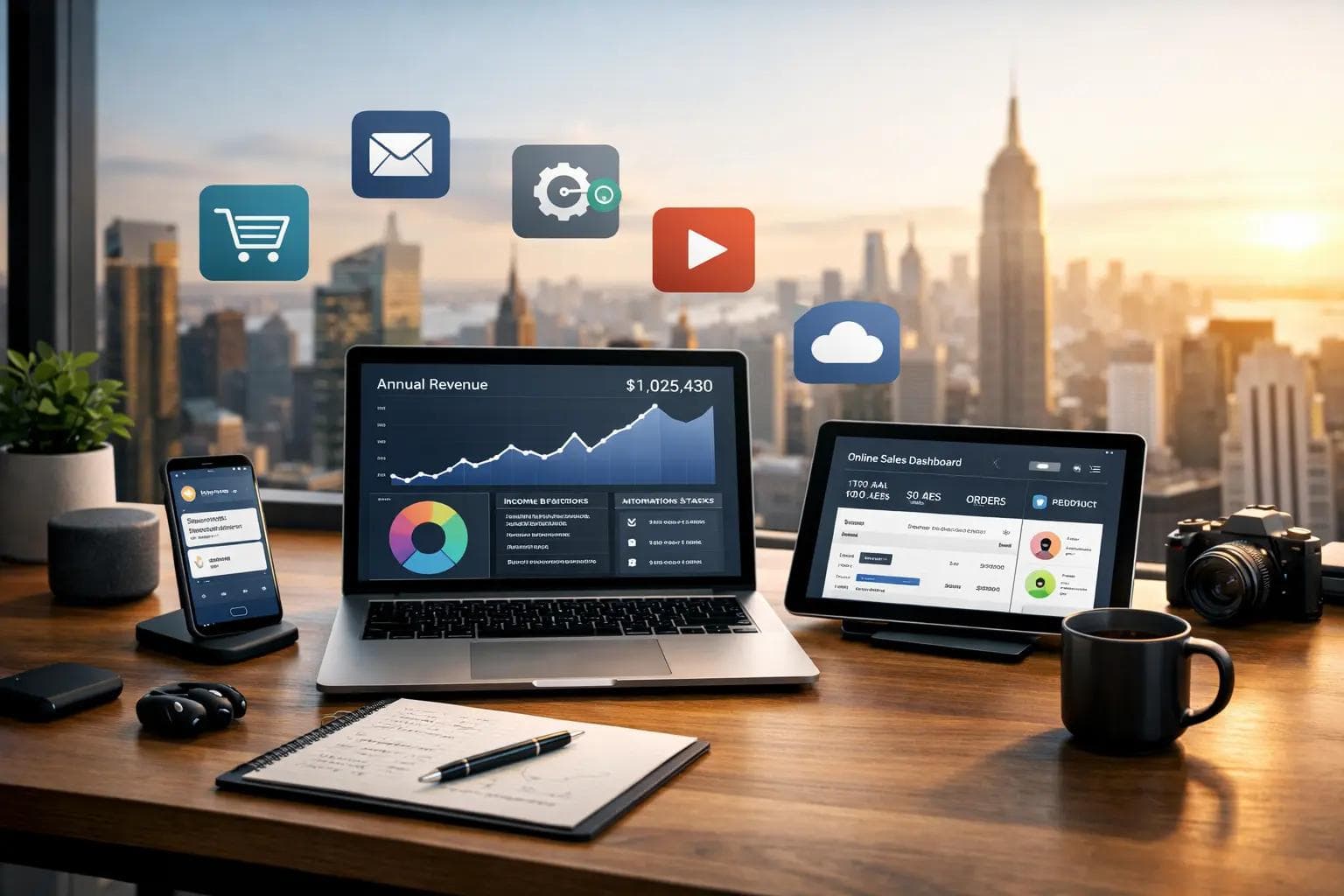
Ten years ago, if you told someone you ran a million-dollar company, their first question would be, "How many employees do you have?" They would imagine a bustling office, HR departments, and expensive overhead.
In 2026, that question is obsolete.
We have entered the golden age of the "One-Person Unicorn." Today, a single individual with a laptop and the right software can outproduce a team of twenty people from 2015. The metric for success is no longer headcount; it is profit margin per employee. And when you have zero employees, that margin is spectacular.
But let’s be clear: "Solopreneur" does not mean you are doing everything yourself. It means you are the only human on the payroll. The rest of your team is digital.
If you want to build a high-revenue business without the headache of managing people, you need leverage. That leverage comes from your tech stack. This guide breaks down the essential software ecosystem you need to run a seven-figure operation entirely on your own.
The Philosophy: Software as a Workforce
Before we look at the specific tools, you need to understand the architectural shift that happened over the last few years.
In the past, software was a tool. You used Microsoft Word to write a document. You used Excel to calculate numbers. You were the active user, and the software was passive.
In 2026, software is an agent. You don't just use the tools; you assign them jobs. The modern solopreneur acts more like a conductor of an orchestra than a musician playing every instrument. Your job is to set the strategy and ensure the different pieces of software are talking to each other.
If a task is repetitive, it should be automated. If a task requires complex data analysis, it should be delegated to AI. You should only be doing the deep, creative work that requires a human soul.
The "Builder" Stack: Creating Product Without a Dev Team
The biggest barrier to entry used to be technical skill. If you wanted to build an app or a SaaS (Software as a Service) platform, you needed to hire expensive engineers. That barrier has collapsed.
1. The AI Code Editor
For those building software, the days of writing every line of syntax are over. Tools like Cursor or Windsurf have become the standard.
You act as the architect. You write a prompt explaining exactly what feature you want—"Create a user login page with a 'Forgot Password' flow"—and the editor writes the code for you. Your job is to review it, test it, and deploy it. This allows a single founder to build complex applications that used to require a team of five full-stack developers.
2. The No-Code Powerhouses
If you prefer not to touch code at all, the "No-Code" movement has matured into a professional industry.
- Bubble & WeWeb: These platforms handle the logic and frontend of web apps. You can build marketplaces like Airbnb or Uber clones just by dragging and dropping elements.
- FlutterFlow: For mobile apps, this tool allows you to build native iOS and Android apps visually.
In 2026, these aren't just for prototypes. They are robust enough to handle millions of database records and thousands of concurrent users.
The "Growth" Stack: Marketing on Autopilot
Marketing used to be a massive time sink. Writing blog posts, editing videos, and scheduling social media can easily take 40 hours a week. The 2026 stack automates 90% of this.
1. Content Repurposing Engines
You should only create a piece of content once. If you record a 30-minute video for YouTube, your tech stack should take over from there.
Tools like OpusClip or Munch (and their 2026 successors) automatically scan your long-form video, identify the most viral moments, crop them into vertical format for TikTok and Instagram Reels, add captions, and even generate the description text.
You film once. The software gives you 10 pieces of content.
2. The Newsletter Operating System
Email remains the most valuable asset for a solopreneur because you own the audience. You are not at the mercy of an algorithm change.
Platforms like Beehiiv or ConvertKit have evolved into full-blown growth engines. They don't just send emails; they have built-in referral programs, ad networks to help you monetize, and recommendation engines to help you grow. They handle the "business" of the newsletter so you can focus on the writing.
3. Programmatic SEO
Writing thousands of SEO articles manually is impossible for one person. However, using data to generate pages is scalable.
By connecting a database (like Airtable) to your website builder (like Webflow or WordPress), you can create thousands of landing pages targeting specific keywords. For example, if you run a travel site, you don't write 500 articles. You create a database of 500 cities and use a template to generate "Best things to do in [City Name]" pages automatically.
The "Operations" Stack: The Glue That Holds It Together
This is the most critical part of the solopreneur system. If your tools don't talk to each other, you become a data-entry clerk.
1. The Automation Hub
Zapier or Make are the nervous system of your business. They connect your disparate apps.
- Example Workflow: When a customer buys a product on your website (Stripe), Zapier automatically adds them to your email list (ConvertKit), sends them a welcome message, creates an invoice in your accounting software (Xero), and sends you a notification on Slack.
In 2026, these workflows are "smart." They can handle exceptions. If a payment fails, the automation knows to send a polite "update your card" email without you lifting a finger.
2. The Second Brain
You cannot keep a million-dollar business in your head. You need a Knowledge Management System.
Notion or Obsidian serves as your company wiki. This is where you document your Standard Operating Procedures (SOPs). Even if you don't have employees, you should write SOPs for yourself (or for the AI agents you use). It keeps you organized and ensures that if you ever do hire a contractor, onboarding takes minutes, not days.
The "Support" Stack: 24/7 Customer Service
Scaling a business usually means scaling support tickets. This is the nightmare of every solopreneur. You don't want to spend your day resetting passwords.
1. AI Support Agents
The chat widget on your site is no longer a simple decision tree. It is powered by Large Language Models (LLMs) trained specifically on your documentation.
Tools like Intercom, BotPenguin or Help Scout now offer AI layers that resolve up to 80% of inquiries instantly. The AI reads your refund policy, technical docs, and past conversations. It can answer complex questions like, "Why isn't my API key working?" by looking up the user's account status and troubleshooting in real-time.
You only step in for the "Level 2" issues that require human empathy or complex decision-making.
The "Finance" Stack: Keeping the Money Straight
A $1M business involves a lot of transactions. You cannot use a spreadsheet for this.
1. The Merchant of Record (MoR)
Selling globally is a headache because of tax laws. If you sell a digital product to a customer in Germany, you owe VAT. If you sell to someone in Texas, you owe sales tax.
Solopreneurs in 2026 use platforms like Lemon Squeezy or Paddle. They act as the "Merchant of Record." Technically, the customer buys from them, and they pay you. They handle all the global tax compliance, remittance, and legal headaches. It costs a small percentage of revenue, but it buys you peace of mind and keeps you out of jail.
2. Automated Bookkeeping
Connect your bank account to a tool that automatically categorizes expenses. The software should be able to tell the difference between a software subscription (Business Expense) and a coffee (Personal/Meals). By the time tax season rolls around, your P&L statement is already done.
The Cost of the Stack: Is It Worth It?
You might be looking at this list and thinking, "This sounds expensive." Let's break down the monthly math for a hypothetical $1M/year business.
- Hosting & Webflow/Bubble: $100
- AI Code Editor / GitHub Copilot: $40
- Email Marketing (Beehiiv/ConvertKit): $300 (scales with subscribers)
- Automation (Make/Zapier): $150
- Customer Support AI: $100
- Video Repurposing Tools: $50
- Miscellaneous SaaS: $200
Total Monthly Cost: ~$940 Total Annual Cost: ~$11,280
Compare this to the "Old Way":
- 1 Full-Time Developer: $120,000
- 1 Marketing Manager: $80,000
- 1 Virtual Assistant: $30,000
Total Annual Cost (Old Way): ~$230,000
The tech stack costs roughly 5% of the price of a human team. This is why the profit margins for modern solopreneurs are often 80% to 90%.
The Risks: What No One Tells You
While this tech stack is powerful, it introduces new risks that you must manage.
1. Platform Risk
If your entire business is built on top of one platform (e.g., you rely 100% on Twitter for traffic or Amazon for sales), you are vulnerable. If they ban you, your revenue goes to zero overnight.
- Solution: Own your audience (email list) and diversify your traffic sources.
2. The "Shiny Object" Syndrome
With so many new AI tools launching every week, it is easy to spend all day tweaking your stack instead of working.
- Solution: Follow the "Good Enough" rule. If your current tool works, don't switch just because a new one looks cooler. Optimization is a form of procrastination.
3. Isolation
Working alone with only AI for company can be isolating.
- Solution: Join paid communities or "masterminds" of other solopreneurs. You need human connection to keep your sanity and bounce ideas off real brains.
Frequently Asked Questions (FAQ)
Q: Can I really handle $1M in revenue alone? A: Yes, if the business model is right. Selling digital products, SaaS, or high-ticket consulting scales well. Selling physical handmade goods does not scale as easily without logistics help.
Q: Do I need to know how to code? A: In 2026, you need "Technical Literacy," not deep coding skills. You need to understand how APIs work and how data moves between apps, but you don't need to memorize syntax.
Q: What happens if I get sick? A: This is why automation is key. If your sales and delivery systems are automated, the business makes money while you sleep (or recover). However, for long-term absences, you should have a "break glass" plan where a trusted contractor can step in.
Q: Is it better to be a solopreneur or hire a small team? A: It depends on your personality. If you love mentoring and management, build a team. If you value freedom and hate meetings, go the solopreneur route. There is no right answer, only the right answer for you.
Conclusion: The Era of the Digital Artisan
The "Solopreneur Tech Stack of 2026" is not just a collection of apps. It is a passport to freedom.
For the first time in history, the means of production are cheap, accessible, and automated. You do not need venture capital. You do not need a co-founder. You do not need an office lease.
You simply need a problem to solve, the curiosity to learn the tools, and the discipline to build.
The barrier to entry has never been lower, but the barrier to success remains the same: execution. The tools won't save a bad business idea. But if you have a great idea, these tools will give you the superpowers to scale it to the moon, all from the comfort of your home office.
Start building. The software is ready when you are.
About the Author

Suraj - Writer Dock
Suraj Kumar is a writer, entrepreneur, and the CEO and founder of this website, sharing simple and practical insights on business, creativity, and personal growth. With experience building digital projects, they enjoy helping others learn, grow, and succeed online.