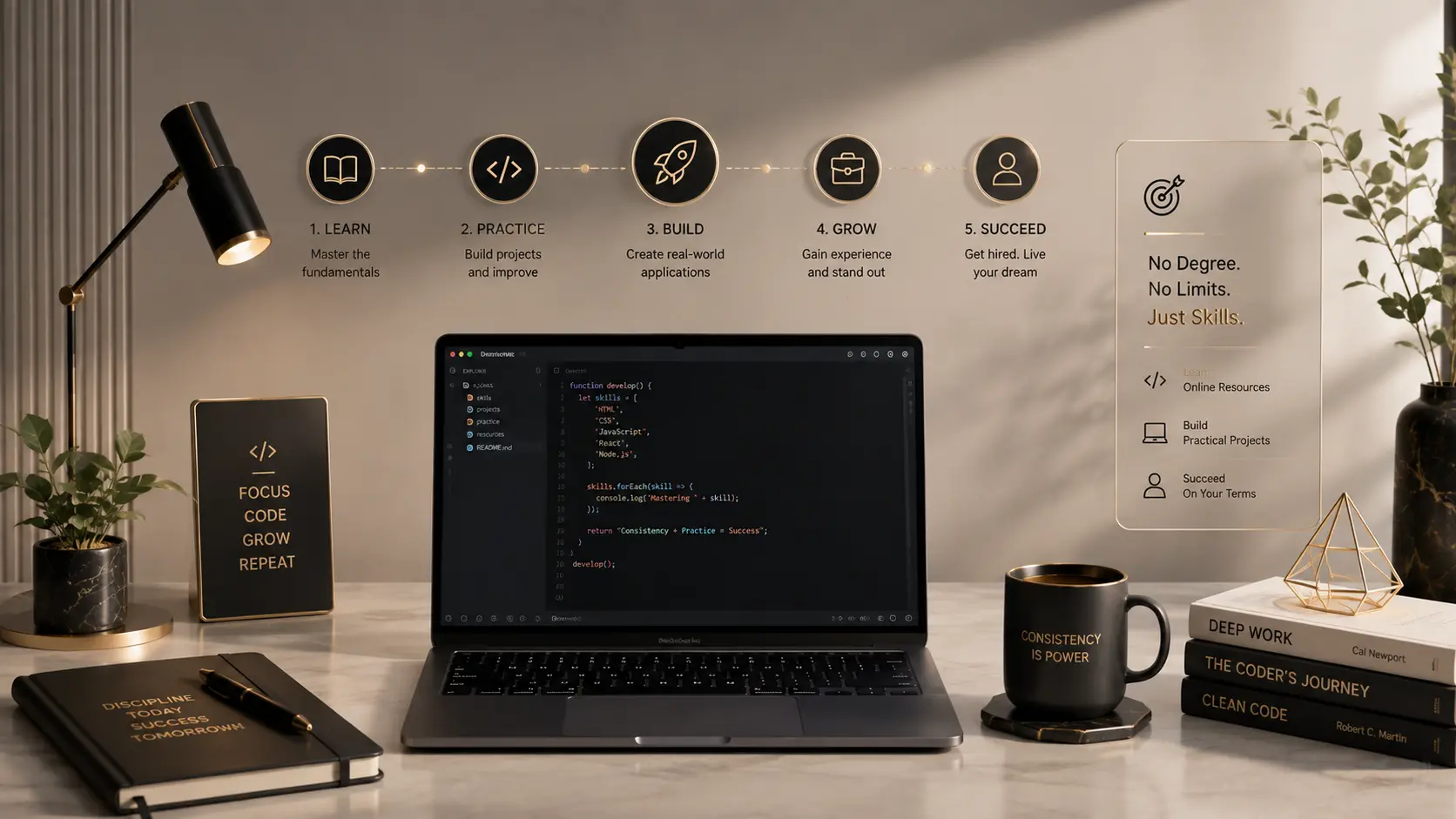
Nobody tells you this when you're stuck in a job you hate, googling career changes at midnight: you don't need a four-year computer science degree to write code for a living. I've watched people go from zero programming experience to a paying developer job in under a year, and I've also watched people burn eighteen months on the wrong plan and quit. The difference usually comes down to a handful of decisions made in the first thirty days. This article walks through how to become a software developer in 2026 without a degree — what actually works, what wastes your time, and what I'd do differently if I were starting today.
You'll get a realistic roadmap, the tools worth paying for, the mistakes that trip up almost everyone, and honest answers to the questions people ask before they commit.
Why Skipping the Degree Actually Works Now
Ten years ago, walking into a tech interview without a degree meant fighting an uphill battle. That's shifted. Stack Overflow's developer surveys have tracked this over time, and one widely cited wave found that roughly a quarter of professional developers had no degree at all, with self-teaching being the most common way developers picked up new frameworks and tools. More recent industry reporting has pointed the same direction: the share of newly hired developers holding a traditional computer science degree has been quietly slipping, even as overall hiring in software keeps growing.
That doesn't mean degrees are worthless. It means the industry has built other ways to prove you can do the job — a working portfolio, a solid GitHub history, and the ability to talk through your code in an interview. Companies hire for output, not credentials, more than they used to.
In my experience, the people who make it without a degree aren't smarter than everyone else. They're just relentless about building real things instead of collecting certificates. That distinction matters more than anything else in this guide.
Pick a Lane Before You Touch a Tutorial
Most people fail before they even open their first code editor, because they try to learn "programming" in general. That's too vague to act on. You need a lane.
Here's how to pick one without overthinking it:
- Web development (frontend or full-stack) — fastest path to a first job, huge demand, tons of free resources.
- Backend development — better long-term pay ceiling, slightly steeper learning curve.
- Mobile development — smaller job pool, but less competition per opening.
- Data-adjacent development — good if you already work with spreadsheets or analytics and want to transition gradually.
If you genuinely have no preference, pick full-stack web development. It has the most beginner-friendly job market and the widest range of entry-level roles, from junior frontend engineer to junior full-stack developer.
When I first tried to learn coding, I made the mistake of jumping between Python, JavaScript, and Swift in the same month because I couldn't decide. I wasted close to ten weeks with almost nothing to show for it. Pick one lane and stay in it for at least six months.
Build a Six-Month Learning Plan You'll Actually Follow
A learning plan only works if it fits into your actual life. Here's a structure that holds up for people working full-time jobs while they transition.
Months 1–2: Fundamentals
Learn one language deeply — JavaScript if you chose web development, Python if you chose backend or data. Cover variables, functions, loops, data structures, and basic debugging. Resist the urge to jump to frameworks yet.
Months 3–4: Build Real Projects
Stop watching tutorials passively. Build three to five small projects from scratch: a to-do app, a weather app pulling from a public API, a simple blog. Each project should force you to solve a problem you haven't seen solved for you already.
Months 5–6: Frameworks, Git, and Portfolio Polish
Pick one framework relevant to your lane (React for frontend, Node.js or Django for backend). Learn git and push everything to GitHub. Rebuild your best project using what you've learned, and write clear README files — hiring managers actually read these.
A common mistake here is polishing one perfect project for months instead of shipping several decent ones. Recruiters and hiring managers want to see range and consistency, not a single masterpiece.
Tools Worth Using (and a Few Worth Skipping)
You don't need a paid bootcamp to get any of this right, but a few tools genuinely speed things up:
- freeCodeCamp — free, structured, and still one of the best starting points for web development fundamentals. No catch, no upsell.
- Claude or another AI coding assistant — useful for explaining errors and reviewing your code, but dangerous if you let it write everything for you before you understand the basics. Use it to learn, not to skip learning.
- GitHub — non-negotiable. Your commit history becomes part of your resume whether you plan for that or not.
- A paid bootcamp — only worth it if you need external accountability and can't build that discipline on your own. Many people don't need this and pay thousands of dollars for structure they could build themselves with a calendar and a study group.
I've tried both the fully self-taught route and a short paid bootcamp for a specific framework, and honestly, the bootcamp only helped because it forced a deadline onto me. If you're disciplined enough to set your own deadlines, save the money.
Build a Portfolio That Gets You Interviews
Your portfolio is the actual credential now — it replaces the degree in a hiring manager's eyes. A weak portfolio with five toy projects copied from tutorials won't get you far. A strong one shows judgment.
Aim for three portfolio pieces that each demonstrate something different:
- A project that solves a real, specific problem — ideally one you personally had.
- A project that shows you can work with an external API or database.
- A project built with a teammate, even an informal one, that shows you can collaborate using git branches and pull requests.
Write a short case study for each one explaining the problem, your approach, and what you'd improve with more time. This single habit sets candidates apart more than almost anything else, because it shows expertise instead of just output.
The portfolio isn't there to prove you can code. It's there to prove you can think through a problem like the person who'll eventually be your manager.
Get Your First Job Without a Degree on Your Resume
This is where most self-taught developers stall, not because they can't code, but because they apply the wrong way.
Skip large corporate job boards at first. Your resume gets filtered out by automated systems before a human ever sees it. Instead:
- Apply directly to startups and small companies where a hiring manager, not a filtering algorithm, reads applications.
- Reach out to people already working at companies you like and ask for fifteen minutes, not a job.
- Contribute to a small open-source project. Real, visible contributions carry more weight than a listed skill.
- Consider a junior contract or freelance gig first — it's a lower-stakes way in, and it becomes real experience on your resume.
According to research from developer hiring platforms in recent years, technical assessments and take-home projects now weigh more heavily in hiring decisions for junior roles than resume screening alone. That trend favors self-taught developers directly, because it puts your actual work front and center instead of your education history.
One thing I'd change if I were starting over: I sent nearly forty generic applications before landing a single interview. Once I switched to five to ten personalized applications a week, referencing something specific about each company's product, my response rate roughly tripled.
Common Mistakes That Slow People Down
A few patterns show up again and again with people trying to break in without a degree:
- Tutorial hopping — always starting a new course instead of finishing projects.
- Learning too many languages too early — spreading yourself thin instead of going deep on one stack.
- Waiting to feel "ready" — nobody feels ready. Apply while you still feel unfinished.
- Ignoring soft skills — being able to explain your thinking clearly in an interview matters as much as the code itself.
- Comparing your month three to someone else's year three — a fast track for one person isn't a fast track for everyone; backgrounds, time available, and starting point all vary.
Key Takeaways
- You don't need a computer science degree to become a professional software developer in 2026 — a strong portfolio now carries more weight than a diploma for most junior roles.
- Pick one lane (web development is the easiest entry point) and commit to it for at least six months before switching.
- Build real projects instead of collecting tutorial certificates; your GitHub history is your new resume.
- Use AI coding tools to learn faster, not to skip understanding the fundamentals.
- Apply directly to small companies and personalize your outreach — it beats mass-applying through job boards.
- Expect the timeline to vary; six to twelve months is realistic for most people learning around a full-time job.
Where This Path Doesn't Work as Well
To be honest about the limits: some companies, especially large enterprises and certain regulated industries, still filter hard on degrees, particularly for visa sponsorship or government-adjacent roles. If you're targeting one of those specifically, a degree or an accredited certification may be close to mandatory rather than optional. This path works best for startups, agencies, product companies, and remote-first teams, which make up a large share of the current junior developer market but not all of it.
Frequently Asked Questions
What is the fastest way to become a software developer without a degree? Focus on one specialization, usually web development, and spend the first two months on fundamentals before jumping into frameworks. Most people who move fastest build projects in parallel with learning rather than finishing a course first, then building. Six to nine months of consistent, focused effort is realistic for a first junior role.
How do I explain not having a degree in a job interview? Lead with what you built, not what you're missing. Talk through a specific project, the problem it solved, and a technical decision you made along the way. Most interviewers care far more about how you think through problems than which school you attended, especially at startups and small teams.
Can I get hired as a self-taught developer in a competitive job market? Yes, though it takes a more targeted approach than mass-applying. Smaller companies, contract roles, and referrals through open-source contributions tend to convert better than large corporate applications, which often get filtered by automated resume screening before reaching a human.
Should I do a coding bootcamp instead of learning on my own? Only if you need external structure and accountability to stay consistent. A bootcamp can compress the timeline, but it isn't required — plenty of developers learn everything a bootcamp teaches using free resources and a disciplined weekly schedule.
Is it too late to become a software developer in 2026? No. Demand for developers who can actually ship working software hasn't disappeared, even with AI tools changing parts of the job. What's changed is the bar: employers expect you to use modern tools effectively, not avoid them, and to show real project work rather than just theoretical knowledge.
Does learning to code with AI tools hurt my chances later? Not if you use them to understand your code rather than replace your understanding of it. Interviewers can usually tell quickly if a candidate can't explain or debug their own project. Use AI assistants for explanations and code review, but write and understand the core logic yourself.
Conclusion
Becoming a software developer without a degree in 2026 is realistic, but it isn't effortless — it takes a focused lane, a handful of real projects, and a job search strategy that skips the algorithms filtering out non-traditional candidates. The people who make it aren't the ones who studied the longest; they're the ones who built the most and applied the smartest. If you take one thing from this article and act on it today, let it be this: stop researching and build your first small project this week, even if it's ugly. Momentum beats preparation every time.
About the Author

Madhu - WriterDock
Madhu is a writer and SEO Executive who is passionate about creating informative, engaging, and search-optimized content that helps readers find practical solutions. With expertise in content strategy and SEO, she transforms complex topics into easy-to-understand, valuable blog posts. She loves sharing knowledge through helpful blogs that educate, inspire, and empower audiences.