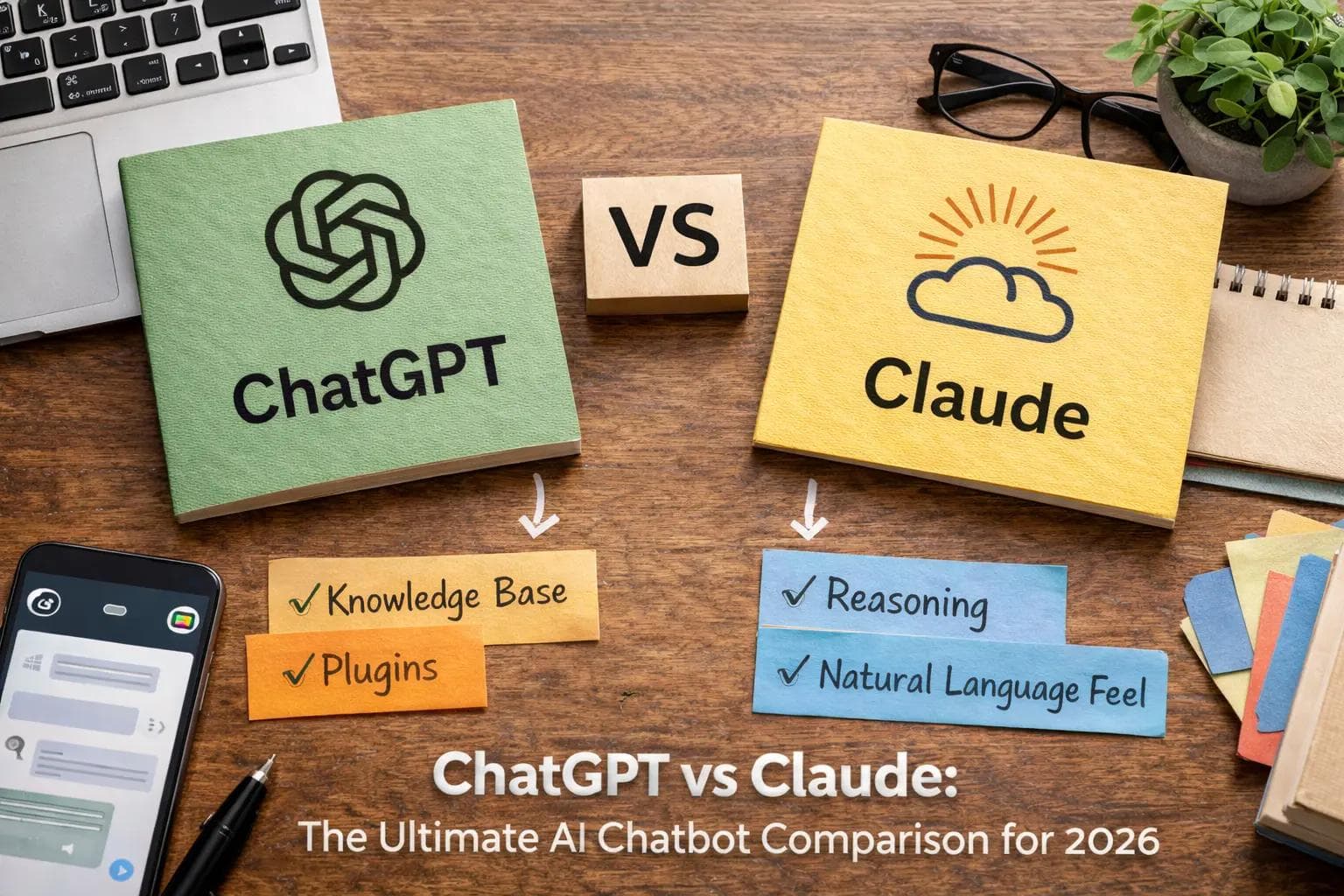
The artificial intelligence landscape has matured rapidly, and choosing the right digital assistant is no longer just about novelty. It is a critical workflow decision. As we navigate the complexities of modern knowledge work, two platforms have emerged as the undisputed leaders: OpenAI’s ChatGPT and Anthropic’s Claude.
This guide is designed for professionals, developers, writers, and business leaders who need to understand exactly which is better: ChatGPT or Claude. Both platforms have recently launched their next-generation models—including the GPT-5 and o-series from OpenAI, and the Claude 4.5 family from Anthropic. However, their underlying philosophies, capabilities, and ideal use cases differ drastically.
In this comprehensive AI chatbot comparison, you will learn how these tools stack up in real-world scenarios. We will dissect their coding proficiency, writing nuance, pricing structures, and long-context reasoning. By the end of this guide, you will have a clear, actionable roadmap to select the best AI assistant 2026 has to offer for your specific needs.
Quick Comparison Table
| Feature | ChatGPT (OpenAI) | Claude (Anthropic) |
|---|---|---|
| Ease of Use | High (Voice mode, broad plugins) | High (Clean UI, Artifacts workspace) |
| Pricing | Free; Plus ($20/mo); Pro ($200/mo) | Free; Pro ($20/mo) |
| Best For | General versatility, multimodal tasks, brainstorming | Coding, complex analysis, nuanced writing |
| Accuracy | Excellent for broad knowledge | Superior for deep logic and factual retrieval |
| Writing Quality | Good, but can sound formulaic | Exceptional, highly human-like and nuanced |
| Coding Capability | Excellent for rapid prototyping |
What is ChatGPT?
ChatGPT is the flagship product of OpenAI and arguably the most recognizable name in generative artificial intelligence. Built on the GPT architecture, it was the catalyst for the modern AI revolution. Today, it operates as a versatile, multimodal assistant capable of processing text, voice, and images natively.
Key Features
ChatGPT boasts a massive ecosystem. It features advanced voice mode for real-time conversational interactions, native integration with DALL-E for image generation, and the ability to run Python code directly within the chat interface. Furthermore, the introduction of custom GPTs allows users to build hyper-specific assistants tailored to unique workflows.
Strengths
The primary strength of ChatGPT is its sheer versatility. It is the ultimate generalist. Whether you need a quick recipe, a macro for Excel, or a customized image for a presentation, ChatGPT handles it instantly. Its massive training data gives it a broad foundational knowledge across nearly every conceivable topic.
Limitations
ChatGPT can sometimes suffer from the "AI tone"—a recognizable, slightly robotic cadence in its writing. Additionally, while its context window has expanded, it can still occasionally lose track of subtle details when parsing exceptionally long and complex documents compared to its competitors.
What is Claude?
Claude is the premier AI model developed by Anthropic, a research company founded by former OpenAI executives. Claude was built from the ground up with a focus on "Constitutional AI," a framework designed to make the system highly ethical, safe, and less prone to hallucinations.
Core Features
Claude is heavily optimized for deep cognitive tasks. Its standout feature is the "Artifacts" UI, a dedicated side-panel workspace where generated code, documents, and web components can be viewed and edited in real-time. It also features a massive 200,000-token context window that processes information with near-perfect recall.
Strengths
Claude dominates in areas requiring sustained logical reasoning. It is widely considered the best model for complex software engineering and long-form analysis. Furthermore, its writing style is remarkably natural, nuanced, and easy to adapt to a brand's specific voice, making it a favorite among content creators and marketing teams.
Limitations
Claude lacks the expansive multimodal features of ChatGPT. It does not natively generate images or video, and it lacks a real-time conversational voice mode. Its plugin ecosystem is also much smaller, making it slightly less versatile for casual, everyday consumer queries.
Feature-by-Feature Comparison
Ease of Use
Both platforms offer intuitive, chat-based interfaces. ChatGPT provides a highly interactive experience with its voice application and mobile app accessibility. Claude offers a cleaner, less cluttered desktop experience. The Artifacts feature in Claude elevates its usability for professionals, allowing users to interact with generated code and documents seamlessly alongside the chat.
Writing Quality
When evaluating ChatGPT vs Claude for writing, Claude takes a decisive lead. ChatGPT tends to default to a specific structure: an introductory hook, bullet points, and a summary paragraph that often starts with "In conclusion." Claude writes more organically. It mimics human cadence, varies sentence length, and requires significantly less editing to sound authentic.
Coding & Technical Tasks
ChatGPT vs Claude for coding is a heavily debated topic among developers. ChatGPT, particularly the GPT-5 and o3 models, is fantastic for rapid prototyping, generating boilerplate code, and exploring unfamiliar frameworks. However, Claude 4.5 Sonnet and Opus currently lead the industry benchmarks (like SWE-bench). Claude is vastly superior at understanding multi-file architecture, debugging complex logic, and refactoring large codebases without breaking existing dependencies.
Research & Long-Form Analysis
Claude is the superior researcher. Its massive context window allows users to upload entire books, legal contracts, or financial reports. When prompted to find a needle in a haystack, Claude does so with surgical precision. ChatGPT handles large documents well, but it is more prone to summarizing heavily rather than analyzing the minute, interconnected details of a 100-page PDF.
Context Window & Memory
Context window refers to the amount of text the AI can "remember" in a single conversation. Claude offers a standard 200,000-token window across its main models. OpenAI has recently pushed boundaries, offering up to 400,000 tokens on specific enterprise GPT-5 tiers. However, benchmark testing routinely shows that Claude maintains higher factual retrieval accuracy when the context window is pushed to its absolute limits.
AI Reasoning
OpenAI's o-series (o3 and o4-mini) introduced specialized "thinking tokens" designed specifically for multi-step mathematical and logical reasoning. For isolated logic puzzles and advanced math, OpenAI is currently unmatched. However, for nuanced business strategy and architectural system design, Claude's hybrid reasoning models provide more practical, grounded, and cautious advice.
Safety & Guardrails
Anthropic built Claude on a Constitutional AI framework, making it highly resistant to generating harmful, biased, or unethical content. This makes Claude highly attractive to enterprise compliance teams. ChatGPT is also secure, but its broader guardrails occasionally result in "refusal fatigue," where the AI overly censors benign requests, or conversely, confidently hallucinates incorrect facts.
Integrations & Ecosystem
ChatGPT wins the ecosystem battle. Its custom GPT marketplace allows users to connect to thousands of third-party apps, from Zapier to Canva. It also integrates deeply into the Microsoft ecosystem. Claude is more isolated, though it offers excellent API access and solid integrations with developer tools like GitHub and enterprise communication platforms like Slack.
Performance & Speed
For everyday queries, ChatGPT (using GPT-4o or GPT-5) is blazingly fast, generating text almost instantly. Claude 4.5 Haiku matches this speed, but the heavy-lifting models like Claude 4.5 Opus take more time to "think." If speed is your primary metric for simple tasks, ChatGPT is the clear winner.
Pricing Comparison
Understanding ChatGPT vs Claude pricing is crucial for both individuals and businesses scaling AI operations.
- Free Plans: Both offer highly capable free tiers. ChatGPT provides access to GPT-4o with usage limits. Claude provides access to Claude 3.5 Haiku and limited Sonnet access.
- Paid Subscriptions: ChatGPT Plus and Claude Pro both cost $20 per month.
- Premium Tiers: OpenAI recently introduced a $200/month "Pro" tier for power users requiring massive compute and reasoning tokens. Anthropic does not currently have a direct consumer equivalent at this price point.
- Value for Money: For pure text generation and coding, Claude Pro offers immense value. For users who need image generation, data visualization, voice mode, and web search bundled together, ChatGPT Plus is the most cost-effective suite on the market.
Real-World Testing: My Experience
After testing both tools extensively over the last year, the differences in daily workflow utility have become crystal clear. I use AI heavily for complex web development, content strategy, and daily productivity management.
In my experience, when I used ChatGPT to brainstorm SEO blog titles about SaaS startups or to quickly summarize daily tech news, its speed and web-search capabilities were flawless. It is my go-to for rapid ideation. Furthermore, when I want to apply the 2-Minute Rule to clear out my inbox or organize my tasks into a Kanban board format, ChatGPT's conversational agility makes the process frictionless.
However, my workflow shifts entirely when dealing with deep, structural work. While using Claude for long documents—specifically when parsing through software architecture documentation or drafting a 2000-word article—the output quality is noticeably different. Claude requires almost no heavy editing to sound human.
The biggest contrast appeared during full-stack development. While coding a complex user authentication flow for a MERN stack application, I fed the same broken React components and Node.js backend files to both platforms. ChatGPT provided a quick fix that patched the immediate error but ignored a subtle state management issue. Claude 4.5 Sonnet, on the other hand, analyzed the entire component tree, identified the root cause of the state leak, and refactored the code while explaining its methodology. For deep focus work, Claude feels like a senior engineering partner, while ChatGPT feels like a lightning-fast junior assistant.
Pros and Cons
ChatGPT Pros and Cons
Pros:
- Unmatched versatility (voice, vision, text, code).
- Native image generation via DALL-E.
- Incredible speed for rapid brainstorming and prototyping.
- Massive ecosystem of plugins and custom GPTs.
Cons:
- Writing can sound generic, formulaic, and recognizable as AI.
- Can occasionally hallucinate facts confidently.
- Struggles slightly with massive, multi-file codebases compared to Claude.
Claude Pros and Cons
Pros:
- Exceptional, human-like writing quality.
- The Artifacts UI is a game-changer for viewing code and documents.
- Industry-leading coding and debugging capabilities.
- Near-perfect recall within its massive 200K context window.
Cons:
- No native image or video generation tools.
- Lacks a mobile voice mode comparable to ChatGPT.
- Strict safety guardrails can sometimes feel overly restrictive.
ChatGPT vs Claude for Different Users
For Students
ChatGPT vs Claude for students depends on the task. ChatGPT is excellent for quick tutoring, explaining complex concepts in simple terms, and generating study guides. Claude is superior for analyzing long academic PDFs, synthesizing research papers, and helping structure complex essays without writing the whole thing in a robotic tone.
For Content Writers
Claude is the definitive choice for professional writers. Its ability to mimic specific brand voices, adhere strictly to style guides, and avoid the dreaded "AI vocabulary" (words like delve, tapestry, or robust) makes it an invaluable drafting partner.
For Developers
Claude 4.5 Sonnet is currently the best AI assistant for software engineers. Its ability to process entire repositories and its precision in debugging make it indispensable. ChatGPT remains useful for quick shell scripts or regex generation, but Claude dominates architecture and complex logic.
For Researchers
Researchers dealing with massive datasets, legal briefs, or historical texts should rely on Claude. Its 200,000-token window and factual grounding ensure that nuances are not lost when analyzing hundreds of pages simultaneously.
For Businesses
ChatGPT vs Claude for business comes down to the use case. Marketing and compliance departments generally prefer Claude for its tone and safety. Operations and sales teams often prefer ChatGPT Enterprise for its integrations with existing CRM tools and its data visualization capabilities.
For Casual Users
If you want an AI to plan a travel itinerary, create a funny image for a presentation, or chat with you via voice while you drive, ChatGPT is the far superior lifestyle companion.
Top Alternatives to Consider
While OpenAI and Anthropic dominate the conversation, several ChatGPT alternatives and Claude alternatives exist:
- Google Gemini: Deeply integrated into Google Workspace, Gemini boasts a massive 2-million token context window and excellent real-time web search capabilities.
- Perplexity AI: The ultimate AI search engine. It cites its sources with live web links, making it the best tool for factual research and current market data.
- Microsoft Copilot: Powered by OpenAI models, Copilot is ideal for enterprise users firmly entrenched in Word, Excel, and Teams.
- DeepSeek: An emerging open-weights model that is highly cost-effective and performs exceptionally well on coding benchmarks.
Frequently Asked Questions
Is Claude better than ChatGPT?
There is no absolute winner; it depends entirely on the task. Claude is better for coding, complex logic, and nuanced writing. ChatGPT is better for multimodal tasks, image generation, data visualization, and rapid, general-purpose assistance.
Is ChatGPT more accurate than Claude?
For general trivia and broad knowledge, they are highly comparable. However, for factual retrieval within long, uploaded documents, Claude typically demonstrates higher accuracy and fewer hallucinations. For advanced mathematics, OpenAI’s o3 model is currently the most accurate.
Which AI is better for coding?
In 2026, Claude 4.5 Sonnet is widely regarded as the superior model for software engineering. It handles large context windows better and provides more surgical, root-cause fixes for complex bugs than ChatGPT.
Which is better for long documents?
Claude is the industry leader for long-document analysis. Its architecture allows it to read hundreds of pages and extract specific details without losing the thread of the narrative, a task where ChatGPT occasionally falters.
Is ChatGPT worth paying for in 2026?
Yes. If you require an all-in-one suite that handles text generation, image creation, voice interaction, and data analysis, the $20/month ChatGPT Plus subscription remains one of the best software investments available.
Does Claude replace ChatGPT?
For specific professionals—like developers and copywriters—Claude can entirely replace ChatGPT. However, for users who rely on DALL-E images, web search integration, and mobile voice features, Claude serves as a powerful supplement rather than a complete replacement.
Final Verdict: Which Should You Choose?
After years of testing AI tools, my conclusion on the ChatGPT vs Claude debate is that choosing a side limits your potential. The true power lies in understanding their distinct strengths.
You should choose ChatGPT if your work requires extreme versatility. If your day involves analyzing a spreadsheet, generating a concept image for a slide deck, and quickly drafting a standard email, ChatGPT is the ultimate Swiss Army knife. It is the best all-around assistant for the general user.
You should choose Claude if your work requires deep, specialized focus. If you are a developer managing a massive codebase, a technical SEO strategist analyzing deep architectural website issues, or a content writer who refuses to publish robotic text, Claude is your definitive tool. Its Artifacts workspace and nuanced reasoning are unmatched for professionals.
My Practical Recommendation: If budget allows, use both. In my daily operations, I use ChatGPT as my researcher, brainstormer, and fast-action assistant. But when it is time to write production-level code or draft high-converting, deeply researched content, I copy the context over to Claude to do the heavy lifting.
About the Author

Suraj - Writer Dock
Suraj Kumar is a writer, entrepreneur, and the CEO and founder of this website, sharing simple and practical insights on business, creativity, and personal growth. With experience building digital projects, they enjoy helping others learn, grow, and succeed online.