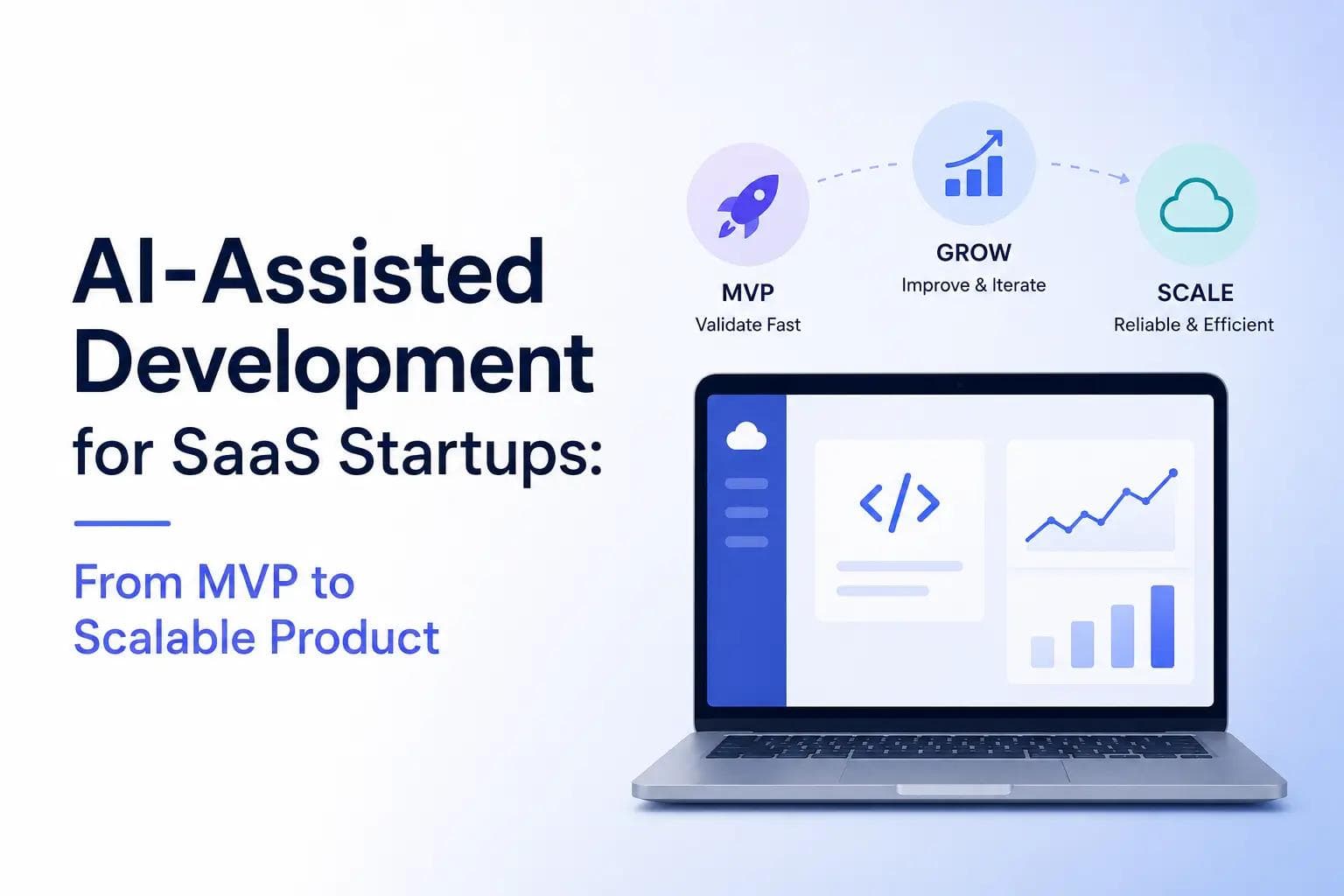
The race for SaaS Startups has been about time: create quickly, validate early, and grow efficiently. Now, artificial intelligence offers new tools to improve this race against time. Developers using AI tools will move faster from concept to MVP (minimum viable product) than they ever have and be able to expand into stronger, production-quality platforms with significantly fewer resources used.
This article covers how developers of SaaS Startups can use AI during the entire Product Lifecycle, whether it’s when they first design their product prototype or when they are expanding their infrastructure, while using superior quality/efficiency/speed/cost control.
The Role of AI in Modern SaaS Development
AI’s Impact on SaaS Development Today
Instead of taking the place of developers, AI serves as an enhancement for developers. Developers are able to use AI tools to help streamline redundant tasks and make better decisions, whether those tasks are related to writing new code, automating the testing of existing code, generating insights from product data or providing automated support to their customers.
Some of the major areas that AI will assist with include:
- Writing new code and offering auto-complete features (such as GitHub Copilot and CodeWhisperer)
- Automating the testing and quality assurance process
- Offering assistance with UX/UI design
- Providing analysts and insights through the use of data analytics and reporting tools
- Providing automated support to customers through chatbots and automated AI representatives
For SaaS companies with small teams and limited budgets, these capabilities can dramatically reduce the amount of time it takes to develop new products or features.
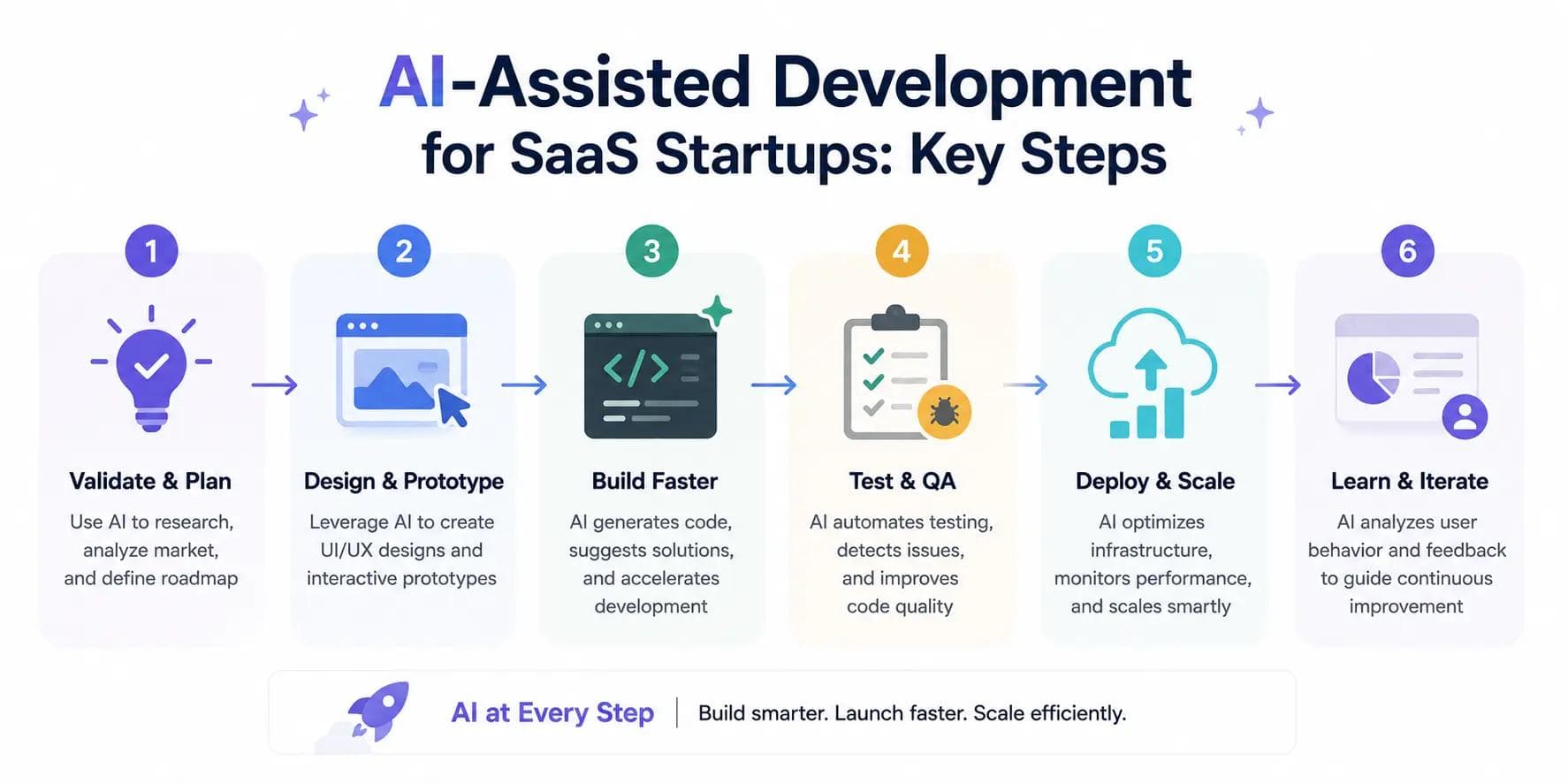
Stage 1: Rapid MVP Development with AI
1. Market Research and Validation of Ideas
AI tools can provide validation of your idea before you write code and do so by:
- Analyzing market trends, competition, and similar ideas
- Developing user groups (enter a few phrases that describe your customer)
- Finding a need or an opportunity
ChatGPT, Claude, or the Perplexity AI system can use the published data to generate real-time information based on pattern analysis; the AI has access to lots of data, but the AI is not going to build your app for you.
2. Prototyping and UI Design
You can reduce your prototyping time from months to hours by using some AI tools in the design process to get from a concept to a functional UI prototype with the following capabilities:
- Ability to produce UI prototypes by interpreting text prompts
- Ability to convert handwritten sketches into functional design systems
- Ability to provide UX recommendations based on industry best practices
You will not have to find a lot of graphic designers and/or rely on them for design quality.
3. Code Generation and Development
Discover how to use code sample generators like code assistants to:
- Generate sample code
- Help develop architecture
- Debugging in real-time
- Write APIs, queries, and integrations efficiently
Although automated code sample generators provide benefits to small teams that have less experience in building an MVP, it is still important that these sample generators receive supervision to ensure that the quality and security of the code meet the needs of the organization as a whole.
4. Automated Testing and Debugging
By introducing automated testing and debugging, you will be able to:
- Automate generating tests
- Identify defects for a given set of conditions
- Anticipate potential defects
Using automated testing and debugging on your MVP before releasing it to early users will help to ensure that the MVP meets minimum quality/functional standards without a lot of additional manual testing.
Stage 2: Enhancing Product-Market Fit
Following the launch of the MVP, the emphasis will shift to learning and improving based on this new information. At this stage, AI-assisted development plays a key role in helping teams analyze data, refine features, and deliver better user experiences.
1. Analysis of User Behaviour
Utilizing analytics software that is powered by Artificial Intelligence, it is possible to determine how users are utilizing the product, where they are losing interest within the product (i.e. where drop-off points are) and which features add the greatest value. These tools will allow startup founders to make accurate, data-driven decisions rather than relying on guesswork.
2. Individualised Experiences (Personalisation & UX)
AI can offer users highly personalised dynamic experiences through recommendations of content, onboarding processes and adaptive User Interface elements; this will enhance user engagement (a key metric for growing a Software as a Service (SaaS) company) and ultimately increase customer retention.
3. AI-Assisted Customer Support
Startups can deploy Artificial Intelligence (via chatbots and other virtual assistants) to: answer frequently asked questions (FAQ), provide 24/7 customer support, and reduce the total time/worker load of a customer support function; therefore, allowing a small company (with few employees) to offer the same level of customer service as much larger businesses.
Stage 3: Create a Scalable SaaS Application
As your application continues to gain traction, it is essential to develop a framework that can accommodate additional users and continue running reliably.
1. Smart Infrastructure Management
AI can assist in optimizing the cloud by:
- Making predictions about traffic patterns
- Automatically scaling resource utilization
- Reducing cost of operation
All of the major platforms such as AWS, Azure, and Google are creating more and more functionality from their services that leverage AI to make better decisions regarding their infrastructure.
2. Improve Performance
AI Tools assist with monitoring and improving:
- Performance of Applications
- Efficiency of the Database
- Response Times of APIs
They also have the ability to automatically discover anomalies and tell you what corrective actions you can take to resolve the anomalies before your users have an issue.
3. Reduce Risk and Increase Security
AI can improve the security of your application by:
- Detecting Unauthorized Access
- Mitigating Fraud
- Identifying Vulnerabilities
This is particularly important for SaaS start-up companies that deal with customer data.
4. Continuously Adapting and Releasing Software
AI Assisted Continuous Integration / Continuous Delivery (CI/CD) can:
- Automate the review of Code
- Predict the risk of deploying code
- Improve the efficiency of your release cycle
This will lead to the ability to provide more frequent, reliable, and safe updates to your product.
Considerations and Obstacles
Even though AI can provide many benefits, there are also several risks that new businesses need to address:
1. Dependence On AI
Using AI to generate code or make decisions without question leaves you open to things like:
- Security holes
- Bad architectural design
- Technical debt
You need to rely on people and their knowledge to help with what the AI produces.
2. Data Protection and Compliance
When new businesses use AI tools, they'll usually work with users' data. They must ensure that they are compliant with:
- GDPR or any other regulatory issues
- Following proper procedures to keep users' data safe
3. Selecting and Combining Tools
Because there are so many AI tools available, it can be difficult to figure out which ones will work for you. Avoid:
- Selecting too many tools
- Making sure that the tools work well with your existing technology
- Looking for tools that have the potential to provide you with a good return on investment
Best Practices for AI-Assisted SaaS Development
To maximize the benefits of AI:
- Begin with limited use cases of Artificial Intelligence.
- Validate the results of any codes or insights created by Artificial Intelligence.
- Measure the effect of your use of Artificial Intelligence on productivity, speed and quality.
- Coach your development staff in the proper use of Artificial Intelligence.
- Keep an open mind about changing tools as Artificial Intelligence technology continues to develop.
SaaS Startups' Future With AI
The advent of artificial intelligence will support the expansion of development by creating new opportunities such as:
- Completely independent coders
- Advanced product management using artificial intelligence
- Understanding how users will act through predictive modeling of behavior
- Self-tuning systems
Companies that use AI in their product development will have a tremendous competitive edge over other companies. They will develop not only at a greater rate but also create products that are more innovative, adaptable, and intelligent than those created by less AI-oriented companies.
Conclusion
AI-based development is changing the way SaaS startups create and grow products. AI enables teams to create MVPs faster and to enhance performance at scale while requiring less effort on their part. To benefit from the many capabilities that AI provides, companies must have a balance of AI as a helper and have the proper level of human control and planning.
SaaS startups that want to move quickly without making mistakes no longer consider AI an option. AI has become an integral part of the ongoing development stack.
FAQ
1. How does AI assist in developing software as a service (SaaS)?
Artificial intelligence technology can help with the programming, testing, and decision-making processes of software, which allows a team to create products more quickly and cost-efficiently.
2. What are the key steps in AI-assisted SaaS development?
Four general procedures: creating a prototype, studying users' actions with the prototype, enhancing the prototype based on the study results, and then adding AI to assist with the enhancement of future prototypes.
3. What role does AI play in building up an MVP?
Artificial intelligence tends to speed up the development of a prototype by writing code, providing design help, and reducing the number of tests needed for an MVP.
4. What are the main benefits for startups?
1) Reduced time to produce a product;
2) Reduced cost of production;
3) Improved quality of products produced;
4) Improved ability to grow a business when using AI.
About the Author

Suraj - Writer Dock
Suraj Kumar is a writer, entrepreneur, and the CEO and founder of this website, sharing simple and practical insights on business, creativity, and personal growth. With experience building digital projects, they enjoy helping others learn, grow, and succeed online.