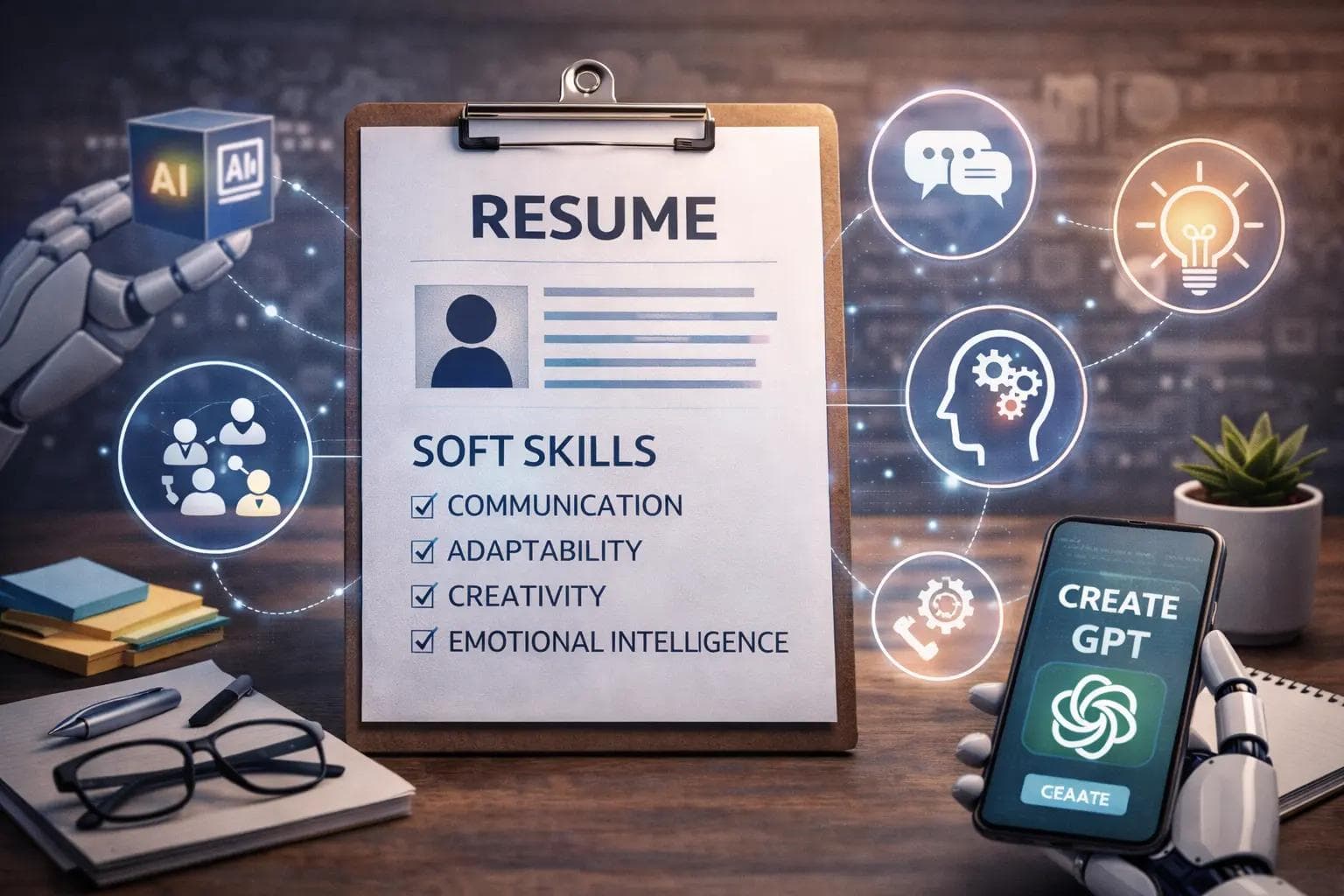
The job market has shifted. Only a few years ago, having a long list of technical certifications and mastery of specific software was enough to land a top-tier interview. Today, those technical skills are still important, but they are no longer the "gold standard" they once were.
Advanced automation and sophisticated algorithms have taken over many of the routine, data-heavy, and repetitive tasks that humans used to perform. This change has created a new reality: hard skills get you noticed, but human skills get you hired.
In 2026, employers are looking for people who can do what machines cannot. They want individuals who can navigate complex office politics, empathize with customers, and solve problems that don't have a clear, data-driven answer.
If you want your resume to stand out in an automated world, you must learn to highlight your soft skills. These are the human traits that remain "future-proof" and resistant to being replaced by modern technology.
What are Soft Skills and Why Do They Matter Now?
Soft skills are non-technical abilities that relate to how you work and interact with others. While "hard skills" might include coding in Python or analyzing financial statements, "soft skills" include things like how you handle stress, how you lead a team, and how you resolve a conflict.
In the current landscape, these skills have become the new "power skills." As automated systems become better at crunching numbers and writing basic reports, the value of human judgment and connection has skyrocketed.
Think of it this way: technology is great at providing the "what" and the "how," but humans are still the only ones who can truly understand the "why."
The Top Human Skills for your 2026 Resume
To make your resume resilient against the rise of automation, you need to focus on a specific set of human-centric abilities. Here are the core skills you should be highlighting today.
1. Emotional Intelligence (EQ)
Emotional intelligence is the ability to recognize, understand, and manage your own emotions while also influencing the emotions of others. In a workplace where communication often happens through screens and digital tools, EQ is more valuable than ever.
How to highlight it: Don't just write "High EQ" on your resume. Instead, describe a time when you used empathy to solve a problem.
- Example: "Mediated a high-stakes disagreement between two departments, resulting in a 20% increase in project delivery speed."
2. Critical Thinking and Complex Problem Solving
Automated tools are excellent at solving linear problems—ones that follow a specific set of rules. However, they struggle with "messy" problems where the rules change or the information is incomplete.
How to highlight it: Focus on your ability to look at a situation from multiple angles and find creative solutions that aren't immediately obvious.
- Example: "Identified a hidden flaw in the supply chain process that saved the company $50,000 annually without sacrificing product quality."
3. Adaptability and Learning Agility
The pace of change in the modern workforce is staggering. Skills that were relevant two years ago might be obsolete today. Employers are looking for "long-term learners"—people who can unlearn old habits and pick up new tools quickly.
How to highlight it: Show that you are comfortable with change. Mention times you pivoted your strategy or mastered a new industry trend on short notice.
- Example: "Successfully transitioned a team of 50 to a fully remote environment in 48 hours while maintaining 100% of client satisfaction scores."
Mastering the Art of "Human-to-Human" Communication
Communication is often listed on every resume, but in 2026, you need to be more specific. Standard communication is easy for a machine, but "complex communication" is a different story.
Negotiation and Persuasion
Machines can present data, but they cannot persuade a skeptical board of directors to change their mind. Persuasion requires understanding human psychology, timing, and nuance.
Cross-Cultural Collaboration
As the world becomes more connected, you will likely work with people from dozens of different backgrounds and time zones. The ability to navigate cultural differences and build trust across borders is a skill that cannot be automated.
Leadership Without a Title
Many people think leadership is only for managers. In a modern, technology-driven workplace, "influence" is a form of leadership that everyone needs. This is often called "lateral leadership."
Strategic Influence
Can you get people to follow your lead even if you aren't their boss? Can you inspire a colleague to help you with a project? Highlighting your ability to influence others shows that you have the social gravity that a computer program lacks.
Ethical Judgment
Automation doesn't have a moral compass. It follows the data, even if that data leads to an unethical outcome. Humans are the final safeguard. Your ability to make ethical decisions—even when the data says otherwise—is a major asset.
How to Show (Not Just Tell) Your Soft Skills
One of the biggest mistakes job seekers make is creating a "Skills" section that is just a list of words like "Communication," "Leadership," and "Teamwork." This is a waste of space.
To make your resume truly proofed against modern algorithms, you must weave these skills into your professional experience section using the "Action-Context-Result" (ACR) method.
Use the ACR Method
Instead of saying you are a "Great Leader," use a bullet point like this:
- Action: Led a cross-functional team of eight.
- Context: During a company-wide rebranding phase with a tight 3-month deadline.
- Result: Successfully launched the new brand on time and under budget, receiving a personal commendation from the CEO.
This shows the reader (and the automated sorting systems) exactly how you applied your soft skills to achieve a tangible business result.
The Role of Curiosity and Originality
Automation is inherently derivative. It looks at what has happened in the past to predict what will happen in the next moment. It cannot be truly "original" because it doesn't have curiosity.
Creative Thinking
On your resume, highlight projects where you had to come up with a completely new idea. Did you invent a new way to track inventory? Did you design a marketing campaign that went against the industry standard? These are signs of a human mind at work.
Intellectual Curiosity
Show that you stay ahead of the curve. If you have taken courses in psychology, philosophy, or even art alongside your technical training, include them. It shows you have a broad, curious mind that can connect ideas across different fields.
Why "Human Touch" Roles are Growing
If you look at the job market trends for 2026, the roles experiencing the most growth are those that require high levels of human interaction. This includes:
- Healthcare and patient advocacy.
- High-end consulting and strategy.
- Community building and social services.
- Creative direction and story-telling.
Even in purely technical fields like software engineering, the highest-paid individuals are not just the best coders. They are the ones who can explain complex code to non-technical stakeholders and lead a team of diverse personalities.
Real-World Example: The "Future-Proof" Resume Makeover
Let’s look at how to transform a standard, dry bullet point into one that highlights human value.
Before (Dry and Technical):
- Managed customer service tickets and resolved issues daily.
After (Soft Skill Focused):
- Leveraged high-level conflict resolution skills to de-escalate frustrated clients, maintaining a 95% customer retention rate during a major service outage.
In the second version, you aren't just "doing a task." You are using conflict resolution (soft skill) to achieve retention (business result). This is what modern recruiters are looking for.
FAQs: Your Resume in 2026
Should I still include hard skills on my resume?
Yes, absolutely. Hard skills are often the "filters" that get you through the initial screening software. However, once a human recruiter looks at your resume, they are looking for your soft skills to decide if you are the right "culture fit" for the team.
How many soft skills should I list?
Don't overdo it. Focus on 4 to 6 core soft skills that are most relevant to the job you are applying for. It is better to have three skills backed by strong examples than ten skills that are just words on a page.
Can soft skills be taught?
Many people believe you are either born with soft skills or you aren't. This is a myth. You can improve your emotional intelligence, your negotiation skills, and your public speaking through practice and training. Mentioning your "ongoing development" in these areas is actually a positive sign to employers.
Is it okay to use automated tools to write my resume?
While you can use tools to help you structure your thoughts or check your grammar, you should be careful. If your resume sounds exactly like every other applicant's, you have lost your "human" advantage. Make sure your unique voice and personal stories shine through.
Conclusion: The Human Advantage
The fear that technology will replace humans in the workforce is not entirely unfounded, but it is often misunderstood. Technology replaces tasks, not people.
The people who will thrive in 2026 and beyond are those who lean into their humanity. By focusing on emotional intelligence, critical thinking, and complex communication, you make yourself an irreplaceable asset to any company.
Your resume is more than just a list of things you have done. It is a story of who you are and how you solve problems. When you highlight your soft skills, you are telling an employer that you bring something to the table that no algorithm can replicate: a human soul, a creative mind, and the ability to connect with others.
Don't be afraid of the changing landscape. Embrace it. Update your resume to reflect your human strengths, and you will find that the job market is full of opportunities for those who know how to show their true value.
About the Author
Suraj - Writer Dock
Suraj Kumar is a writer, entrepreneur, and the CEO and founder of this website, sharing simple and practical insights on business, creativity, and personal growth. With experience building digital projects, they enjoy helping others learn, grow, and succeed online.