In 2026, we are no longer just "prompting" LLMs; we are engineering them. The industry has shifted aggressively from simple chatbots to Agentic Workflows—autonomous systems that can plan, execute, debug, and iterate on tasks without constant human hand-holding.
For developers and engineering leads, the question is no longer "How do I make the model write code?" but rather "How do I orchestrate a team of models to build, test, and deploy that code reliably?"
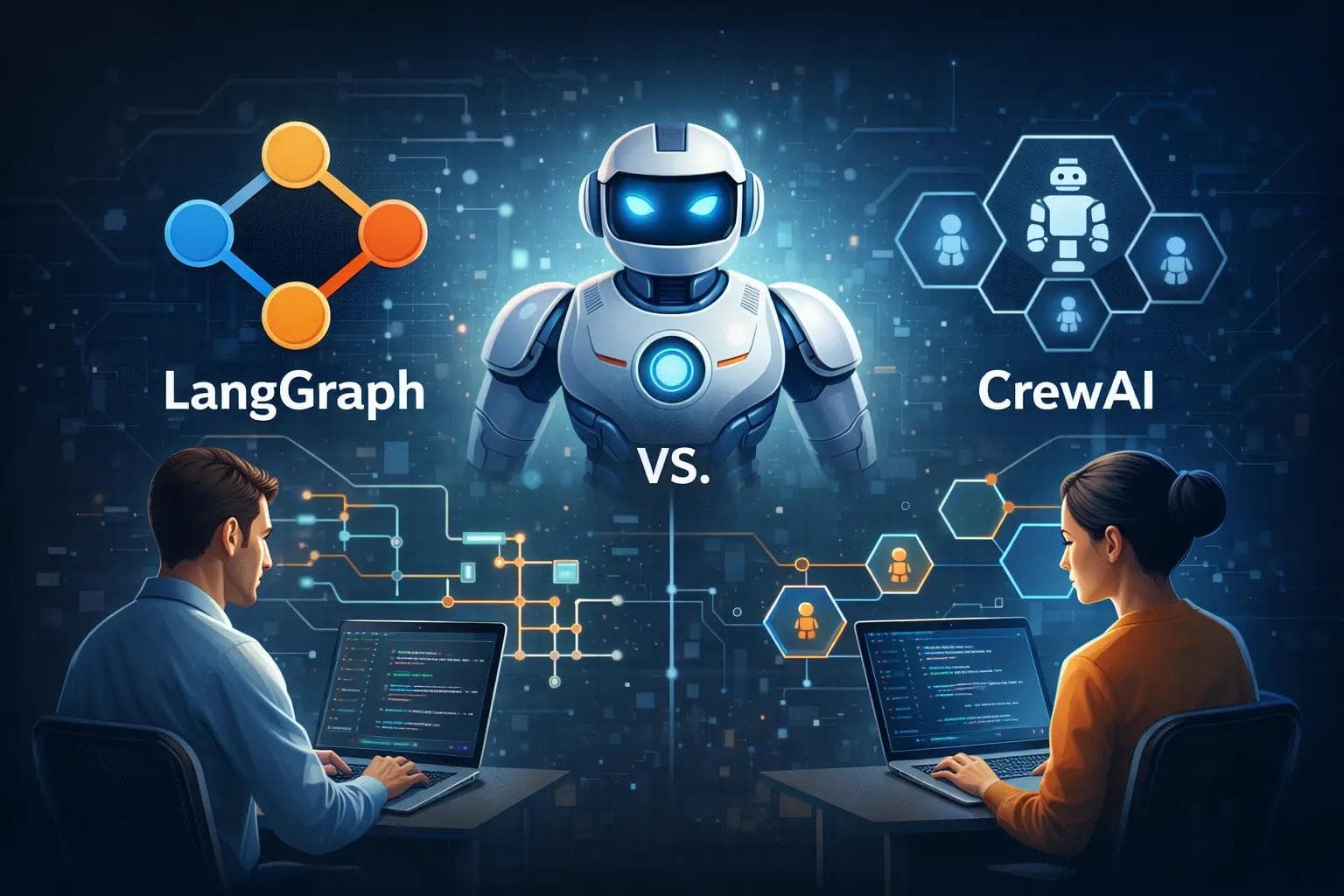
Two frameworks have risen to the top of this stack: LangGraph and CrewAI. While they often solve similar problems, they approach agent architecture from fundamentally different philosophies.
This guide breaks down the technical and architectural differences between them to help you decide which tool fits your production needs.
The Landscape: Why Agents Matter Now
To understand the choice, you must understand the shift. In 2024, we built "chains"—linear sequences of events (Input -> LLM -> Output).
In 2026, we build loops. Real-world tasks require trial and error. If an agent writes code that fails a unit test, it shouldn't crash; it should read the error, rewrite the code, and try again. This cyclic behavior is the heartbeat of modern AI agents.
Both LangGraph and CrewAI handle these loops, but one acts like a Project Manager, while the other acts like a Systems Architect.
Deep Dive: CrewAI (The "Team" Metaphor)
CrewAI is built around the concept of Role-Playing. It abstracts the complexities of orchestration into a familiar mental model: a human team. You don't define "nodes" or "state transitions"; you define "Workers" and "Managers."
How It Works
In CrewAI, you instantiate Agents, give them a Role, a Goal, and a Backstory. You then group them into a Crew and assign them Tasks.
- The Researcher: Scrapes the web for data.
- The Analyst: Reads the data and finds patterns.
- The Writer: Takes the analysis and writes a report.
CrewAI handles the conversation flow between these agents automatically. It decides who speaks when (or follows a strict sequential/hierarchical process you define).
The Strengths
- Velocity: You can spin up a multi-agent system in 10 minutes. The abstraction layer is high, making it readable for non-engineers.
- Human-Like Collaboration: It excels at tasks that map to human organizational structures, such as content creation pipelines, market research, or trip planning.
- Built-in Tooling: It comes with pre-packaged tools (rag_tool, browser_tool) that work out of the box.
The Trade-off
The abstraction that makes CrewAI easy can also make it rigid. Debugging why the "Manager Agent" decided to delegate a task to the wrong worker can be opaque. You are trusting the framework's orchestration logic rather than writing your own.
Deep Dive: LangGraph (The "Graph" Metaphor)
LangGraph (developed by LangChain) takes a "low-level" approach. It treats agent workflows as State Machines. It is built on the mathematical concept of a Directed Cyclic Graph (DCG).
How It Works
You don't define "people"; you define Nodes (functions) and Edges (control flow).
- Node A (Draft): LLM writes an email.
- Node B (Review): LLM critiques the email.
- Edge: If the critique is "Bad", go back to Node A. If "Good", go to Node C (Send).
This explicit control allows for "cycles" (loops), which are essential for robust engineering tasks.
The Strengths
- Fine-Grained Control: You define exactly how data flows. You are not hoping the agents "collaborate" correctly; you are programming the logic of their interaction.
- Persistence & "Time Travel": LangGraph saves the state of the graph at every step. This allows you to pause an agent, wait for human approval (Human-in-the-loop), or even "rewind" the agent to a previous step to fix a mistake.
- Production Ready: It is designed for reliability. If you are building a customer support bot that must follow strict compliance rules, LangGraph's deterministic nature is superior.
The Trade-off
The learning curve is steeper. You need to understand state schemas, conditional edges, and reducers. It feels more like writing a distributed backend system than scripting a conversation.
Feature Comparison Benchmark
| Feature | CrewAI | LangGraph |
|---|---|---|
| Primary Abstraction | Roles, Teams, Tasks | Nodes, Edges, State |
| Best For | Creative/Open-ended Collaboration | Deterministic/Cyclic Engineering Tasks |
| Setup Time | Fast (Minutes) | Moderate (Hours) |
| Control Level | High-Level (Orchestrator handles flow) | Low-Level (You code the flow) |
| Human-in-the-Loop | Supported (via approvals) | Native (Interrupt/Resume State) |
| Learning Curve | Beginner Friendly | Intermediate/Advanced |
Which One Should You Choose?
The decision rarely comes down to which library is "better," but rather which matches your specific use case.
Choose CrewAI If:
- Your process is linear or hierarchical. (e.g., Research -> Write -> Edit).
- You are prototyping. You need to show a proof-of-concept to stakeholders tomorrow.
- The problem is "Creative". You want agents to brainstorm and chat with each other to find a solution.
- You want "batteries included". You don't want to build your own tools or memory systems from scratch.
Choose LangGraph If:
- Your process requires loops. (e.g., Code -> Test -> Fail -> Rewrite Code).
- You need absolute control. You cannot afford for an agent to "hallucinate" a deviation from the process.
- You are building a product. You need deep observability, state persistence, and the ability to update the agent's logic without breaking existing user sessions.
- You are an engineer. You prefer explicit code over "magical" prompting abstractions.
The Hybrid Approach
In advanced production environments (like the ones we see in 2026), these tools are often used together.
You might use LangGraph to build the rigid "skeleton" of your application—handling the API inputs, the database connections, and the final output validation. However, one of the nodes inside that graph could spin up a CrewAI team to perform a specific creative sub-task, like "Generate 5 marketing taglines," before returning the result to the main graph.
FAQ
Q: Can I use LangGraph with local LLMs? A: Yes. Both frameworks are model-agnostic. You can plug in Ollama, Llama 3 (or whatever is current in 2026), or DeepSeek just as easily as OpenAI.
Q: Is CrewAI just a wrapper around LangChain? A: Originally, yes. However, it has evolved into its own distinct ecosystem with its own orchestration logic, though it still plays nicely with LangChain tools.
Q: Which one scales better? A: LangGraph scales better for complexity and reliability. CrewAI scales better for team size (adding more agents to a chat). For enterprise scale, LangGraph's state management usually wins.
Conclusion
Building your first agent is a milestone. If you want to feel like a Manager directing a digital workforce, start with CrewAI. If you want to feel like an Architect designing an intelligent system, start with LangGraph.
Ultimately, the "best" framework is the one that allows you to ship reliable value to your users. In 2026, the tooling is powerful enough that the only limit is your architectural imagination.
About the Author

Suraj - Writer Dock
Suraj Kumar is a writer, entrepreneur, and the CEO and founder of this website, sharing simple and practical insights on business, creativity, and personal growth. With experience building digital projects, they enjoy helping others learn, grow, and succeed online.