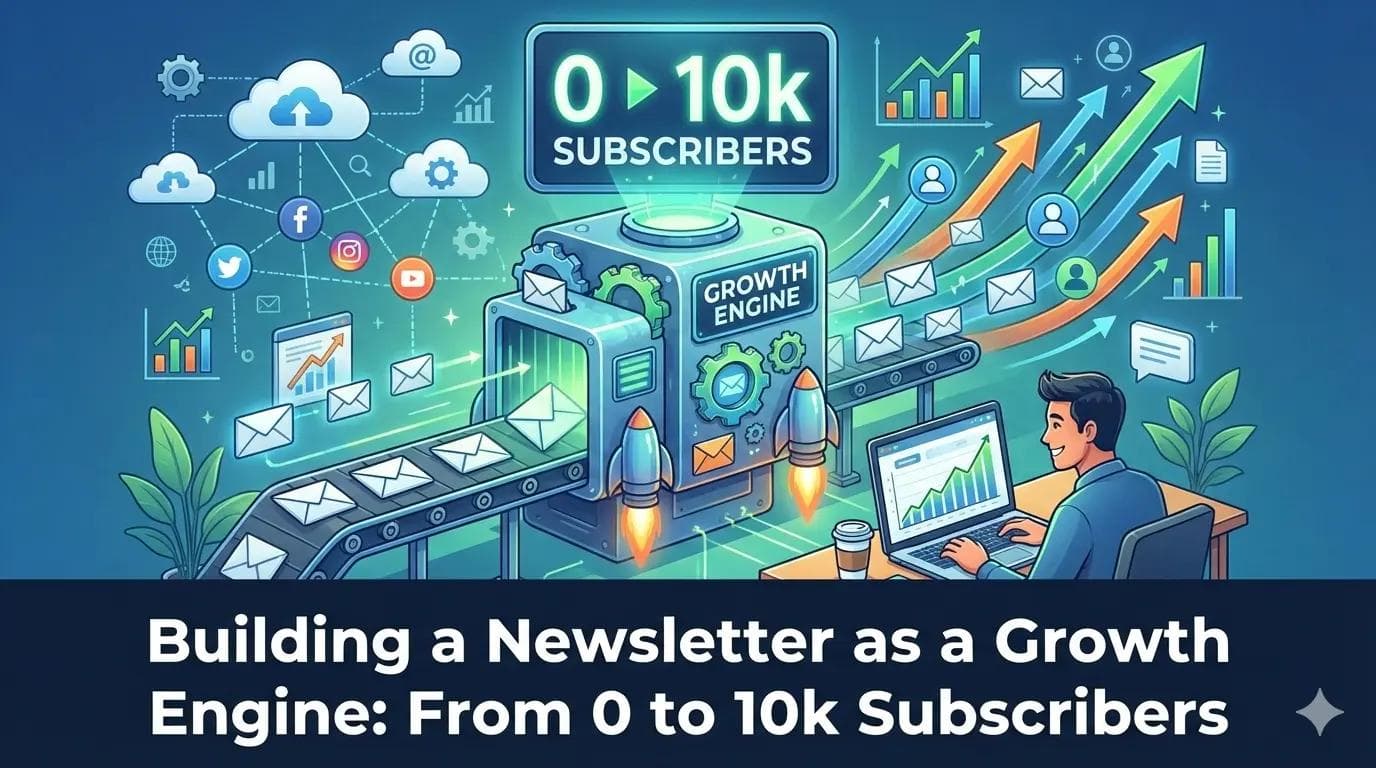
Social media algorithms change like the weather. One day your posts reach thousands; the next, you are shouting into a void. In this volatile digital landscape, there is one asset you can truly own: an email list.
Building a newsletter is not just about sending weekly updates. It is about creating a direct line of communication with your audience—a channel that no algorithm can suppress. For businesses and creators alike, a newsletter is a powerful growth engine that drives revenue, builds authority, and nurtures community.
However, the journey from zero subscribers to a thriving community of 10,000 readers feels daunting. How do you get your first 100 sign-ups? What content keeps people engaged? How do you scale without spending a fortune on ads?
This guide provides a step-by-step roadmap to navigate these challenges. We will move beyond generic advice and dive into actionable strategies to build, grow, and monetize your newsletter.
Why a Newsletter is Your Most Valuable Asset
Before we discuss growth tactics, it is crucial to understand why you are building this. Many creators focus on vanity metrics like Instagram followers or LinkedIn connections. While these platforms are excellent for discovery, they are terrible for retention.
You rent your audience on social media. You own your audience on email.
The Power of Direct Access
When you send an email, it lands directly in a subscriber's inbox. There is no gatekeeper deciding if your content is "viral" enough to be seen. Industry data consistently shows that email marketing offers a higher Return on Investment (ROI) than any social media channel.
Stability in a Changing World
Platforms come and go. MySpace vanished. Facebook's reach declined. TikTok faces regulation. Email, however, has remained the standard for digital communication for decades. It is an open protocol, meaning no single company can shut it down.
Phase 1: The Foundation (0 to 100 Subscribers)
The hardest part of the journey is starting. At zero subscribers, you might feel like an impostor. This phase is not about massive growth; it is about validation and finding your voice.
Define Your "Value Proposition"
Why should anyone give you their email address? People are protective of their inboxes. "Subscribe for updates" is no longer a compelling pitch. You need a specific promise.
Ask yourself these three questions:
- Who is this for? (e.g., freelance graphic designers)
- What problem does it solve? (e.g., finding high-paying clients)
- What is the unique angle? (e.g., actionable templates, not just theory)
A strong value proposition looks like this: "The weekly newsletter that helps freelance designers negotiate higher rates and manage difficult clients."
Choosing the Right Platform
Don't get bogged down in technical comparisons. You need a tool that is easy to use and reliable.
- Substack/Beehiiv: Great for writers who want a simple, all-in-one solution with built-in growth tools.
- ConvertKit/Mailchimp: Better for businesses that need advanced automation and segmentation.
Securing Your First 100 Readers
Do not run ads yet. Your first 100 subscribers should be people who already know and trust you.
- Personal Outreach: Message your friends, colleagues, and LinkedIn connections. Ask them personally if they would like to join.
- Email Signature: Add a link to your newsletter in your work email signature.
- Social Bio: Update your profiles on X (Twitter), Instagram, and LinkedIn with a direct link to your signup page.
The Goal: Get 100 people to sign up. Once you have them, commit to a consistent schedule. Whether it is weekly or bi-weekly, consistency builds trust.
Phase 2: Finding Product-Market Fit (100 to 1,000 Subscribers)
Now that you have a small audience, you need to prove that strangers find your content valuable. This phase is about content quality and organic discovery.
Create a Lead Magnet
A lead magnet is a free resource you give away in exchange for an email address. It reduces the friction of signing up. If your content is good, the lead magnet is the hook that gets them in the door.
Effective lead magnet ideas include:
- A 5-day email course (e.g., "5 Days to Better Copywriting").
- A downloadable checklist or template.
- A curated list of tools or resources.
- Exclusive access to a video or case study.
Leverage "Borrowed" Audiences
You don't have a large audience yet, but other people do. You need to get in front of them.
- Guest Posting: Write articles for blogs in your niche. Instead of asking for payment, ask for a link back to your newsletter landing page.
- Podcast Appearances: Reach out to small podcasts. Share your expertise and pitch your newsletter at the end as the best way to learn more from you.
- Cross-Promotions: Find other newsletter writers with similar audience sizes (e.g., 300-500 subscribers). Offer to shout them out in your newsletter if they do the same for you.
optimizing Your Landing Page
Your landing page has one job: conversion. Remove navigation bars, social icons, and distractions.
- Headline: Clear and benefit-driven.
- Sub-headline: Explains what they get (e.g., "A 5-minute read every Tuesday").
- Social Proof: "Join 500+ marketers" or a testimonial from a happy reader.
- Call to Action (CTA): A big, clear button that says "Subscribe" or "Get the Free Guide."
Phase 3: The Growth Engine (1,000 to 5,000 Subscribers)
Hitting 1,000 subscribers is a major milestone. It means you have traction. Now, you need to build systems that drive growth automatically.
Referral Programs
Word of mouth is powerful, but you can engineer it. A referral program rewards your existing subscribers for bringing in new ones.
Tools like SparkLoop or the built-in features of platforms like Beehiiv make this easy.
- 1 Referral: Get a shoutout in the newsletter.
- 3 Referrals: Get a PDF guide or ebook.
- 10 Referrals: Get a branded t-shirt or a 15-minute consultation call.
The rewards don't have to be expensive. Digital products often work best because they have zero marginal cost.
Social Media Content Funnels
Stop posting random thoughts. Build a content funnel.
- Top of Funnel (Viral): Broad tweets or LinkedIn posts about general industry trends. The goal is views.
- Middle of Funnel (Educational): Threads or carousels that teach a specific concept.
- Bottom of Funnel (Conversion): The final slide or the first comment should always link to your newsletter: "If you liked this, you'll love my weekly deep dive..."
Paid Acquisition (Testing the Waters)
Once you know your content works, you can spend a little money. You don't need a huge budget.
- Newsletter Sponsorships: Pay $50–$100 to sponsor a niche newsletter that targets your ideal reader. This is often cheaper and more effective than Facebook ads because the audience is already reading emails.
- Lead Ads: Run Facebook or LinkedIn ads that allow users to sign up without leaving the app.
Phase 4: Scaling to Authority (5,000 to 10,000+ Subscribers)
At this stage, your newsletter is a serious publication. Growth becomes a mix of brand building, SEO, and advanced partnerships.
SEO for Newsletters
Many creators forget that newsletters can live on the web as articles. Publish your archives on your website. Optimize the titles and headers for keywords people search for.
For example, if you write about finance, an edition titled "How to Invest in 2025" can bring in search traffic for years. This turns your newsletter archive into a passive lead generation machine.
Recommendation Networks
This is the biggest game-changer in recent years. Platforms like Substack and ConvertKit have "Creator Networks." When someone subscribes to Newsletter A, they are recommended to subscribe to Newsletter B.
By networking with other large creators and getting on their recommendation lists, you can gain hundreds of subscribers per day on autopilot.
Analyzing and Pruning
As you scale, quality control is vital. Having 10,000 subscribers means nothing if only 10% open your emails.
- Open Rate: Aim for 30–50%.
- Click-Through Rate (CTR): Aim for 2–5%.
Every 3 to 6 months, clean your list. Remove subscribers who haven't opened an email in the last 6 months (after sending a re-engagement campaign). A smaller, engaged list is better for deliverability and sponsorship rates than a large, dead list.
Content Strategy: What to Actually Write
Growth tactics are useless if the content is boring. Your newsletter needs a consistent format so readers know what to expect.
Curated vs. Original Content
- The Curator: You browse the internet so your readers don't have to. You share the 5 best links, tools, or news stories of the week with your commentary. (Example: The 1440 Daily Digest).
- The Thought Leader: You write deep-dive essays, personal stories, or tutorials. This builds a deeper connection but requires more effort. (Example: James Clear’s 3-2-1).
- The Hybrid: A short original intro followed by 3 curated links. This is the most sustainable model for most creators.
The "Hook, Value, CTA" Structure
Every email needs a structure.
- The Subject Line: The most important text. It determines if the email gets opened. Use curiosity ("The secret to...") or direct benefit ("How to save $500").
- The Hook: The first sentence must grab attention immediately.
- The Value: Deliver on the promise of the subject line. Be concise.
- The CTA: What should they do next? Reply? Click a link? Buy a product?
Monetization: Turning Subscribers into Income
You don't need 10,000 subscribers to make money. You can monetize much earlier if your audience is niche and engaged.
Sponsorships
Brands love newsletters because the audience is focused. You can charge based on CPM (Cost Per Mille, or cost per 1,000 subscribers) or CPO (Cost Per Open).
- Example: If you have 5,000 subscribers and a $50 CPM, you can charge $250 per email ad.
Affiliate Marketing
Recommend tools or books you truly love. Use affiliate links. If you write a tutorial on "How to use Notion," include your Notion affiliate link. It feels natural and helpful.
Digital Products
Once you know your audience's pain points, solve them with a product.
- Sell an ebook for $20.
- Sell a course for $150.
- Sell a consulting call for $300.
Your newsletter is the trust-builder that makes these sales possible.
Paid Subscriptions
The "Substack Model." Offer some content for free and lock the best content behind a paywall (e.g., $8/month). This works best for specialized industry analysis or investing advice where the reader gets a tangible financial return.
Common Pitfalls to Avoid
1. Inconsistent Sending
If you promise a weekly email, send it weekly. If you ghost your audience for three weeks, they will forget who you are. When you finally email them again, they will mark you as spam.
2. Subject Line Bait and Switch
Do not write "URGENT: Your account status" if it is just a marketing newsletter. You might get the open, but you will lose the trust. Trust is your currency.
3. Ignoring Mobile Optimization
More than 50% of emails are opened on phones. If your email has massive images or tiny text that is hard to read on a mobile screen, people will delete it immediately. Send test emails to your phone before publishing.
Technical Tips for Deliverability
You want to land in the "Primary" tab, not the "Promotions" tab or the Spam folder.
- Authenticate Your Domain: Set up DKIM, SPF, and DMARC records. It sounds technical, but most email platforms have guides on how to do this with your domain host. It tells Gmail and Outlook that you are a real person.
- Ask for Replies: In your welcome email, ask a question like "What is your biggest struggle right now? Reply and let me know." When a subscriber replies, it signals to email providers that you are a friend, not a spammer.
- Avoid Spam Trigger Words: Excessive use of "FREE," "CASH," "Guaranteed," or using all caps can trigger spam filters.
Frequently Asked Questions (FAQ)
How often should I send my newsletter?
Weekly is the sweet spot for most creators. It is frequent enough to stay top-of-mind but manageable to write. Daily is too much for most people unless it is short news. Monthly is too infrequent; people will forget you.
What is a good open rate?
The industry average hovers around 20–25%. However, for a creator-led newsletter, you should aim for 35–50%. If you are above 50%, you are doing exceptionally well.
Can I switch platforms later?
Yes. You own your email list (the CSV file of addresses). You can export your subscribers from Mailchimp and import them into ConvertKit or Substack at any time. Don't let "platform paralysis" stop you from starting.
How long does it take to get to 10k subscribers?
For most successful creators, it takes 18 to 36 months of consistent work. It is not a get-rich-quick scheme. It is a long-term asset build.
Should I buy an email list to jumpstart growth?
Absolutely not. Never buy a list. These people did not ask to hear from you. They will mark you as spam, ruining your sender reputation, and your emails will never reach the people who actually want them.
Conclusion: The Long Game Wins
Building a newsletter from 0 to 10,000 subscribers is a journey of persistence. The first 100 subscribers are harder to get than the last 1,000.
In the beginning, you are shouting into the wind. But as you refine your voice, understand your audience, and build your library of content, the flywheel starts to spin. Your existing readers share your work, your SEO kicks in, and your reputation grows.
A newsletter gives you independence. It protects you from the whims of social media algorithms and gives you a portable business that you can run from anywhere.
Don't overthink the logo. Don't worry about the perfect tech stack. Just write the first email. Then write the next one. The growth will follow the value you provide.
About the Author

Suraj - Writer Dock
Suraj Kumar is a writer, entrepreneur, and the CEO and founder of this website, sharing simple and practical insights on business, creativity, and personal growth. With experience building digital projects, they enjoy helping others learn, grow, and succeed online.